Selection Versus Effect
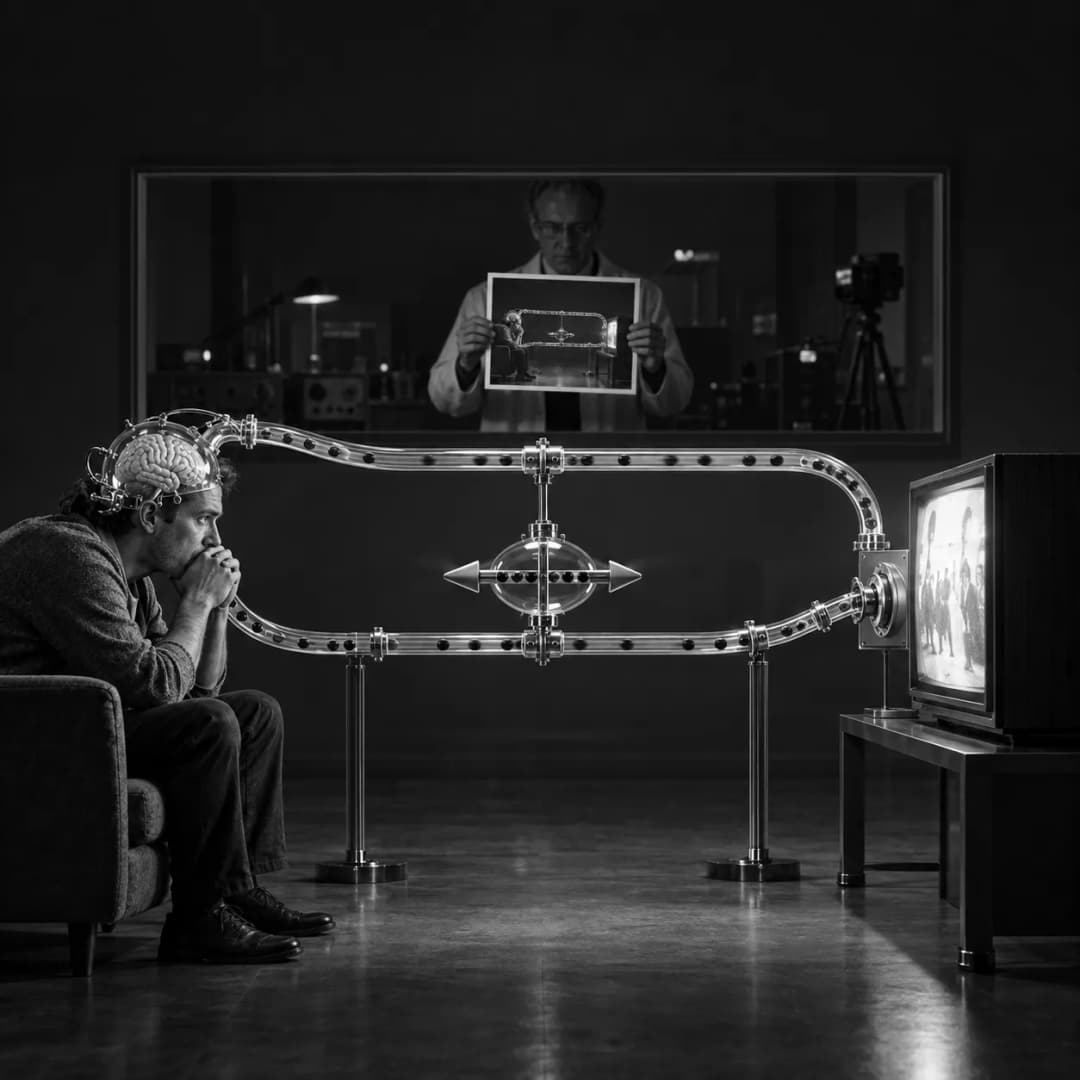
Selection versus effect is the standing objection to cultivation research. The claim is that heavy viewing shifts beliefs; the objection is that anxious people may simply watch more, rather than watching making people anxious. The core evidence is cross-sectional survey work, which correlates reported viewing with reported belief at a single point in time and cannot separate the two directions. The sharpest fact on this page is that no experiment has ever manipulated viewing. Fifty years of research, and nobody has assigned anybody to watch more or less television and measured what happened.
What it is
A cross-sectional correlation between two measurements taken together is symmetric, so if fearful people and heavy viewers are the same people then the design is equally consistent with television producing the fear, with the fear producing the viewing, and with something else producing both. Nothing in the statistics distinguishes the three, and the question is not answerable by a better regression on the same data.
This objection is a logical consequence of the design rather than a published finding by any one critic, and it is written here in this site's own voice for that reason, while the structural basis for it is verified: every origin-paper design is cross-sectional and correlational, Anthony N. Doob and Glenn E. Macdonald showed in 1979 that the correlation is partly a location confound, reproducing when four Toronto areas are pooled and becoming undetectable within them, and Michael Hughes showed in 1980 that it largely vanishes when nine demographic controls are entered at once. Two designs would answer it, an experiment that assigns viewing and a longitudinal panel that measures both variables repeatedly to see which moves first, and Michael Morgan's 1982 study is longitudinal, which is the right shape, but it comes from inside the originating group and could not be read for this page, so no result from it appears here.
In effect
The experiments in the cultivation literature manipulate something other than exposure, because L. J. Shrum, Robert S. Wyer and Thomas C. O'Guinn used a priming methodology in 1998 to change which television-derived examples were available at the moment of judgement, which is a real mechanistic contribution in which nobody was assigned to watch more or less television, and the experiment inside Shrum, James E. Burroughs and Aric Rindfleisch's 2005 paper manipulates processing rather than viewing. So the one thing the literature would most need to establish its central claim is the one thing it has never done, and not for want of forty-five years. The confound results are what fill the gap and they point the other way, because the correlation shrinks or disappears when you control for where people live or for nine demographics at once. The direction problem is not unique to television either, since any claim built on self-reported exposure correlated with a self-reported outcome has it, which is why the argument about screen time runs into the same wall at the same joint.
What it does not say
It does not say the effect runs the other way, because nobody has evidence that anxious people watch more either, and asserting that would be the same error with the sign flipped, so the honest position is that the design does not identify a direction and the direction is therefore unknown rather than reversed. It does not say the correlation is spurious, since the pooled estimate across five decades is positive and stable, and two confound results from 1979 and 1980 on particular items in particular places do not dispose of it, though they do establish that at least one route other than causation is capable of producing the pattern in real data. It does not say a longitudinal study would settle it either, because panel designs narrow the question without closing it, as an unmeasured third variable can drive both series; what would settle it is random assignment of viewing, and the reason that study does not exist is worth being honest about, since it is hard to run, expensive, and nobody in either camp has needed it in order to publish. And it licenses no verdict on anybody's motives, because the originators amended their theory in print, replied to their critics at length and have gone on pooling the evidence, so the disagreement is about what a correlational design can show and this site records each side's position in the form its own authors gave it.
Sources
- Gerbner, G., & Gross, L. (1976). 'Living with Television: The Violence Profile.' Journal of Communication, 26(2), 172-199. doi:10.1111/j.1460-2466.1976.tb01397.x. The cross-sectional origin design.
- Doob, A. N., & Macdonald, G. E. (1979). 'Television viewing and fear of victimization: Is the relationship causal?' Journal of Personality and Social Psychology, 37(2), 170-179. doi:10.1037/0022-3514.37.2.170. Abstract read in full.
- Hughes, M. (1980). 'The Fruits of Cultivation Analysis: A Reexamination of Some Effects of Television Watching.' Public Opinion Quarterly, 44(3), 287-302. doi:10.1086/268597. Abstract read in full.
- Shrum, L. J., Wyer, R. S., Jr., & O'Guinn, T. C. (1998). 'The Effects of Television Consumption on Social Perceptions: The Use of Priming Procedures to Investigate Psychological Processes.' Journal of Consumer Research, 24(4), 447-458. doi:10.1086/209520. Abstract read in full. Priming was manipulated, not viewing.
- Shrum, L. J., Burroughs, J. E., & Rindfleisch, A. (2005). 'Television's Cultivation of Material Values.' Journal of Consumer Research, 32(3), 473-479. doi:10.1086/497559. Abstract read in full.
- Morgan, M. (1982). 'Television and adolescents' sex role stereotypes: A longitudinal study.' Journal of Personality and Social Psychology, 43(5), 947-955. doi:10.1037/0022-3514.43.5.947. Bibliographic record verified; abstract not deposited and not read, so no result from it is reported.
- Potter, W. J. (2014). 'A Critical Analysis of Cultivation Theory.' Journal of Communication, 64(6), 1015-1036. doi:10.1111/jcom.12128. Abstract read in full.