Self-Efficacy
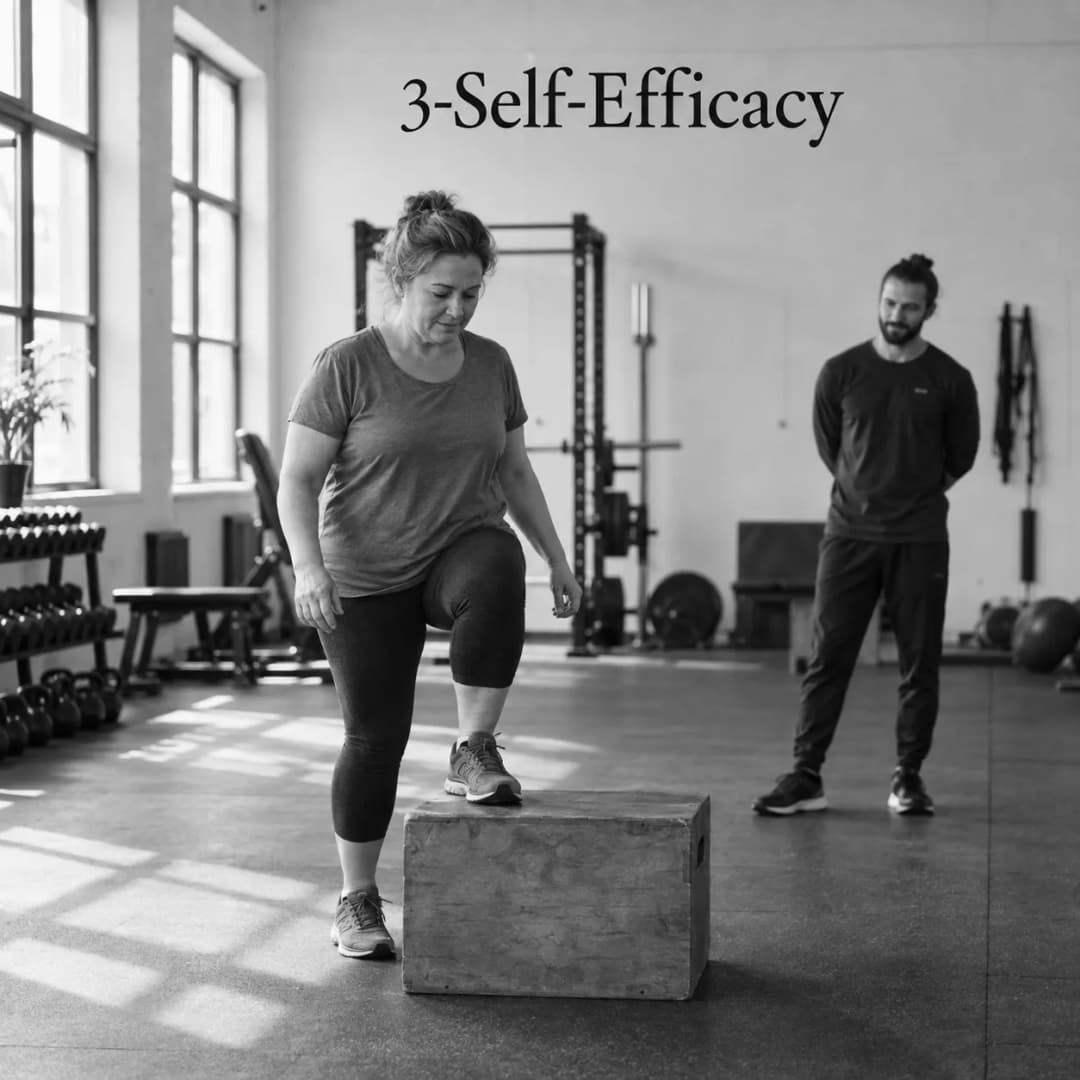
Self-efficacy is a person's belief that they can carry out a specific behaviour in a specific situation. Albert Bandura's construct is narrow by design: not general confidence, not self-esteem, but a judgment about one particular task under one particular set of conditions. In a 2026 systematic review of psychosocial predictors of adherence in adult group fitness classes, it was the most consistently supported domain, with small-to-moderate associations with attendance, ahead of generic social support. It is also the predictor most lists of adherence factors leave out entirely, including the one this vault carried until September 2026.
What it is
The narrowness is the point. Someone can hold high self-efficacy for a forty-minute class they have taken twenty times and very low self-efficacy for the same forty minutes after a fortnight away. It is not a trait. It moves, it is specific to a task and a situation, and it moves before behaviour does.
Two people book the same beginner class. One has done a version of it before and expects to get through it. The other has never done it, went too hard at their first attempt at something else, and stopped. The variable that differs is not how much either of them wants to be fit. It is whether they expect to be able to do the thing in front of them.
Bandura originated the construct in 1977 and it sits inside social learning theory, later social cognitive theory, as the mechanism through which people's beliefs about their own capability shape what they attempt. He has no page on this site yet.
In effect
Research: the adherence finding
Gao, X., Song, Y.-G., Shu, Y., Silva, A. F., & Greco, G. (2026). "Perceived Capability, Social Belonging, and Behavioral Adherence in Adult Group Fitness Classes: A Systematic Review of Psychosocial Predictors", Behavioral Sciences, 16(6), 882.
The review found self-efficacy the most consistently supported domain among the psychosocial predictors examined, with small-to-moderate positive associations with attendance. Social support and group cohesion appeared weaker and less consistent in the same review. That ordering is the useful result, because it inverts the one popular fitness writing uses.
Why this page exists at all
Article 14's own draft named four adherence predictors, and self-efficacy was not among them. Neither was it in this vault's note on exercise adherence before the September 2026 verification pass. It out-predicts several of the factors that get named instead, and it is routinely absent from them, which is a reasonably common shape for a finding that has no memorable story attached.
Everyday life: the most efficient way to destroy it
A fortnight of five sessions a week followed by one interrupted month is close to an optimal protocol for damaging self-efficacy. The first fortnight sets an expectation of what a normal week looks like. The interrupted month supplies evidence, repeatedly, that the person cannot meet it. What gets damaged is not their motivation, which may be intact and miserable, but their forecast of whether they can do the specific session in the specific situation.
This is also where self-efficacy meets all-or-nothing thinking. A grading scheme with only two boxes turns every modified week into evidence of incapability, when a shorter session would have been evidence of the opposite.
The neighbouring construct, and why they are not the same
Competence in self-determination theory is the felt experience of getting better at something, and it is a psychological need. Self-efficacy is a situation-specific belief about a task. They are adjacent, they usually move together, and they are not interchangeable. A person can feel they are improving and still expect to fail today's class.
What it does not say
It does not establish cause. The adherence evidence is correlational, like nearly all of this literature. High self-efficacy and high attendance plainly feed each other, and a review of associations cannot say which moves first.
It does not mean confidence. General self-belief, self-esteem and optimism are different constructs with different evidence, and using self-efficacy as a synonym for any of them discards the specificity that makes it predictive.
It does not carry a large effect. Small-to-moderate associations are what the review reports. Being the most consistently supported predictor in a set is not the same as being a strong one.
It does not generalise beyond the setting studied. The 2026 review covers adult group fitness classes. Extending the ranking to solo training, to clinical rehabilitation or to sport is an inference.
Sources
- Gao, X., Song, Y.-G., Shu, Y., Silva, A. F., & Greco, G. (2026). "Perceived Capability, Social Belonging, and Behavioral Adherence in Adult Group Fitness Classes: A Systematic Review of Psychosocial Predictors", Behavioral Sciences, 16(6), 882. Self-efficacy the most consistently supported domain, small-to-moderate associations with attendance, ahead of social support.
- Bandura, A. (1977). The originating statement of self-efficacy, and the construct's home in social cognitive theory.
- Vault verification record, 2026-09-11. Added to the adherence account as the predictor the vault's own list had omitted.
- Where this came from
- One book in this library carries this concept. A concept resting on a single popular retelling is roughly twice as likely to be contested, mixed or unverified as one two or more books carry, so treat it as unchecked until it has been taken to a primary source.