Self-Perception Theory
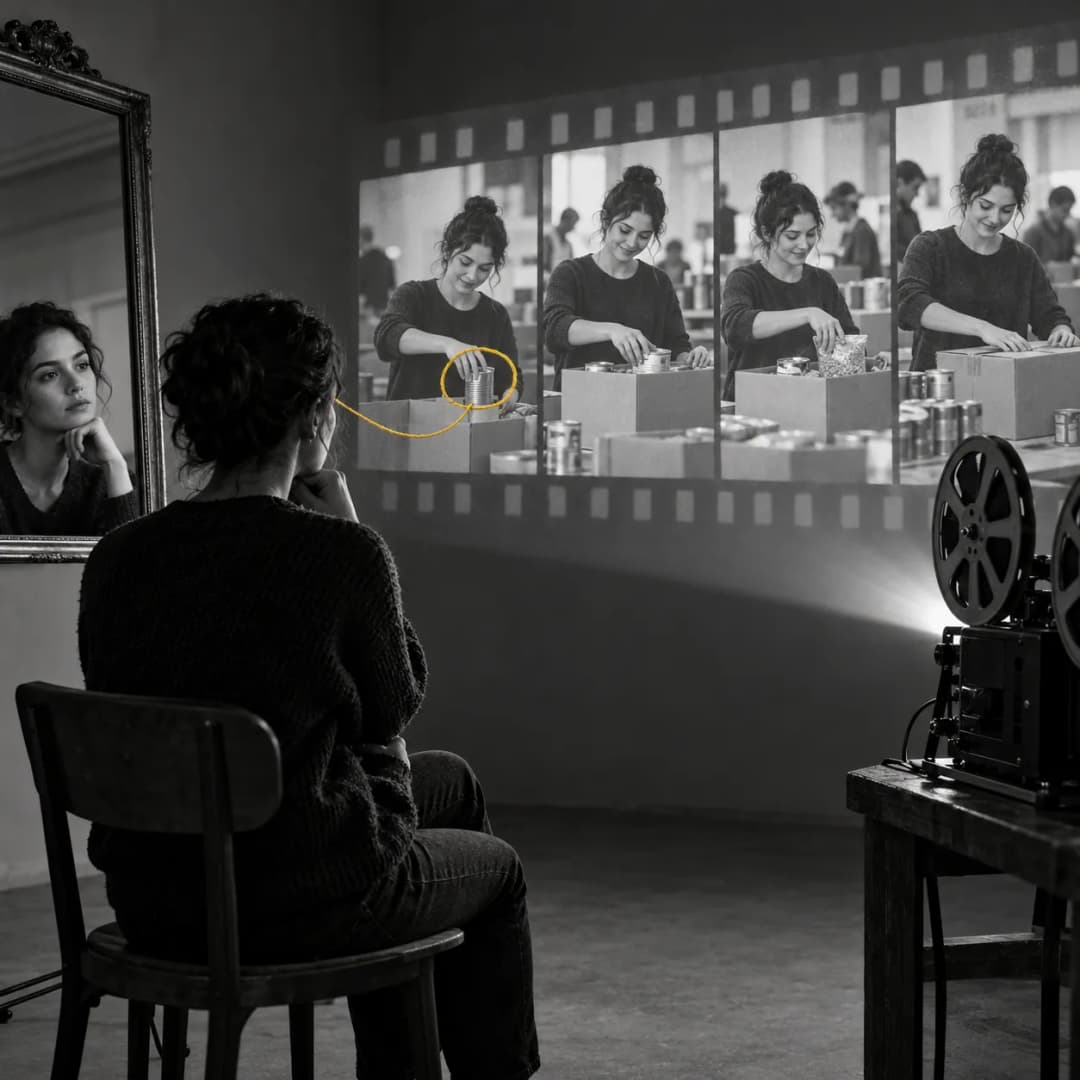
Self-perception theory is the claim, formulated by the social psychologist Daryl Bem, that people work out what they believe and prefer partly by watching what they do. It is the usual explanation offered for the foot in the door technique: a person who agrees to a small request infers that they are someone who helps, and so finds the larger request easier to grant. The theory is real and useful, but as an account of the foot in the door it has been challenged by meta-analyses and by direct tests.
What it is
Bem, now Professor Emeritus at Cornell University, set out the theory in the late 1960s and early 1970s. The idea is that when internal cues about an attitude are weak or ambiguous, people infer the attitude from their own behaviour and the circumstances in which it occurred, much as an outside observer would. The theory is usually set against cognitive dissonance, which explains some of the same findings through discomfort at inconsistency rather than inference.
The theory is sometimes stated in terms of identity. Behaviour comes first, the self-image follows, and later behaviour then follows the self-image. That sequence is the one Robert Cialdini relies on when he argues that a small commitment changes how a person sees themselves.
In effect
A 1975 field experiment by Mark Snyder and a colleague was designed as a test of the self-perception account of the foot in the door. People who first agreed to a small request agreed to a moderate one at about 52 per cent, against about 33 per cent for a control group. A third group, first given a large request they were almost sure to refuse, agreed at about 22 per cent, below the control. The authors read the pattern as support for the theory.
Later work was less kind. A 1983 meta-analysis of 120 experimental groups concluded that the effect is replicable but weak, with nearly half of studies finding no effect or an effect in the wrong direction, and judged the self-perception explanation too imprecise to make clear predictions. A 1984 meta-analysis by James Dillard and colleagues found no positive relationship between the effort of the first request and compliance, which the theory predicts, and concluded that the usual explanation is seriously flawed.
Jerry Burger's 1999 review places self-perception as one of six processes that a foot in the door manipulation can set off, alongside reactance, conformity, consistency, attributions and commitment. His argument is that they operate together, which explains why the procedure sometimes works, sometimes fails and occasionally reduces compliance.
What it does not say
It does not say that behaviour is the only source of self-knowledge, and its authors framed it as strongest where internal cues are weak. It also does not explain why a single small yes should carry weight in daily life. Dariusz Dolinski argued in a 2009 paper in the Polish Psychological Bulletin that people already face many small requests each day. In two small diary studies of twelve students each, participants logged between six and fifteen requests a day in one and about twelve in the other, and said yes to 76 per cent and 62 per cent respectively. The samples are tiny, and the paper is an argument rather than a test, but it raises a direct problem: if agreeing is a daily habit, one more yes is poor evidence about who a person is.
The foot in the door has also faded in direct replications. A 2019 paper in Psychological Reports repeated the original Freedman and Fraser design in Poland and Ukraine, finding the effect in Ukraine but not Poland in 2003 and in neither country in 2013. None of this removes the theory from social psychology. It narrows the claim that it explains the foot in the door.
Sources
- Snyder, M., & Cunningham, M. R. (1975). To comply or not comply: Testing the self-perception explanation of the foot-in-the-door phenomenon. Journal of Personality and Social Psychology, 31(1), 64-67.
- Beaman, A. L., Cole, C. M., Preston, M., Klentz, B., & Steblay, N. M. (1983). Personality and Social Psychology Bulletin, 9(2), 181-196.
- Dillard, J. P., Hunter, J. E., & Burgoon, M. (1984). Human Communication Research, 10(4), 461-488.
- Burger, J. M. (1999). Personality and Social Psychology Review, 3(4), 303-325.
- Dolinski, D. (2009). People in a freezer: Self-perception as an explanatory mechanism for the effectiveness of the foot-in-the-door technique. Polish Psychological Bulletin, 40(3), 113-116.
- Gamian-Wilk, M., & Dolinski, D. (2019). Psychological Reports.