Shared Environment
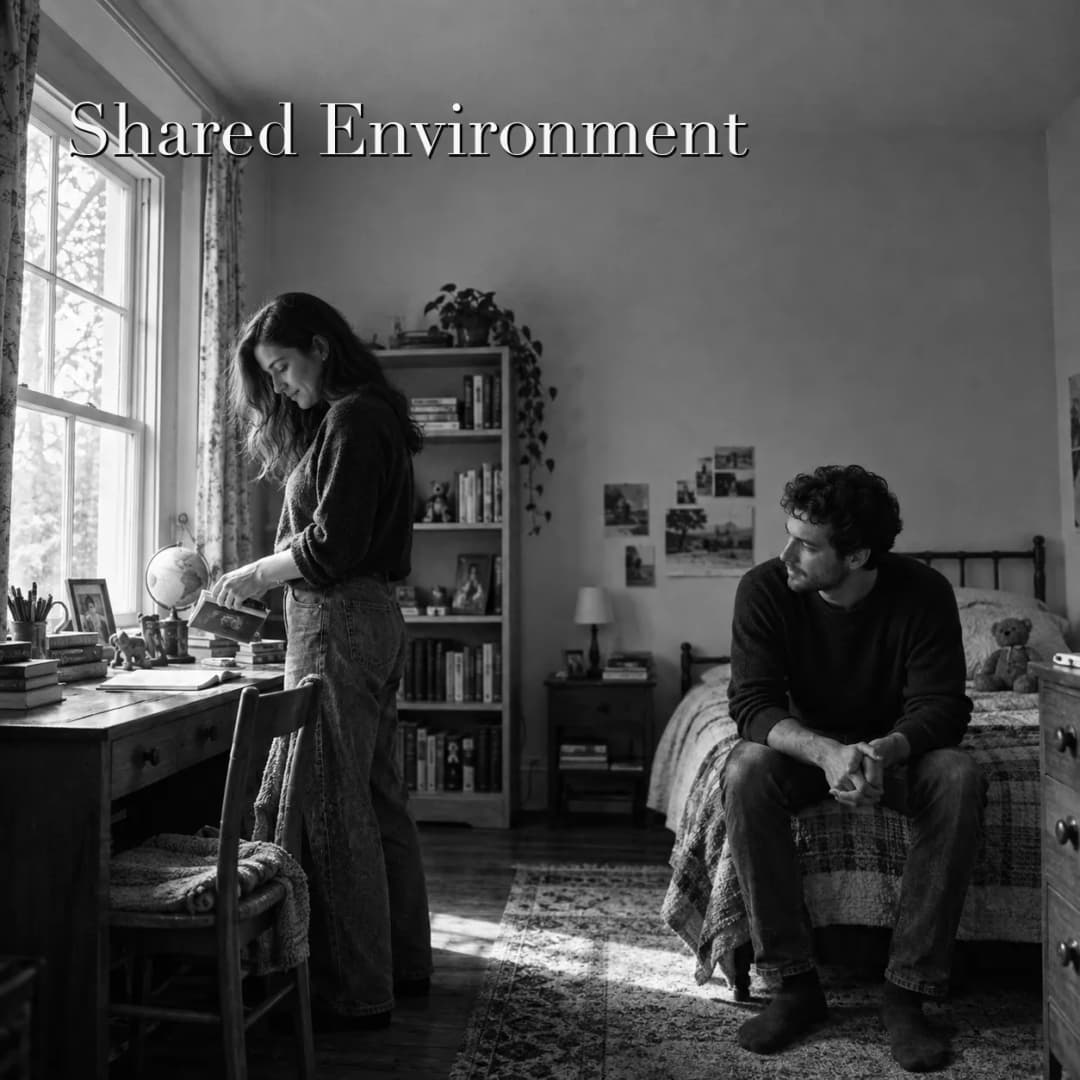
Everything siblings raised in the same household have in common, as distinct from their genes and from whatever happens to each of them separately. For most psychological traits it explains far less than people expect. Infant attachment is one of the few places it explains almost everything.
What it is
Behaviour genetics splits the differences between people into three parts. Genetic variation. Shared environment, meaning whatever makes children in the same family alike for reasons other than genes. And non-shared environment, meaning everything that happens to one child and not the other, which also absorbs measurement error.
The finding that surprised the field, repeatedly, across decades and traits, is that the shared-environment component is usually small. Children raised in the same home are not much more alike than chance once genes are accounted for, on most personality and ability measures.
That is why the attachment result is worth noticing.
In effect
Caroline Bokhorst and colleagues ran the Strange Situation on twins in 2003 and found effectively no genetic contribution to a baby's classification, with the shared family environment accounting for roughly half the variation and the rest split between non-shared environment and error.
Glenn Roisman and Chris Fraley reached the same conclusion in 2008 using a nationally representative American sample of 485 same-sex twin pairs, and found the same for observed parenting quality and for the overlap between parenting and security. All of it environmental.
So whatever the Strange Situation captures, it is capturing the household rather than the child's inheritance. That is unusual, and it is the strongest thing anyone can say in attachment theory's favour: this is one of the few places where the environment demonstrably does the work.
It also has an awkward corollary for the popular version. If the classification is environmentally caused, and a person's environment keeps changing, then nothing about the finding implies the classification should persist.
What it does not say
It does not mean parenting is the whole of the shared environment. Everything siblings share is in that component, including income, housing, neighbourhood and whatever else moves together with them.
It does not extend to the adult measures. Adolescent and adult self-reported attachment shows a non-trivial genetic contribution, which is another piece of evidence that the infant and adult constructs are not the same thing.
And a zero heritability estimate is an estimate. These are twin samples of moderate size, and the confidence around any variance component is wider than a single figure suggests.
Sources
- Bokhorst, C. L., Bakermans-Kranenburg, M. J., Fearon, R. M. P., van IJzendoorn, M. H., Fonagy, P., & Schuengel, C. (2003). Child Development, 74(6), 1769-1782.
- Roisman, G. I., & Fraley, R. C. (2008). Developmental Psychology, 44(3), 831-839.
- Fearon, R. M. P., et al. (2014). Journal of Child Psychology and Psychiatry, on the genetics of adolescent attachment.
- Where this came from
- No book in this library is the source of this concept. It entered the vault from What the Crib Actually Decides, built from primary sources rather than from a book.