Sound of Food
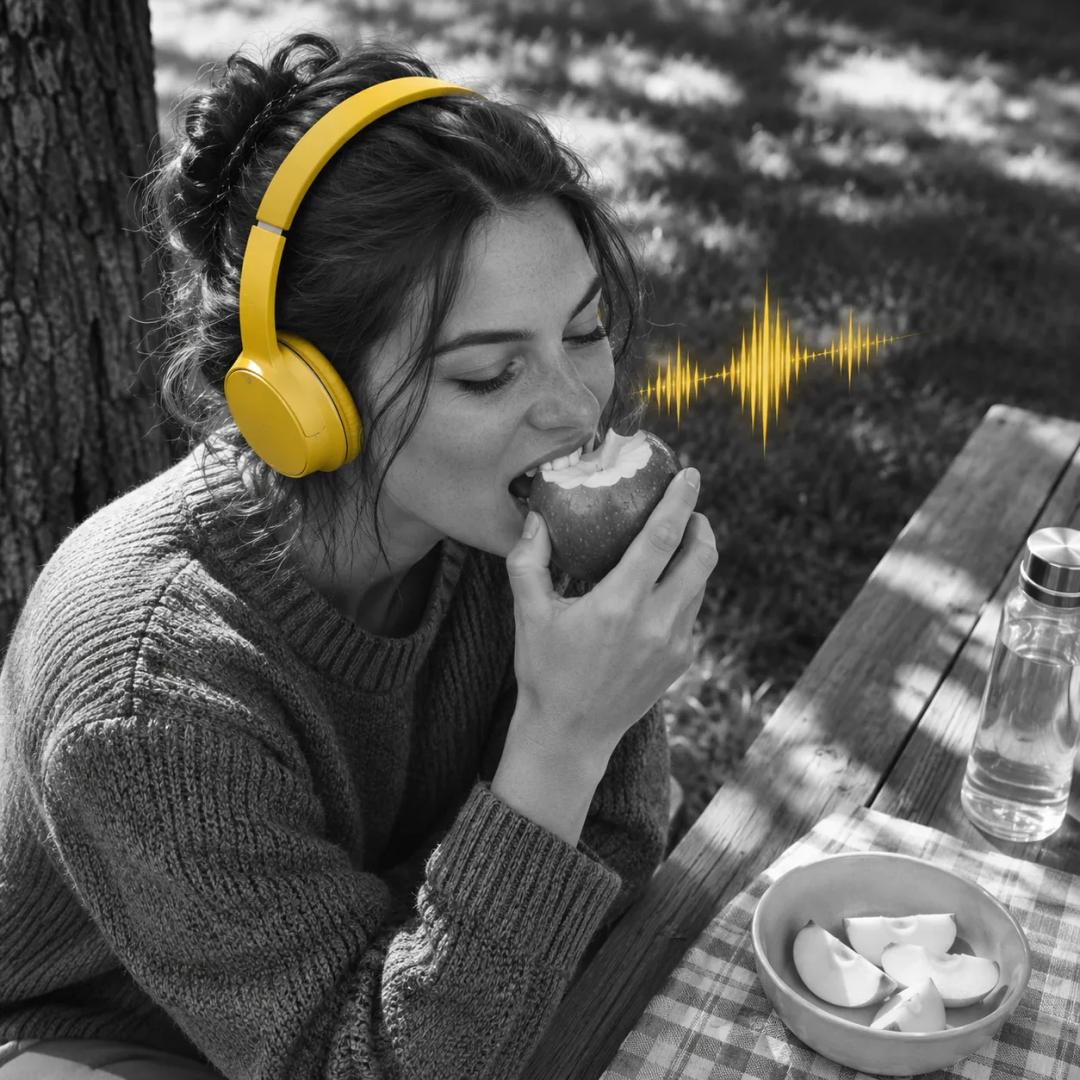
The sound of food is the noise made by biting and chewing, and its part in how crisp, hard and fresh a food seems. In laboratory studies, changing only the sound of a bite changed the verdict on the same food.
What it is
Zata Vickers and Malcolm Bourne proposed in 1976 that crispness is mainly an acoustical sensation. They recorded people biting crisp foods such as vegetables, toast and biscuits and found sound spread across a wide band of frequencies, with loudness that varied irregularly over time. Their cellular model has each ruptured cell or cell wall produce one sound in a series.
Charles Spence reviewed the field in 2015. Drawing on Vickers' work, he separates crispy foods, with strong sound above about 5 kHz, from crunchy foods, which peak around 1 to 2 kHz. He also distinguishes sound carried through the air from sound carried through the jaw and skull.
In effect
Massimiliano Zampini and Spence had people bite crisps and rate crispness or freshness while the biting sound was altered. Raising the overall level, or amplifying frequencies from 2 to 20 kHz, made crisps seem crisper and fresher. Attenuating them made crisps seem staler and softer. Luisa Dematté and colleagues found in 2014 that reducing the sound of an apple bite lowered rated crispness and, when the sound was globally reduced, made the apple seem softer.
Spence also links crispness with freshness in produce such as lettuce, and reports a chocolate-coated ice cream whose reformulation lost its cracking sound and was disliked, though it answered a customer complaint. People are often unaware that sound plays a part.
What it does not say
The effect is strongest where other senses have less to report. Zampini and Spence found that fizz sounds changed the judged carbonation of sparkling water held in the hand, but not of water in the mouth. The studies measure ratings of crispness, hardness and freshness in laboratory settings, not what people buy or choose to eat. The page makes no claim about diet or health.
Sources
- Vickers, Z. M., & Bourne, M. C. (1976). A psychoacoustical theory of crispness. Journal of Food Science, 41(5), 1158-1164. https://doi.org/10.1111/j.1365-2621.1976.tb14407.x
- Zampini, M., & Spence, C. (2004). The role of auditory cues in modulating the perceived crispness and staleness of potato chips. Journal of Sensory Studies, 19(5), 347-363. https://doi.org/10.1111/j.1745-459x.2004.080403.x
- Zampini, M., & Spence, C. (2005). Modifying the multisensory perception of a carbonated beverage using auditory cues. Food Quality and Preference, 16(7), 632-641. https://doi.org/10.1016/j.foodqual.2004.11.004
- Dematté, M. L., Pojer, N., Endrizzi, I., Corollaro, M. L., Betta, E., Aprea, E., Charles, M., Biasioli, F., Zampini, M., & Gasperi, F. (2014). Effects of the sound of the bite on apple perceived crispness and hardness. Food Quality and Preference, 38, 58-64. https://doi.org/10.1016/j.foodqual.2014.05.009
- Spence, C. (2015). Eating with our ears: assessing the importance of the sounds of consumption on our perception and enjoyment of multisensory flavour experiences. Flavour, 4, 3. https://doi.org/10.1186/2044-7248-4-3
- Farrimond, S. The Science of Flavour.