Split-Attention Effect
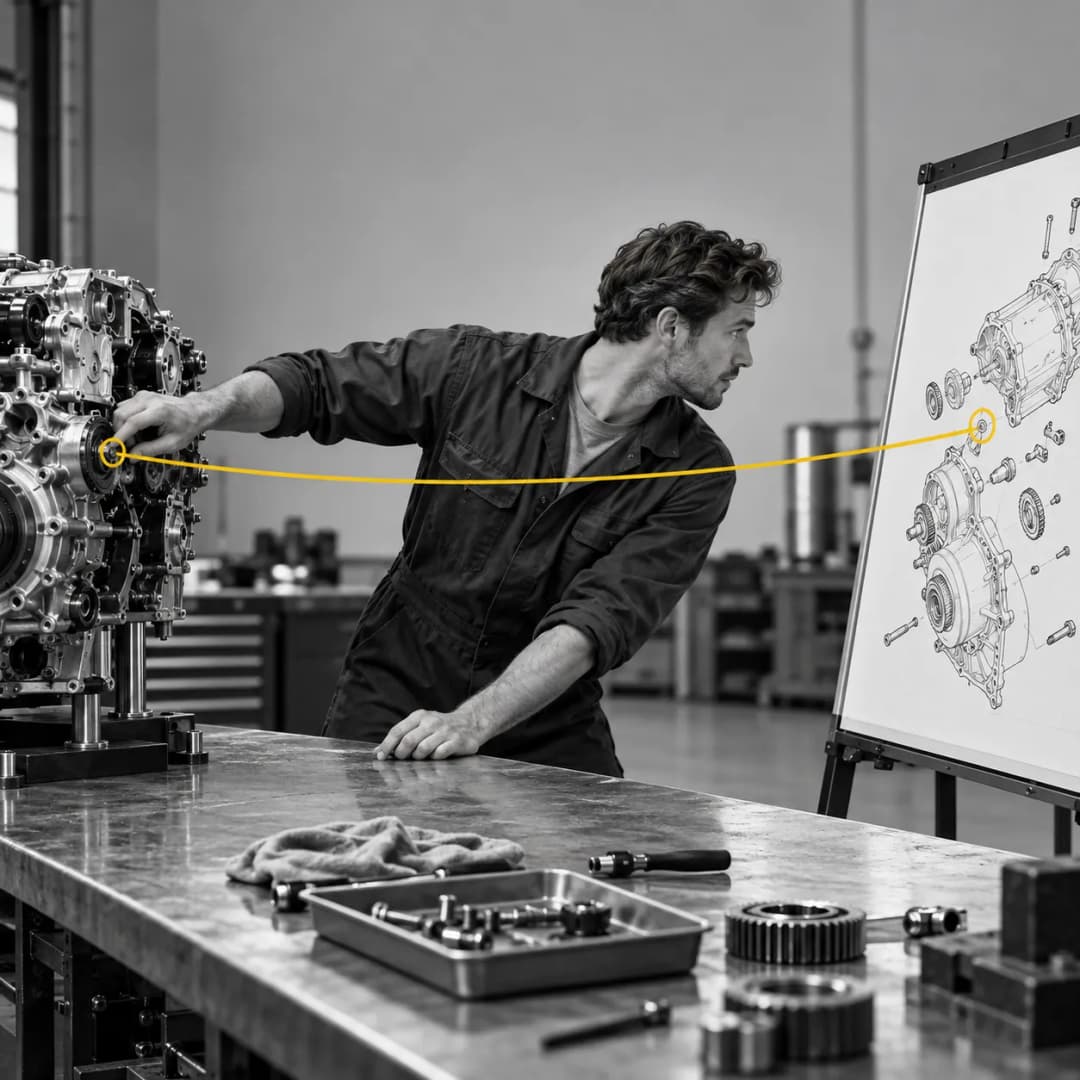
The split-attention effect is the finding that learning suffers when related information, such as a diagram and the text that explains it, is placed apart so that the learner has to combine the two mentally before learning can begin. Paul Chandler and John Sweller reported six experiments in 1991, using electrical engineering and biology materials. The first, run over several months in an industrial training setting, favoured integrated instructions over conventional ones.
What it is
Many instructional materials are built from two sources that only make sense together: a diagram and its explanation, a formula and the text that interprets it, a map and its key. When the sources sit apart, the reader looks at one, holds what was seen in working memory, searches the other, and tries to line the two up. Chandler and Sweller called the arrangement split-source instruction. In integrated instruction the two are combined, for example by placing the explanatory text at the points on the diagram it refers to.
Their 1991 paper, titled Cognitive load theory and the format of instruction, argued that split sources force the learner to integrate the material mentally before any learning can start, and that this integration is a demand that serves no purpose. The paper reports six experiments using electrical engineering and biology materials. The first compared conventional and integrated instructions over several months in an industrial training setting, using materials that were unintelligible until the sources had been integrated. The results favoured the integrated version.
The finding became known as the split-attention effect. It belongs to a family of results in cognitive load theory that treat the layout of instruction as a variable that changes learning even when the content stays the same. In the theory's later vocabulary the demand is extraneous load, meaning load produced by the design rather than by the subject. Sweller's 2010 paper adds that whether a given demand counts as extraneous depends on whether the task needs the interactivity or the design of the instruction produced it.
The practical lesson, in our reading, is a design habit: put the label where the reader is already looking.
In effect
Six experiments on format
The research case is Chandler and Sweller's 1991 paper. Its first experiment is the one described in detail: a months-long comparison in an industrial training setting, with materials that could not be understood without integration, favouring the integrated instructions. The paper reports five further experiments with electrical engineering and biology materials.
An assembly leaflet
An illustration, not a finding from the studies above. A flat-pack furniture leaflet can show a drawing of the parts on one page and a numbered key to them on another, or it can label each part on the drawing itself. The first asks the builder to carry numbers back and forth. The second leaves the matching to the page. The split-attention argument predicts that the second is easier for someone meeting the parts for the first time.
Charts and product pages
Another illustration, from design. A chart whose lines are identified by a legend at the side makes the reader match colours across the page, while direct labels on the lines remove that step. A product page that shows a photograph in one place and the specification it illustrates in another has the same structure. Whether any particular page gains from integration depends on its readers and its content, and the 1991 experiments do not test web pages.
What it does not say
It does not say that text should always sit on top of pictures. The materials in the first experiment could not be understood without integrating the sources, and this page makes no claim about material that can be understood from either source alone.
It does not say the benefit is the same for every reader. Kalyuga and colleagues reviewed evidence in 2003 that methods which help novices can lose their value, or hurt, with more experienced learners, so the advantage of integrated formats should not be assumed for experts.
It does not report the results of the other five experiments in the 1991 paper, and it states no figures.
Sources
- Chandler, P., & Sweller, J. (1991). “Cognitive load theory and the format of instruction.” Cognition and Instruction, 8(4), 293-332. doi:10.1207/s1532690xci0804_2
- Kalyuga, S., Ayres, P., Chandler, P., & Sweller, J. (2003). “The expertise reversal effect.” Educational Psychologist, 38(1), 23-31. doi:10.1207/S15326985EP3801_4
- Sweller, J. (2010). “Element interactivity and intrinsic, extraneous, and germane cognitive load.” Educational Psychology Review, 22(2), 123-138. doi:10.1007/s10648-010-9128-5