Stag Hunt
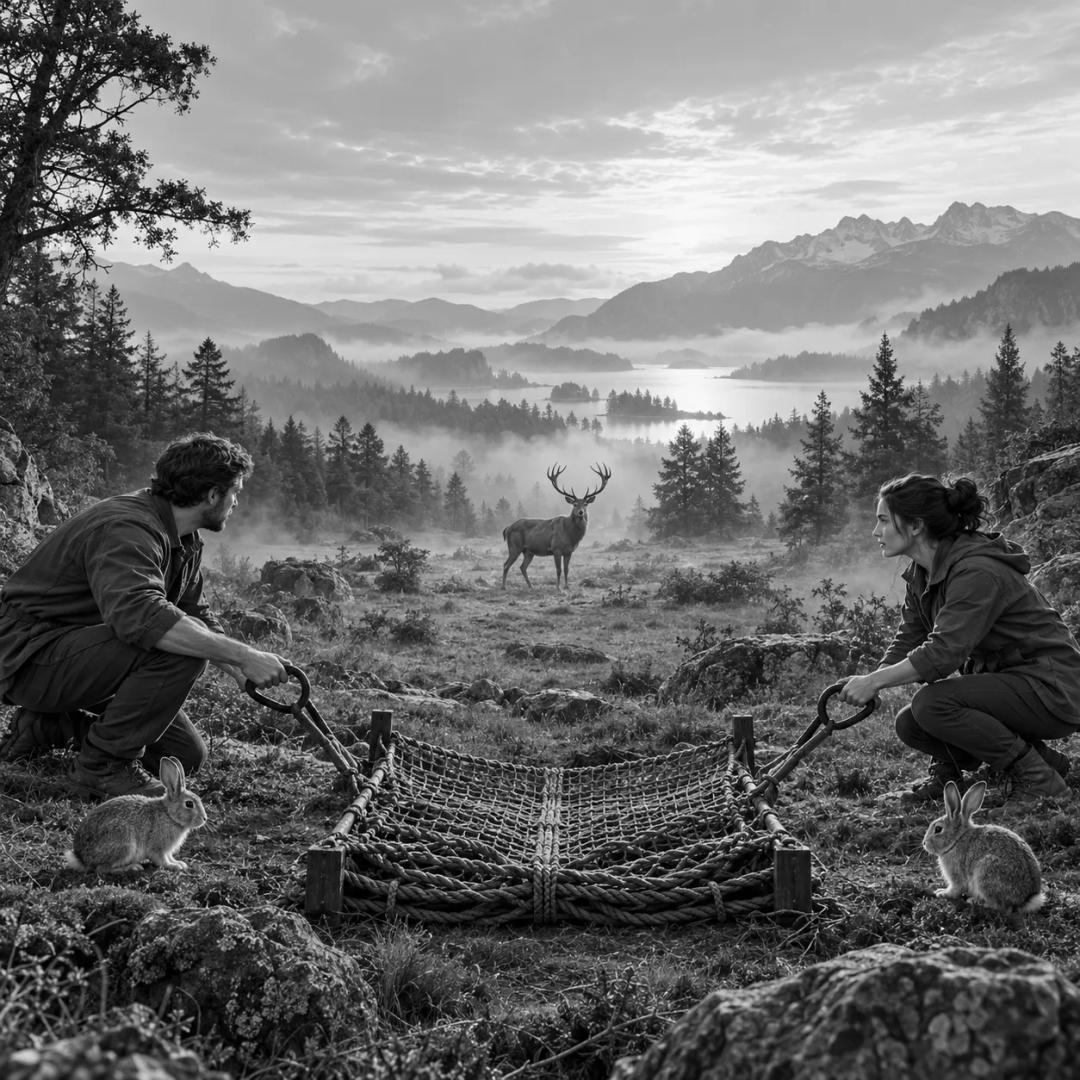
A stag hunt is a payoff structure with two equilibria, one safe and small, one larger and only reachable with a partner. Go it alone and you get the sure thing; commit to the joint effort and you do better if your partner commits too, and worse than nothing if they do not. It is not a prisoner's dilemma, because nobody here wants to defect. The problem is purely one of belief: what you do depends on what you think the other person will do, and on what you think they think you will do.
What it is
The version that carries the evidence is the butcher and the baker. Work alone for a guaranteed dollar, or try to make hot dogs together for a dollar and ten cents each, which pays nothing at all if your partner plays safe. Kyle Thomas, Peter DeScioli, Omar Sultan Haque and Steven Pinker ran it with four information conditions: a messenger tells you alone, the messenger says your partner knows too, the messenger adds that your partner knows you know, or the price is announced over a loudspeaker to both of you.
In effect
Across roughly four thousand participants recruited online, more people tried to coordinate under the loudspeaker than under any other condition, in every payoff condition. Being told that your partner knows beat being told nothing in three of the four payoff conditions and was marginal in the fourth, and the second and third rungs did not differ from each other. The authors read that shape as a qualitative distinction between shared and common knowledge rather than a smooth gradient of nested belief.
What it does not say
It does not show people responding to the incentives. The best bound is inside the paper: the share trying to work together barely moved as the cost of forgoing the safe option changed by a factor of ten, which the authors report as inconsistent with a strict rational-actor account. Participants responded to how public the information was and largely ignored the money. The headline percentages for the private and public conditions are presented in the paper as a figure rather than stated in the text, so they are not printed here, and no independent replication of the butcher-and-baker study was located.
Sources
- Thomas, K. A., DeScioli, P., Haque, O. S., & Pinker, S. (2014). 'The psychology of coordination and common knowledge.' Journal of Personality and Social Psychology, 107(4), 657-676. doi:10.1037/a0037037. Three experiments, 1,600, 1,600 and 800 participants recruited online. Headline percentages appear only in a figure.
- De Freitas, J., Thomas, K., DeScioli, P., & Pinker, S. (2019). 'Common knowledge, coordination, and strategic mentalizing in human social life.' Proceedings of the National Academy of Sciences, 116(28), 13751-13758. doi:10.1073/pnas.1905518116.