Steiner's Task Taxonomy
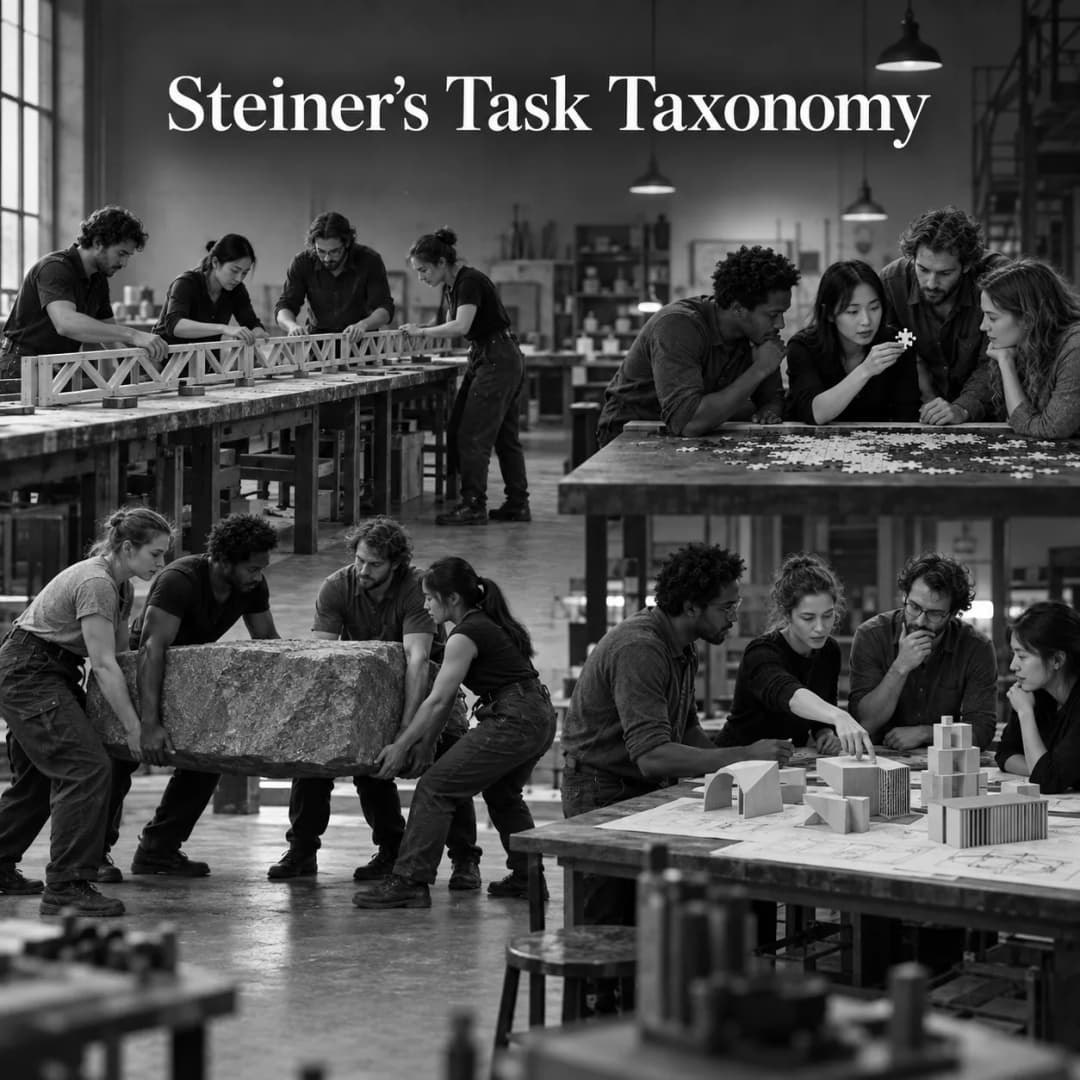
Steiner's task taxonomy is Ivan Steiner's 1972 classification of group tasks by how individual contributions combine into a group product. It is a framework rather than a finding, and it is the thing that tells you in advance which group effects to expect. Most popular disagreement about whether teams help is people comparing results from different rows of this table.
What it is
There are four categories.
Additive tasks are those where contributions sum. Rope-pulling is the standard example. The group beats any individual, and this is where social loafing bites hardest, because nobody's contribution is identifiable within the total.
Disjunctive tasks are those where the group succeeds if any one member succeeds. A puzzle with a single insight is the type case. The group is as good as its best member, provided it will listen to them, and that proviso carries most of the practical difficulty.
Conjunctive tasks are those where the group succeeds only if every member succeeds. A rope of climbers is the image. The group is as good as its worst member, which reverses every intuition carried over from the disjunctive case.
Discretionary tasks are those where the group decides for itself how to combine contributions. Most real knowledge work sits here, which is why most real knowledge work is hard to predict.
In effect
The value of the taxonomy is that it converts a vague question, whether groups are better than individuals, into an answerable one. The claim that synergy is real and rare and depends on task type is only usable once there is a taxonomy of task types to point at, and this is it.
It also predicts where particular effects will appear rather than leaving them as surprises. Social loafing is expected on additive tasks and not on conjunctive ones. The value of getting the best member heard is a property of disjunctive tasks specifically. The difficulty of measuring collective intelligence comes from pooling across categories that behave differently.
One absence is worth recording, and it is the reason this page exists at all. The taxonomy appears nowhere in The Collective Edge. That book credits Steiner correctly and repeatedly for the productivity subtraction formula and takes nothing from the taxonomy. That is a gap in coverage rather than a crediting error, and this publication records it as one: the second half of Steiner was needed and the book that supplied the first half does not contain it.
What it does not say
It is not a finding and cannot replicate. It is a scheme for sorting tasks.
It does not say which kind of task you have. Assigning a real piece of work to a row is a judgement, and the discretionary row exists because most work resists the other three.
It does not predict performance on its own. It predicts which effects are available to operate, which is a weaker and more useful claim.
It does not come from the book this vault took its sibling concept from. It is absent there, and this page is built from the primary description rather than from that source.
Sources
- Steiner, I. D. (1972). Group Process and Productivity. Academic Press. Source of both the productivity formula and the taxonomy. Not read here; confirmed by this publication's external verification pass of 2026-09-23.
- Fisher, C. M. The Collective Edge, recorded as an absence. Checked and the taxonomy was not found anywhere in the book.