Stressor Controllability
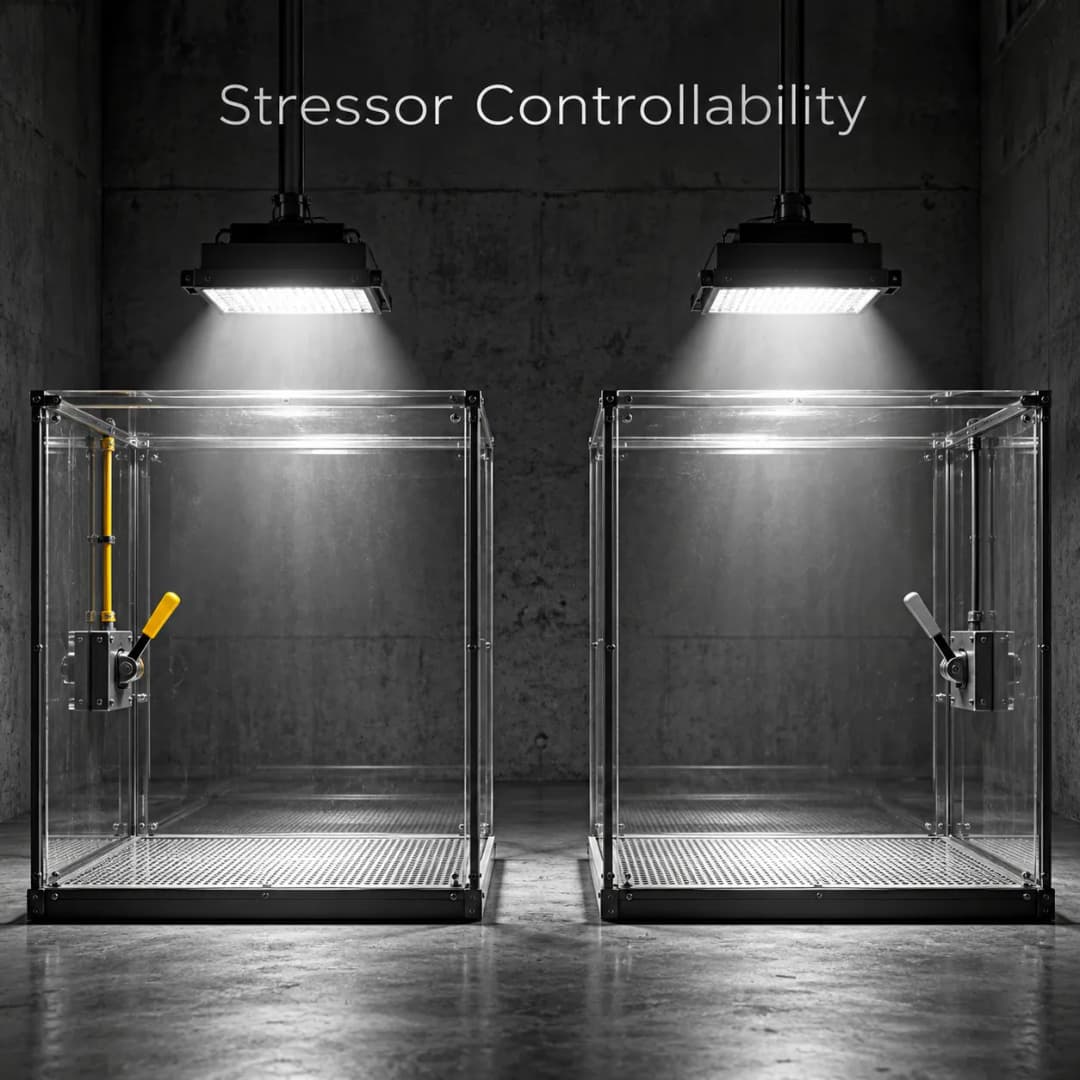
Stressor controllability is whether an aversive event can be ended by the animal's own behaviour. It is the variable that the learned helplessness experiments manipulated, and the 2023 review by Michael Baratta, Martin Seligman and Steven Maier makes it the centre of a revised account. In that account, prolonged aversive stimulation itself produces the debilitation, and control is what the animal learns. Control engages the medial prefrontal cortex, which inhibits a serotonergic response in the dorsal raphe nucleus. The evidence is from rodents, mostly male, and the authors call the translation to humans speculative. This site holds the concept as unreviewed, because it is written here from one review by the group that did the work.
What it is
The review's introduction says Seligman and Maier first coined and manipulated "controllability." The idea is simple to state and demanding to test. Two animals receive physically identical stressors, and the only difference is whether the animal's own response ends them. The review sets this as an inclusion rule for the studies it counts: they must compare "physically identical stressors" that subjects can or cannot control, and "the dimension of control must be experimentally manipulated" for an effect to be credited to control and not to the stressor.
The standard design is the triadic design. One group can escape each shock, a second group is yoked to the first and receives the same shocks with no means of ending them, and a third group is not shocked. In the rodent version, mainly male rats sit in small wheel-turn boxes with shock electrodes fixed to the tail. Escapable shocks end when the rat turns the wheel with its front paws. The authors chose shock because it can be started and stopped quickly, and rats learn the escape response within minutes. They note that other stressors, such as restraint or social defeat, cannot be manipulated for controllability in this way.
Controllability does not change everything. The review reports that several outcomes were the same after escapable and inescapable stress, including reduced sucrose preference, reduced wheel running, potentiated defensive responding, activity of the stress-hormone and autonomic systems, and immune responses. The authors conclude that "stressor controllability effects arise from select brain circuits," so only behaviours that depend on those circuits are affected.
In effect
The circuit has two main parts in the review's account. Prolonged aversive stimulation strongly activates serotonin neurons in the dorsal raphe nucleus, which project to the amygdala, the dorsal periaqueductal grey and the dorsal striatum. Inescapable stress, relative to escapable stress, activated those cells, raised serotonin in the nucleus and its projection regions, and sensitised the neurons for about as long as the behavioural effects last. The effects were blocked by lesions of the nucleus, and activating it without shock reproduced them.
The second part is the medial prefrontal cortex. The authors argue that the nucleus, with about 30,000 neurons in the rat, lacks the sensory and motor inputs needed to detect whether an act controls a shock, so detection must happen elsewhere. Layer V glutamatergic neurons of the cortex synapse onto GABA interneurons in the nucleus, so stimulating the cortex reduces serotonin activity. Neurons in the prelimbic cortex that project to the nucleus were activated after escapable shock. Silencing the cortex during escapable shock removed the differences in serotonin and behaviour, impaired shuttle escape and exaggerated shock-elicited freezing, but did not affect learning of the wheel turn. Activating the cortex during inescapable shock produced the protection seen after escapable shock.
The review links the detection of control to the brain's goal-directed learning system. Escapable shock preferentially induced the activity marker Fos in the dorsomedial striatum, not the dorsolateral striatum. Blocking NMDA receptors in the dorsomedial striatum during escapable shock abolished the protection and the differential serotonin response, while blocking them in the dorsolateral striatum did not. The authors conclude that "the controlling action must be acquired and maintained by the GD system," the goal-directed system.
Control also protects against later stress. Escapable shock in rats aged 35 days blocked the effects of inescapable shock in adulthood, 56 days later, and escapable shock a week before social defeat prevented the defeat-induced rise in serotonin. The review reports that this immunisation needs the medial prefrontal cortex to be active both during the control experience and during the later stress, and needs new protein production.
The circuit also predicts which behaviours control should change. The infralimbic cortex inhibits fear through the amygdala, and control inhibited conditioned fear, accelerated extinction and prevented spontaneous recovery of fear. Silencing that region blocked the effect. Freezing to predator odour, which the amygdala does not regulate, was unaffected.
What it does not say
It does not say the circuit has been shown in people. The authors call their human translation speculative, and they say it is uncertain which area of the human prefrontal cortex is homologous to the rat prelimbic region.
It does not hold equally in both sexes. Until recently nearly all of the work used male rats. In females, the review reports, control did not blunt the stressor: escapable shock produced the same outcomes as inescapable shock, did not constrain the serotonin response and did not selectively engage the prelimbic neurons that project to the nucleus. Females learned the wheel turn as efficiently as males, so the difference lies in circuitry. The review adds that in females the habit system was preferentially engaged during escapable shock, the reverse of the male pattern.
It does not make every link in the circuit equally firm. The review frames its predictions about social dominance and effortful behaviour tentatively, with words such as "might" and "perhaps." Its claim about the short time course, which it ties to desensitisation of serotonin 1A autoreceptors, is a circuit prediction.
It does not stand apart from its authors. The review was written by the group that did much of the work, and this site has not assessed independent replication.
It does not support clinical claims here. The review discusses implications for therapy and prevention, and those sections were not assessed for this page.
Sources
- Baratta, M. V., Seligman, M. E. P., & Maier, S. F. (2023). From helplessness to controllability: toward a neuroscience of resilience. Frontiers in Psychiatry, 14, 1170417. doi:10.3389/fpsyt.2023.1170417. Read online, open access, apart from the sections on therapy and prevention. Every claim on this page comes from this review unless stated.
- Amat, J., Baratta, M. V., Paul, E., Bland, S. T., Watkins, L. R., & Maier, S. F. (2005). Medial prefrontal cortex determines how stressor controllability affects behavior and dorsal raphe nucleus. Nature Neuroscience, 8(3), 365-371. doi:10.1038/nn1399. Bibliographic record only.
- Maier, S. F., & Seligman, M. E. P. (2016). Learned helplessness at fifty: Insights from neuroscience. Psychological Review, 123(4), 349-367. doi:10.1037/rev0000033. Bibliographic record only.
- Seligman, M. E. P., & Maier, S. F. (1967). Failure to escape traumatic shock. Journal of Experimental Psychology, 74(1), 1-9. doi:10.1037/h0024514. The triadic design as described in the 2023 review.