Superstitious Behavior in Pigeons
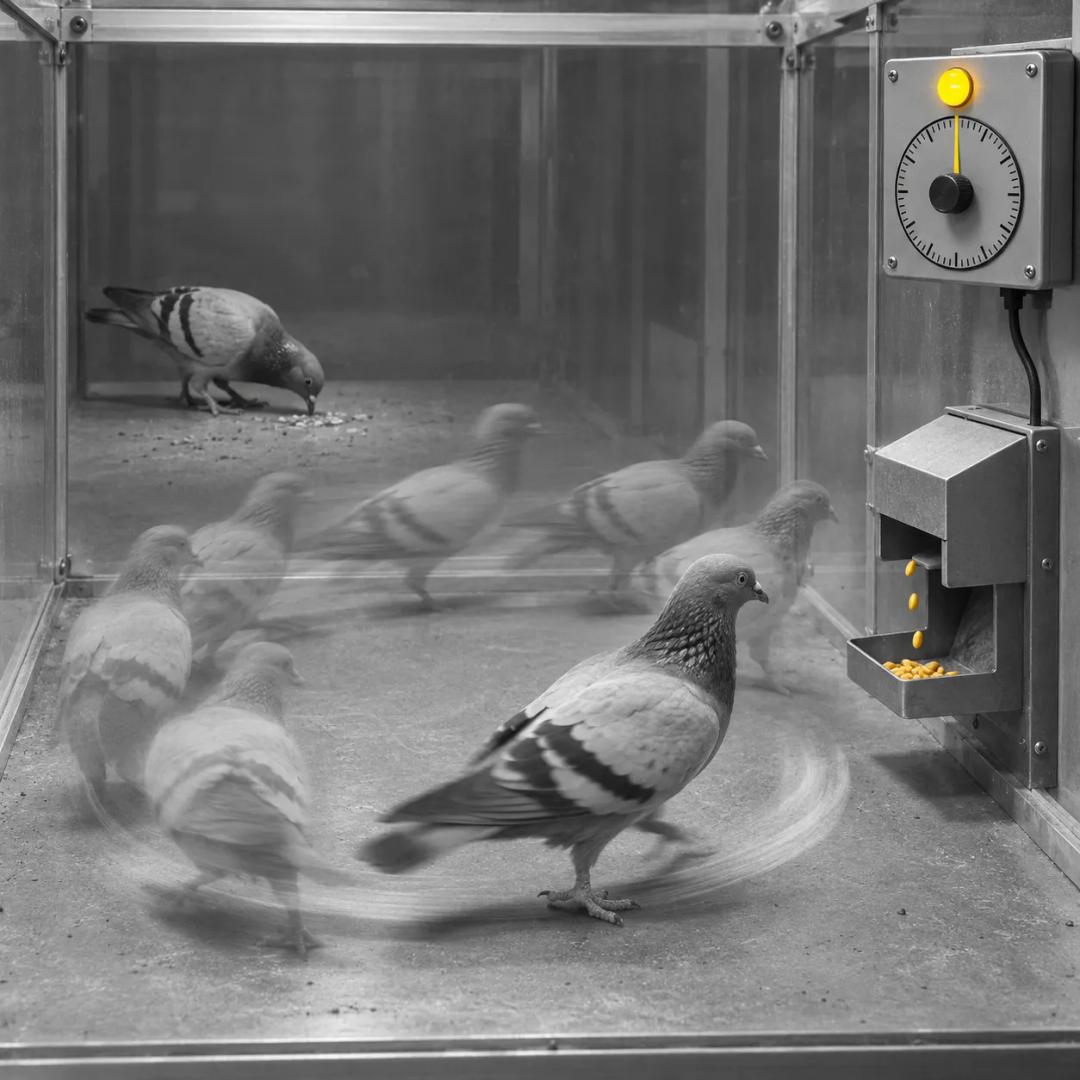
Superstitious behaviour in pigeons is the name B. F. Skinner gave in 1948 to repeated routines that appeared in hungry pigeons fed at regular intervals whatever they did. Skinner read the routines as the result of food strengthening whatever the bird happened to be doing when it arrived. In 1971 John Staddon and Virginia Simmelhag repeated the procedure, watched the behaviour more closely and described two kinds of activity, interim and terminal, concluding that food works mainly by selecting among behaviours that are already present.
What it is
Skinner's report, published in the Journal of Experimental Psychology in 1948 under the title Superstition in the pigeon, described hungry pigeons that received food at set intervals regardless of their behaviour. The birds developed repeated routines. Skinner's explanation was accidental reinforcement: food arriving at a moment when a bird was doing something strengthened that action, so the bird was more likely to repeat it, and the repetition made another accidental pairing more likely. The account became a standard illustration of how a ritual might grow out of coincidence.
Staddon and Simmelhag, in a 1971 paper in Psychological Review titled The superstition experiment: a reexamination of its implications for the principles of adaptive behavior, ran the procedure again and extended it. Hungry pigeons were given food at regular or irregular intervals whether or not they pecked, and some birds were also run on a schedule where food required a peck.
The behaviour of the birds fell into two groups. Interim activities came soon after food. They included pecking the floor, walking in circles, flapping the wings, moving along the wall and raising the beak towards the ceiling. These varied a great deal from bird to bird, and they were not followed by food. The terminal response came later in the interval. Each bird settled into one stable behaviour, usually pecking at the feeder wall, which began several seconds after food on fixed schedules and about two seconds after food on variable schedules, and which continued until food arrived.
In effect
The reexamination changed what the experiment was taken to show. The late-interval response tracked how likely food was at each point in the interval. It did not depend on whether the pecks produced food, and the pecking looked similar whether or not it was required. Early in training the behaviour was varied, and late in the interval the sequences became very rigid.
Staddon and Simmelhag concluded that Skinner's accidental-reinforcement account did not describe what their birds did. The food-related behaviour appeared in anticipation of food, which they said fitted a stimulus-substitution kind of process better than strengthening by accident. They proposed that two sets of principles are needed: one for where behaviours come from before reinforcement, and one for how reinforcement selectively eliminates them. They related this to evolution by natural selection, and they described the interim activities as competition among motivational systems. They also noted that the pattern does not fit a simple Pavlovian account in every case, and presented their scheme as a step towards a more general theory of learning.
For research on belief in luck, the pigeon work offers an animal model of how repeated routines can form around events that arrive by timer. It was designed to study learning in pigeons. It does not measure what people believe about luck, and the 1997 scale described under Belief in Good Luck approaches belief directly.
What it does not say
It does not show that people form lucky routines in the same way. The experiments used hungry pigeons, and the paper concerns principles of adaptive behaviour in that setting.
It does not leave Skinner's account standing unchanged. The 1971 reexamination argued that selection among behaviours, and anticipation of food, explain the pattern better than accidental strengthening.
It does not say that the birds believed anything. Both papers describe behaviour and its causes in terms of reinforcement and motivation.
It does not settle the theory of learning. The authors presented their scheme as a step and said it does not fit a simple Pavlovian account in every case.
Sources
- Skinner, B. F. (1948). Superstition in the pigeon. Journal of Experimental Psychology, 38(2), 168-172. https://doi.org/10.1037/h0055873
- Staddon, J. E. R., & Simmelhag, V. L. (1971). The superstition experiment: a reexamination of its implications for the principles of adaptive behavior. Psychological Review, 78(1), 3-43. https://doi.org/10.1037/h0030305