The 5 Whys
The five whys is a root-cause technique from the Toyota Production System: ask why roughly five times in a row to move past a surface symptom and reach the cause underneath it. Toyota's own tradition credits Sakichi Toyoda with the method, and Taiichi Ohno codified it in Toyota Production System in 1978. Nir Eyal repurposed it in Hooked as a product-design exercise for finding a user's emotional trigger. It is a problem-solving practice rather than a testable effect, and the transfer to emotion is clever and unvalidated.
What it is
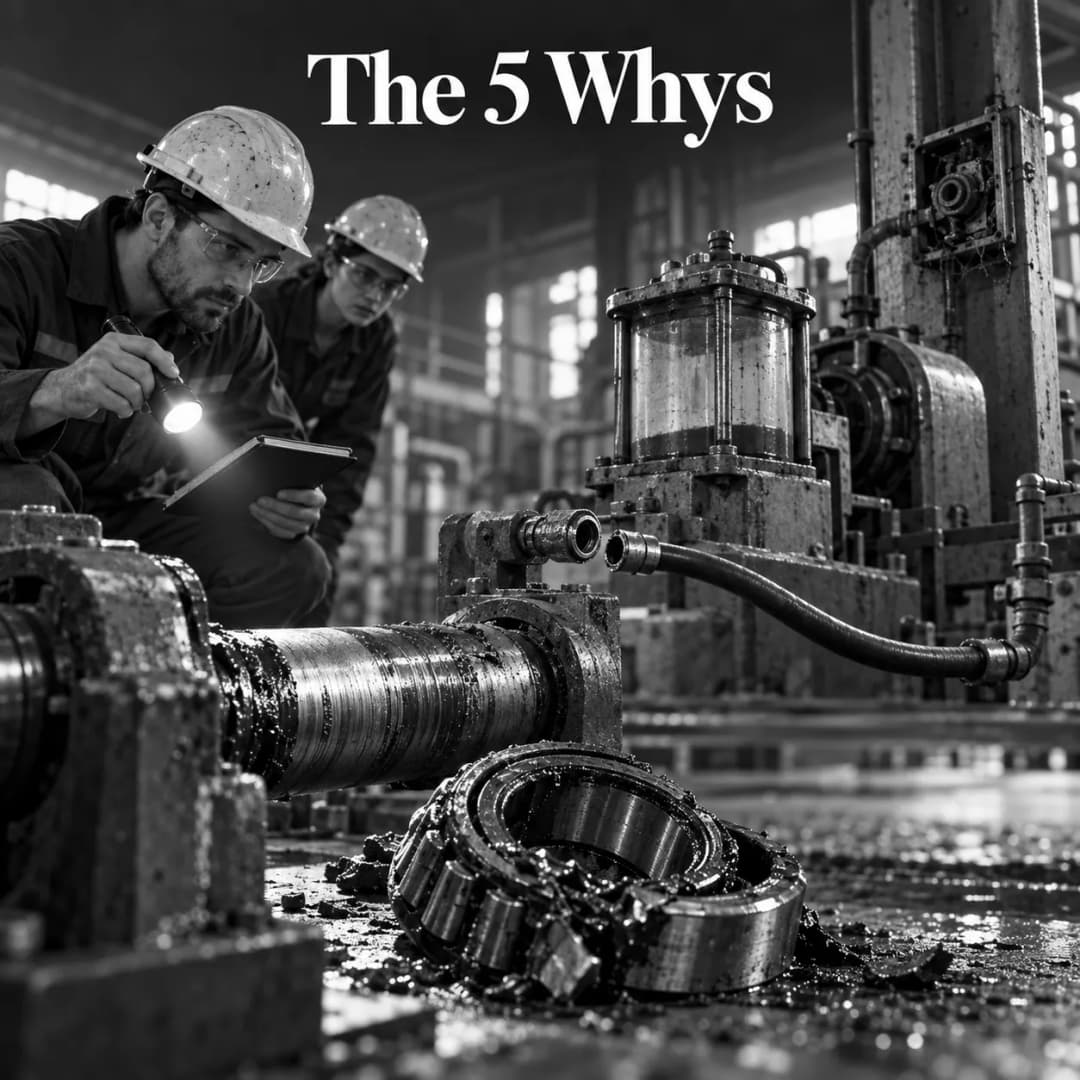
On a production line the method is mechanical. A machine stopped. Why. The fuse blew. Why. The bearing seized. Why. It was not lubricated. Why. The pump was not drawing oil. Why. The shaft was worn because there was no filter. The fix is a filter, not a fuse, and the point of the five repetitions is that the first answer is always the one that leads to replacing the fuse.
Attribution here is worth getting right, because the common simplification credits Ohno alone. Toyota's tradition attributes the method to Sakichi Toyoda, founder of Toyota Industries. Ohno set it out in Toyota Production System, published in Japanese in 1978 and in English in 1988, which is where most citations point, and codifying is not the same as originating. Both names belong on the page.
Eyal's adaptation, in Hooked at pages 54 to 55, runs the same procedure on a person rather than a defect. Ask a user why they would use your product, then ask why of their own answer, and keep going. The first pass or two usually surfaces a rational, sayable reason: it saves time, it keeps me organised. By the fourth or fifth why the answer has turned emotional and is often something the user would not have volunteered unprompted, such as avoiding the anxiety of forgetting something or the discomfort of feeling alone. Whatever sits at the bottom of that chain is what the method calls the internal trigger.
In effect
As an interview heuristic the adapted version has obvious uses. It pushes past the first plausible answer, which is the answer most research instruments stop at, and it costs nothing to run.
Its problems are the ones that always attach to asking people why they do things. There is no study showing that five successive whys reliably surface motives rather than manufacture post-hoc explanations, and the literature on declared against revealed preferences gives good reason to expect the second. An interviewee pressed five times will produce a fifth answer. Whether it is truer than the first is exactly the question the method cannot answer about itself.
The root-cause literature has its own criticism of the original, which is that following a single causal chain finds one cause and by construction misses the others. Real failures are usually overdetermined.
There is a prior art note too. Ernest Dichter's motivational research was excavating the same layer decades earlier with depth interviews, without a repeatable technique attached.
What it does not say
It does not say five is the right number. Five is a rule of thumb from a factory floor, not a finding.
It does not say the emotional answer is the true one. The method produces a deeper-sounding answer. Nothing in it establishes that the deeper-sounding answer is the operative one.
It does not belong to Ohno alone. Toyota's tradition credits Sakichi Toyoda with the method; Ohno codified it.
It does not transfer from defects to feelings for free. A bearing does not have a self-image and cannot confabulate. Eyal's version is an adaptation and should be used as an interview heuristic rather than as a validated technique.
Sources
- Ohno, T. Toyota Production System. Japanese 1978, English 1988. Where most citations point. Toyota tradition attributes the method itself to Sakichi Toyoda, founder of Toyota Industries. Secondary sources; neither read here.
- Eyal, N. (2014). Hooked. The five whys applied to finding a product's internal trigger, pp. 54 to 55.
- Vault verification pass, 2026-09-25. Status not-a-research-claim. Correction recorded in that pass: crediting Ohno alone is the common simplification.