The Algorithm (Framework)
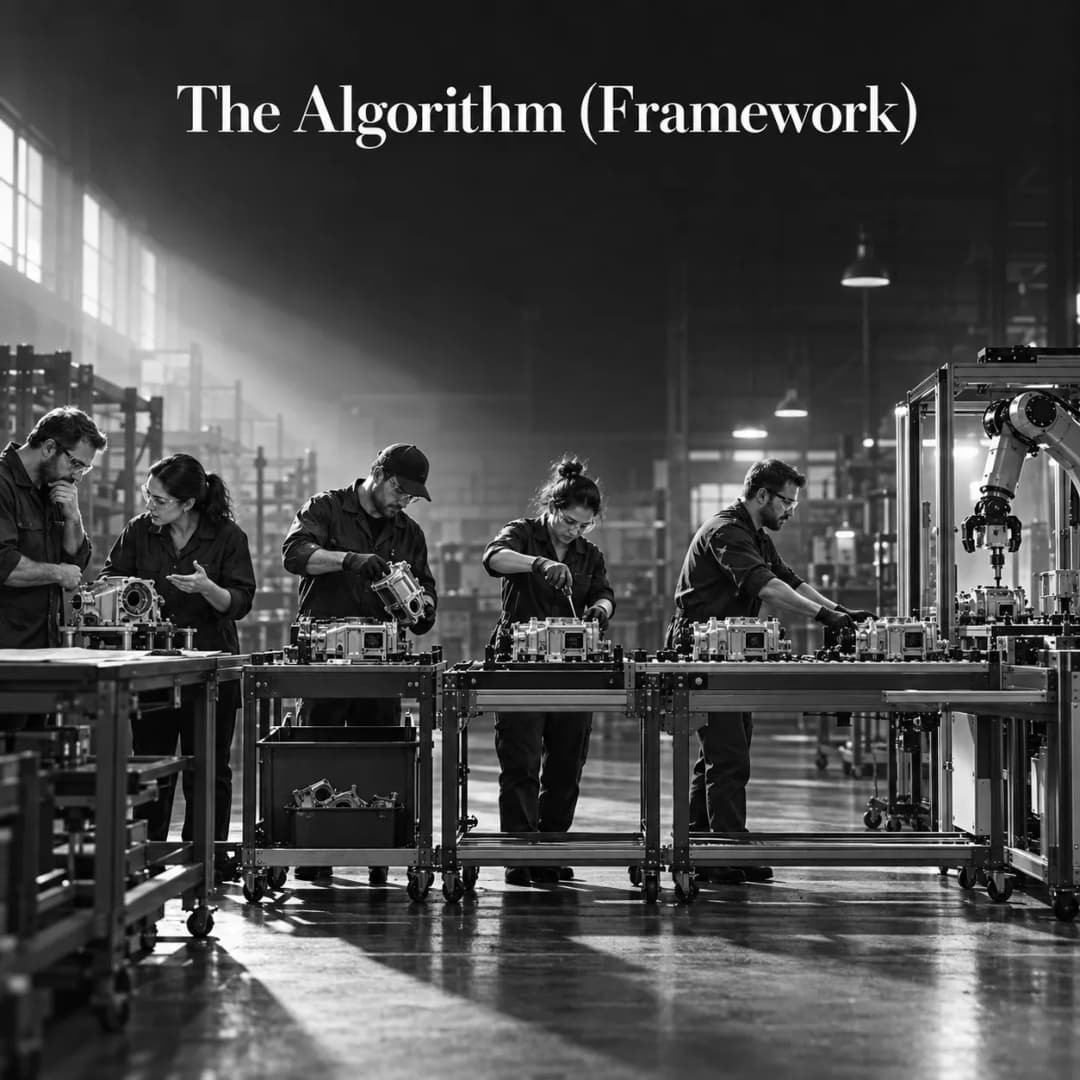
The Algorithm is a five-step sequence for fixing a process: question every requirement, delete every possible step, simplify and optimise, accelerate cycle time, automate last. Jon McNeill presents it as the method he saw applied at Tesla, and his book credits Elon Musk as its architect. The steps are sensible and mostly familiar from lean practice. What earns the framework its place is the insistence that the order is fixed. It is McNeill's proposal, not a tested framework, and this page says so.
What it is
Each step is unremarkable on its own. Together and in that order they form an argument: that speeding up or automating anything before you have established it should exist is the standard way organisations make their problems permanent.
The worked case is a delivery centre where handing over a car takes hours. Step one asks who required each inspection and why. Step two removes the ones nobody can defend. Step three simplifies what remains. Only then is the handover sped up, and only after that is any of it automated. Reverse the order and you build a fast, expensive machine for doing something unnecessary.
The credit in the book is split and the split is worth reporting. Page xix credits Musk as the architect. Page 189, in the acknowledgments, credits Fred Musone with the underlying principles, learned in Japan. That second credit points where the lineage actually runs, which is the Toyota Production System and the work of Taiichi Ohno and Shigeo Shingo. This publication's reading is that the framework is a restatement of lean practice with a new name and a fixed ordering, and that the fixed ordering is the contribution.
In effect
No test of the framework exists in either direction. The book contains no citations, no bibliography and no failed application, and this page treats that as the central fact about its evidential standing rather than as a footnote.
The larger problem is the retrofits. Earlier successes at General Motors and Ford are described in the book as the Algorithm operating under another name. That move makes the framework unfalsifiable as stated, because any success can be read back into it and no failure is on offer to test it against. The case set is winners only, which is survivorship bias in its plainest form.
The correct phrasing in any piece that uses this material is that McNeill argues it. Never that research shows it.
None of which means the method does not work. It may well, and the lean tradition it descends from has a much larger body of practice behind it than the book does. The point is that the book is not evidence for it, and that a reader reaching for the framework should reach past it to the tradition.
What it does not say
It does not say the framework has been tested. Nothing in the book tests it, and nothing outside the book tests it either.
It does not say the steps are new. Four of the five are standard lean process improvement. The fixed ordering is the part worth arguing about.
It does not survive its own retrofits. A framework that can be found retrospectively in every past success cannot be checked, and the book performs that retrofit repeatedly.
It does not credit its lineage in the main text. The Toyota line reaches the reader through an acknowledgment, which is where this vault's uncredited-ancestor pattern usually finds it.
Sources
- McNeill, J. The Algorithm. The five steps occupy chapters one to five, pp. 3 to 120. P. xix credits Musk as architect; p. 189 credits Fred Musone with the underlying principles, learned in Japan. The book has no notes and no bibliography.
- Lineage: the Toyota Production System, via Taiichi Ohno and Shigeo Shingo. This publication's identification. Not read here.