The Basic Emotion Method
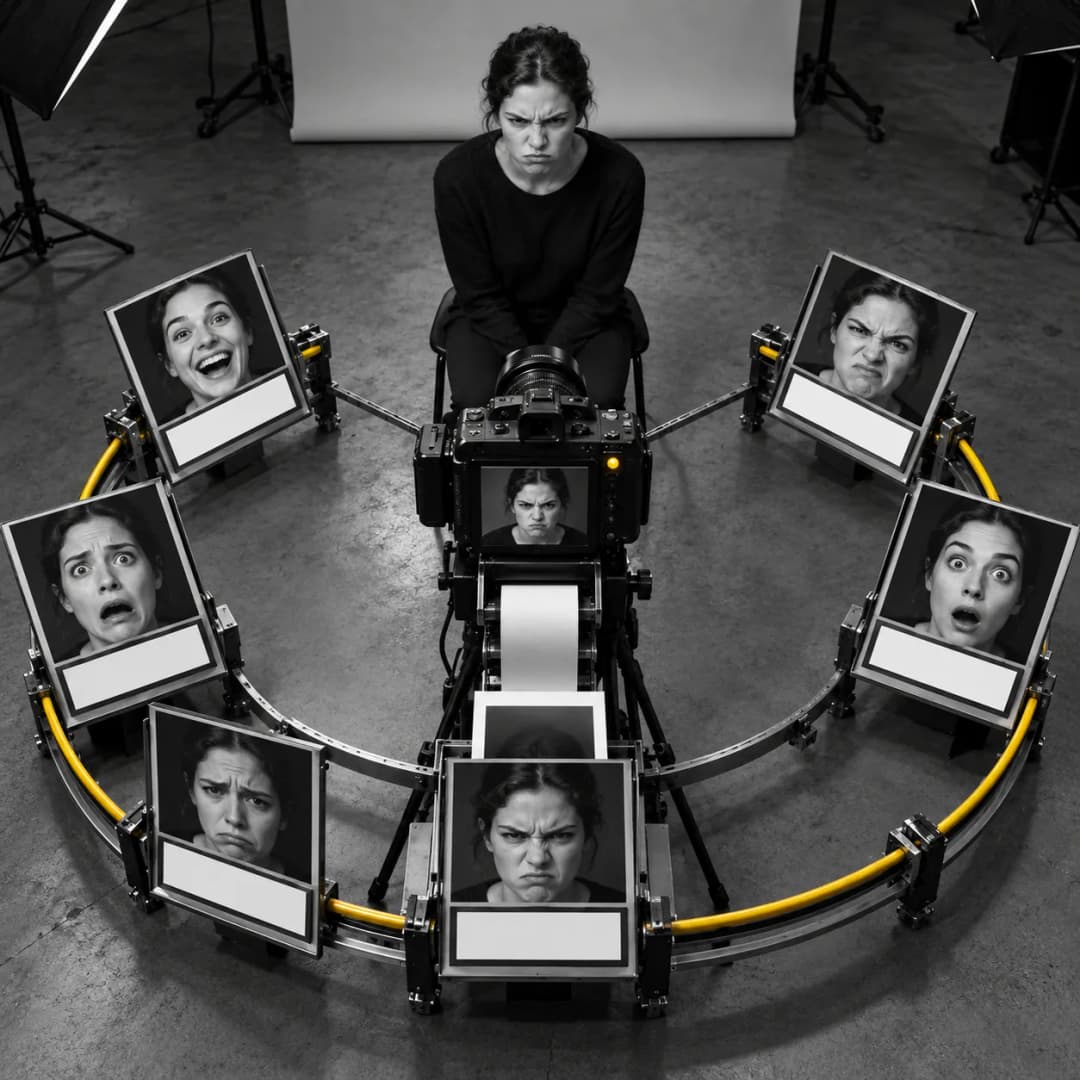
The basic emotion method is the standard instrument of twentieth-century emotion research: posed photographs of faces, plus a short list of emotion words from which an observer picks one. It produces high agreement, which is its strength and its problem. If the poses were shaped by the same common belief the observers hold, the agreement is evidence of the belief. Scores from two widely licensed classifiers fall from 97 per cent to 10 per cent when the photographs stop being standardised.
What it is
The method has two parts and both do work. A stimulus: a photograph of a face in a configuration the research tradition has already specified as the expression of one emotion, usually produced by an actor following instructions. And a response format: a short list of emotion words, from which the observer chooses.
It is efficient, it travels, and it generated the field's best-known cross-cultural results. It is also the instrument on which almost every claim about universal facial expressions rests, which is why its properties matter more than usual.
The circularity, in the 2019 consensus review's own logic. If people's facial poses are themselves shaped by the common view of what each emotion looks like, then a relationship between those poses and the hypothesised categories is evidence of the belief rather than of the category. The actors in the standard databases were instructed to produce configurations the tradition had specified. That is not a confound that a larger sample fixes; it is a circularity in the design.
The forced-choice format does its own work. The review's scorecard rates recognition moderate to strong when people pick from a short list of emotion words and weak to moderate when they describe what they see in their own words. The same stimulus, scored two ways, yields two grades.
The thresholds the review scores against are not its own, and that is what makes the exercise fair. They are taken from the method's defenders' published bands, with 70 to 90 per cent counting as strong support and 20 to 39 per cent as weak. Judged on those bands, the review rates reliability weak and specificity unknown for spontaneous adult expression, in the laboratory and in the field.
The tradition's own clearest self-assessment is the fair version of this side of the science. Paul Ekman surveyed 248 emotion scientists in 2014, published in 2016, with a 60 per cent response rate. Eighty-eight per cent endorsed compelling evidence for universals in some aspect of emotion, 80 per cent endorsed universal signals in face or voice, and five categories were endorsed as empirically established by between 76 and 91 per cent of those taking a discrete or mixed view. Surprise was not among the five. He asked James Russell, his best-known critic, to vet the selection process and the questions, and Russell contributed one. Five rather than six, from the founder of the tradition, with the instrument vetted by the opposition. He died on 17 November 2025.
In effect
In research: the drop off the database
Sabrina Stockli and colleagues put two licensed engines through three tasks. On standardised posed photographs from three databases: 97 and 73 per cent. On real people imitating those same photographs: 63 and 55 per cent. On real people imitating fear: 10 and 1 per cent. Classifying the valence of real facial responses to pleasant pictures, one engine was correct 17 per cent of the time against 97 per cent on responses to unpleasant ones. Her paper also states plainly that only Caucasian participants without glasses, beards or scarves were included in the participant study, and the second study's participants were 110 students.
In everyday life: the word list you were handed
Shown a photograph and asked whether the face is angry, sad, afraid, surprised, disgusted or happy, almost anyone will answer, and most people will answer the same way. Remove the list and ask what the person in the photograph is doing, and the answers scatter. The agreement was partly produced by the question.
In commerce: the benchmark in the brochure
A vendor's accuracy figure is usually a score against a standardised database of posed expressions. On the evidence above, that is the condition on which these systems perform best by a factor of nearly ten, and it is the condition least like a camera in a shop. The buyer's question is which of the three rows in the table above the quoted figure came from.
What it does not say
It does not say the method produced nothing. It produced the field's foundational cross-cultural results and, on the review's own scorecard, recognition from a word list is rated moderate to strong.
It does not say posed stimuli are useless. They are the right instrument for asking whether a configuration is legible, which is a real question. They are the wrong instrument for asking whether the configuration indicates a state.
It does not say the method's defenders claim six universal expressions. Their own survey reports five categories as empirically established, and the leading quantitative work on the other side of the review argues for twenty-eight.
And nothing here is an adverse claim about any researcher. This is a disagreement about instruments among people who have each published their reasoning, and the page describes evidence only.
Sources
- Barrett, L. F., Adolphs, R., Marsella, S., Martinez, A. M., & Pollak, S. D. (2019), Psychological Science in the Public Interest 20(1), 1-68, doi:10.1177/1529100619832930. Read to published page 24 of 68: the executive summary, the scope section with the four criteria and Table 2, the expression-production review for adults, the automated-algorithm section and Table 3. The perception review at published pages 24 to 42 was not read, and the recommendations could not be reached after six attempts.
- Ekman, P. (2016), "What scientists who study emotion agree about", Perspectives on Psychological Science 11(1), 31-34, doi:10.1177/1745691615596992. Full text read, including the complete survey instrument in the appendix.
- Stockli, S., Schulte-Mecklenbeck, M., Borer, S., & Samson, A. C. (2018), "Facial expression analysis with AFFDEX and FACET: A validation study", Behavior Research Methods 50(4), 1446-1460, doi:10.3758/s13428-017-0996-1. Full text read at the publisher.
- Cowen, A., Sauter, D., Tracy, J. L., & Keltner, D. (2019), Psychological Science in the Public Interest 20(1), 69-90. Full text read, for the opposing position in the same journal issue.