The BBC Prison Study
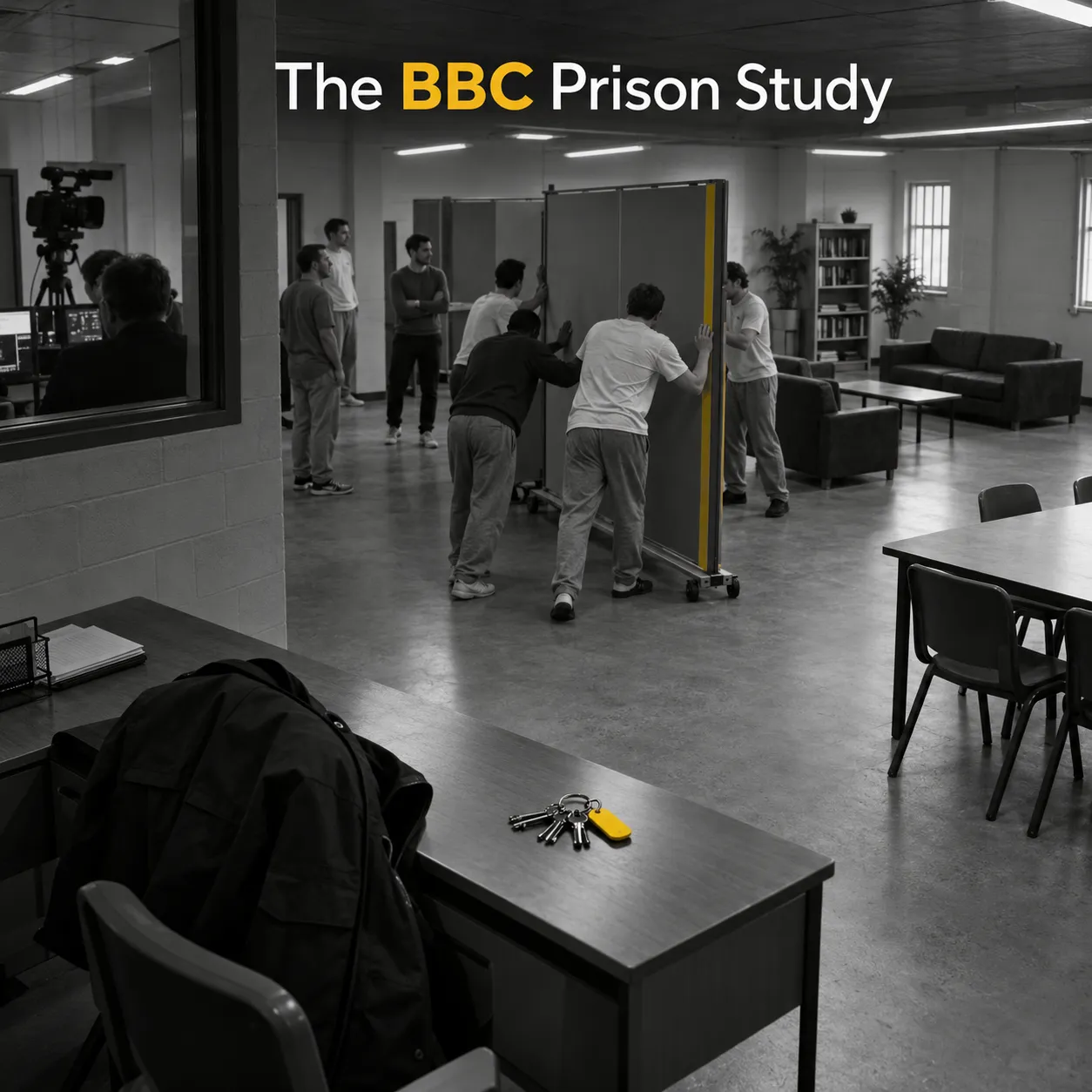
The BBC Prison Study is an eight-day experiment run by Stephen Reicher and Alexander Haslam, filmed in December 2001, broadcast by the BBC in 2002 and published in 2006 in the British Journal of Social Psychology. Men were randomly assigned to be guards or prisoners in a purpose-built setting. The guards did not come to identify with their role, were reluctant to use their authority and were eventually overpowered by the prisoners. It is the nearest thing to a replication of the Stanford Prison Experiment, and it did not reproduce that study's outcome. The two sides of the dispute read it differently, and this page sets out both.
What it is
Reicher and Haslam designed the study to ask when people come to identify with the group they have been assigned to, and what follows when they do or do not. The 2006 paper reports the result in a single long article (British Journal of Social Psychology, 45(1), 1-40). The study was filmed in December 2001 and broadcast by the BBC in 2002; Nature reported the filming in May 2002. Robert Sapolsky dates the study to 2001 and notes that the paper appeared five years later (Behave, p. 467). Accounts that give 2002 are dating the broadcast.
The comparison with Stanford is the reason the study matters. In the Stanford experiment the guards were briefed by the research team on the aim of producing powerlessness, according to the archive (Le Texier, 2019). In the BBC study the guards were given no such instruction on how to behave. The same question was put to a different design: what happens when a prison is staffed by assigned guards and assigned prisoners and nobody tells the guards to be tough.
In effect
The authors report that the guards did not identify with their role. They were reluctant to use authority, and the prisoners eventually overpowered them and set up an egalitarian system. That system proved unworkable, and a harsher regime was then imposed. The prisoners offered only weak resistance to it. From this sequence Reicher and Haslam propose a framework in which powerlessness and the failure of groups make tyranny seem psychologically acceptable. On their reading, cruelty does not follow from the assignment of a role. It follows from how groups form, fail and are led.
Sapolsky gives a fuller account of the sequence and reads it in another way. Prisoners organised and resisted, their morale rose, the guards became demoralised and divided, and the hierarchy collapsed into a power-sharing commune. A small group then overthrew the commune and imposed a draconian regime, and those participants had scored highest on authoritarianism before the study began. He writes that this "suggests bad apples rather than bad barrels" (Behave, p. 468), and he compares the sequence to the French and Russian revolutions, in which a hierarchy collapses into a commune and a harsher order takes over (pp. 467-468). On his reading, the study shows the weight of disposition, a reading that sits closer to the self-selection finding of Carnahan and McFarland (2007) than to Reicher and Haslam's own.
The two readings are not equally supported by the same evidence. The authors' reading rests on how the participants identified with their groups. Sapolsky's rests on pre-study scores of a few participants who ended up running the final regime. A study with this design can show that the 1971 outcome did not recur without instruction. It cannot, on its own, decide between leadership and disposition as the cause of what happened instead.
What it does not say
It does not show that the Stanford results are invalid. It does not show that people never become cruel under a role. It is one study, with a single group of men over eight days, and Sapolsky observes that Zimbardo's study has had only one attempted replication in the literature, which is this one (Behave, pp. 466-467).
It also sits inside an active debate. The statement of 28 August 2018, signed by Philip Zimbardo and Craig Haney as well as by Alexander Haslam and Stephen Reicher, agrees that the new information suggests traditional accounts understate how much the experimenters intervened and that people may not slip into roles as easily as once thought. The same statement asks for open and respectful debate that stays with ideas. Zimbardo and Haney continue to argue for the power of dehumanising environments. Where the two groups disagree, this page does not adjudicate.
The practical use of the BBC Prison Study is as a counterweight. A claim that a role alone produces cruelty has to explain why guards without instruction did not behave as the Stanford guards did.
Sources
- Reicher, S., & Haslam, S. A. (2006). Rethinking the psychology of tyranny: The BBC Prison Study. British Journal of Social Psychology, 45(1), 1-40. https://doi.org/10.1348/014466605X48998 (summary read from the University of St Andrews research portal record, 2026-10-25).
- Adam, D. (2002, 16 May). Reality TV show recreates famed social study. Nature, 417, 213. https://doi.org/10.1038/417213a
- Sapolsky, R. M. (2017). Behave. Penguin Press. Pages 466-468 of the Vintage 2018 edition.
- Carnahan, T., & McFarland, S. (2007). Personality and Social Psychology Bulletin, 33(5), 603-614. https://doi.org/10.1177/0146167206292689
- Le Texier, T. (2019). American Psychologist, 74(7), 823-839. https://doi.org/10.1037/amp0000401
- University of St Andrews (28 August 2018). Researchers call for open and respectful debate around Stanford Prison Experiment.