The Bystander Effect
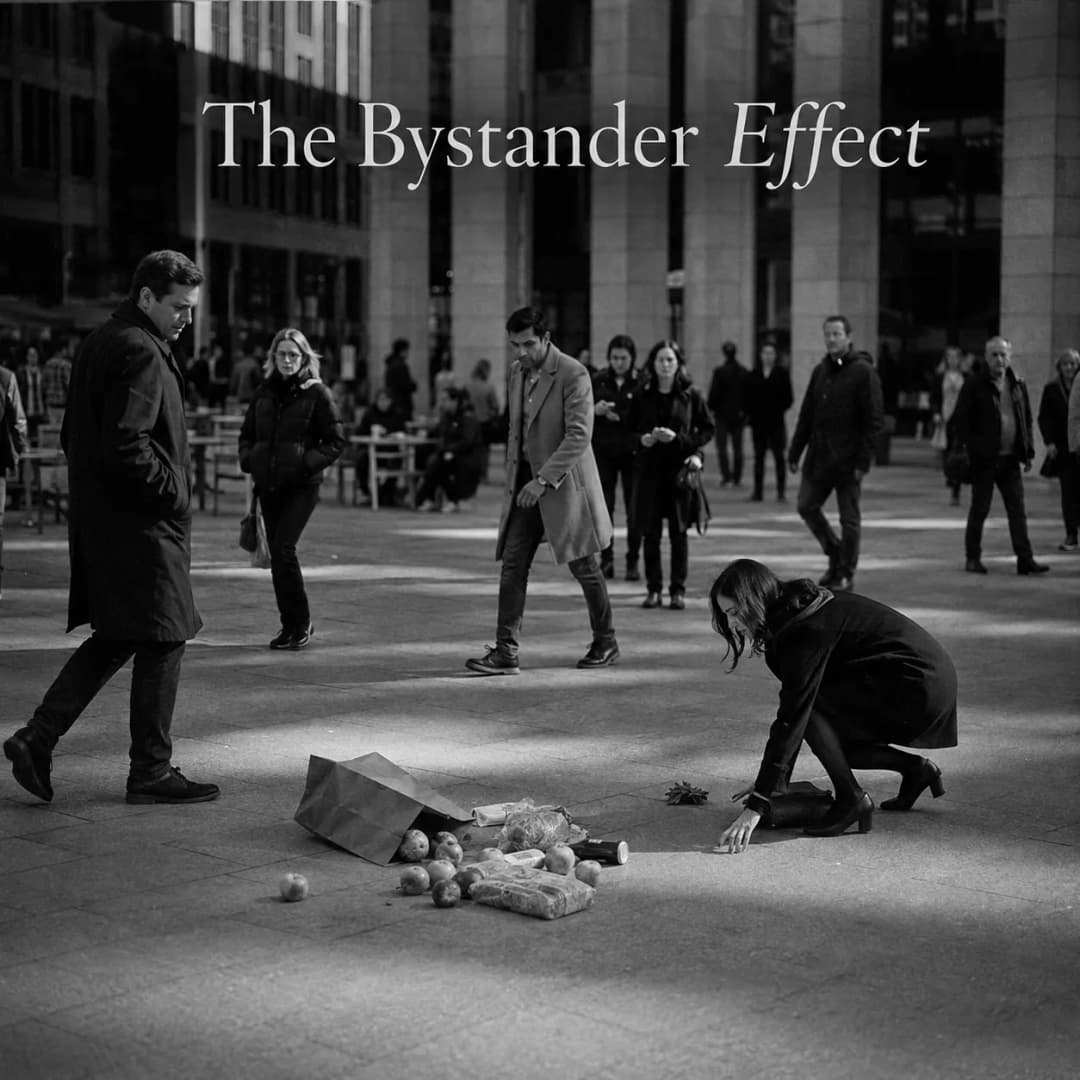
The bystander effect is the finding that the more people present at an emergency, the less likely any one of them is to help. John Darley and Bibb Latané established it experimentally in 1968 and the laboratory work is sound. The field version does not behave the same way. Philpot and colleagues coded CCTV of 219 real public conflicts in 2020 and found someone intervened in nine out of ten, with more bystanders making intervention more likely rather than less.
What it is
Darley and Latané's experiments are good experimental psychology and the effect they found is real. Put one person alone with a staged emergency and they act. Add bystanders and the probability that any given individual acts falls. Two mechanisms were proposed for it: responsibility diffuses across the group rather than concentrating on one person, and everyone reads everyone else for a cue about whether the situation is serious, which produces a room full of people each taking their calm from the next person's calm. The finding replicated and entered every textbook.
What travelled with it was the story of the 38 witnesses to Kitty Genovese's murder, which was false while the experiment was sound. That is dealt with separately on The Parable of the 38 Witnesses, and it is worth keeping the two failures apart. The parable was a fabrication. The effect is a real laboratory phenomenon whose reach was overstated.
The evidence that reset the reach is Philpot, Liebst, Levine, Bernasco and Lindegaard's 2020 paper in American Psychologist. They went to the video. Their analysis covers CCTV recordings of 219 public conflicts in the entertainment and business districts of Amsterdam, Cape Town and Lancaster, three cities that differ sharply in how safe their public spaces are perceived to be. Someone intervened in nine out of ten incidents, usually more than one person. The rate held across all three countries. And a greater number of bystanders present was associated with a greater likelihood that somebody stepped in, which reverses the effect as it is taught.
Both results stand, and the reconciliation is arithmetic rather than a contradiction. The laboratory measured the probability that a given individual acts. The street measures the probability that anybody does. Each additional bystander may be individually less likely to move while the group as a whole becomes more likely to contain someone who will. Nothing in the CCTV data refutes Darley and Latané; it answers a different question, and it is the question a person on the ground actually has.
The field study has its own limit, and it is a serious one. The footage records outcomes and nothing about the people. The coders could see how many people were present, what the conflict looked like and who moved. They could not see who had been drinking, who knew the parties, who worked security for a living, or who had done this before. Any of those would explain intervention without needing a disposition at all, and a nightlife district at two in the morning is full of professional obligation and prior acquaintance. So the honest position after Philpot is that intervention is common and unexplained. Something distinguishes the person who moves from the person standing beside them who does not, and the design cannot say what. The oldest candidate for that something has a name, Courage, and psychology has been shy of it.