The Dark Triad
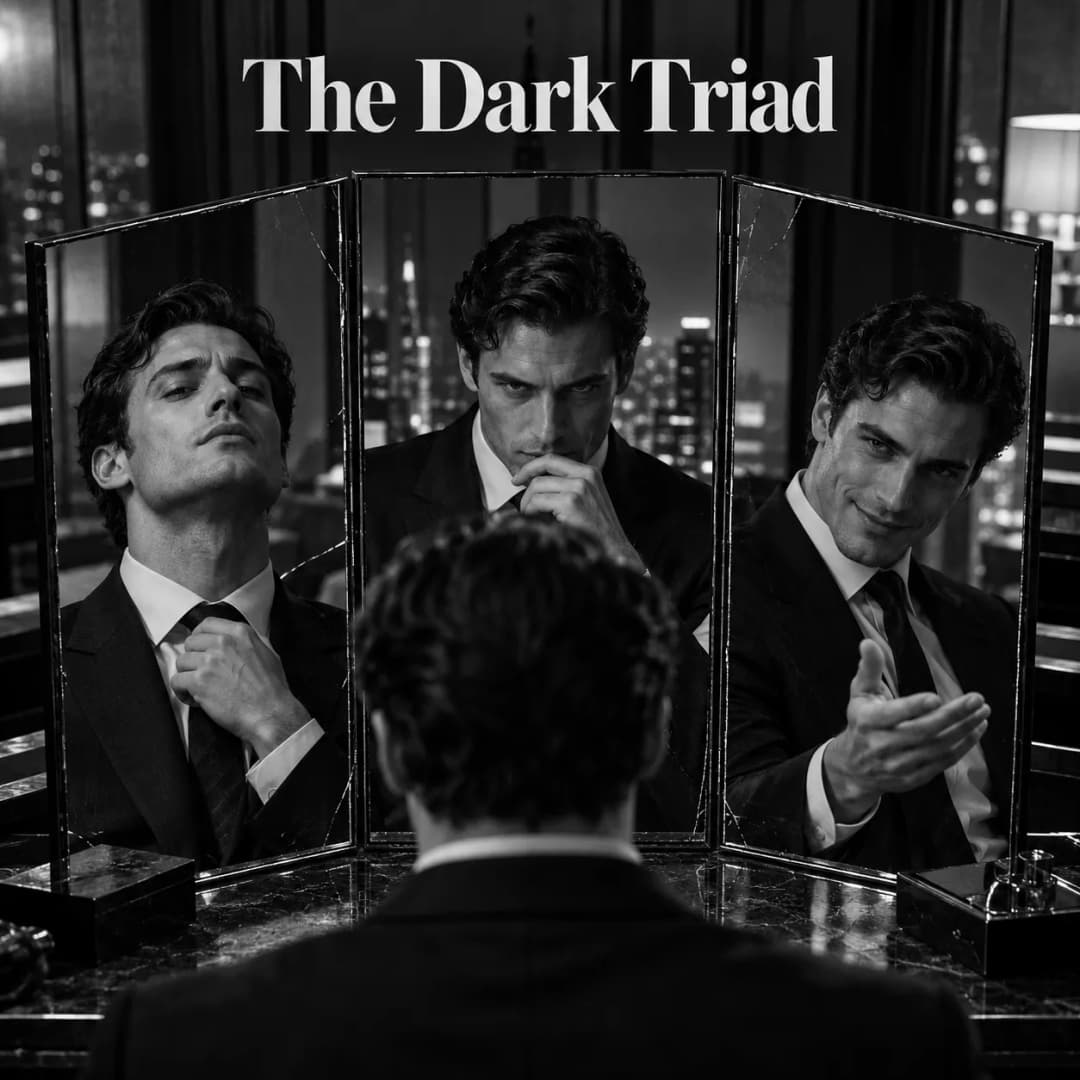
The dark triad groups three socially aversive personality traits, narcissism, Machiavellianism and psychopathy, as one subclinical construct because they overlap heavily and tend to travel together in ordinary, non-clinical people. Delroy Paulhus and Kevin Williams proposed it in 2002. The grouping is a claim about measurement rather than a diagnosis. The original three have a real literature; the later expansions to four and five traits have not been shown to earn their place, which is why this page is marked mixed.
What it is
These are dimensions on which everyone sits somewhere, not conditions a person has or does not have. Machiavellianism is the odd one out of the three, because unlike the other two it was never a clinical syndrome to begin with.
The construct exists because Paulhus and Williams noticed the overlap and asked whether three separate literatures were studying one thing. Their paper appeared in the Journal of Research in Personality in 2002. That same question has since been asked of the triad itself, by people who think the answer is no.
The picture the construct is meant to capture is familiar from any organisation. A high performer who is charming in the room, ruthless outside it, and genuinely convinced they are the most capable person in the building. Nothing here is clinical and nobody is diagnosable, but the pattern is stable enough to measure and it predicts how the person behaves when the incentives get sharp. That is the appeal of a subclinical construct to organisational psychology, and it is also why the category keeps expanding: every new bad-behaviour cluster somebody names looks like it might deserve its own letter.
The lineage runs from the Cluster B personality disorders of the diagnostic manuals, through Robert and Joyce Hogan's working-against-people cluster, to the triad, then a dark tetrad adding sadism, then a dark pentad adding spitefulness, the last credited to Monteiro and colleagues in 2022.