The Ellsberg Urn Problem
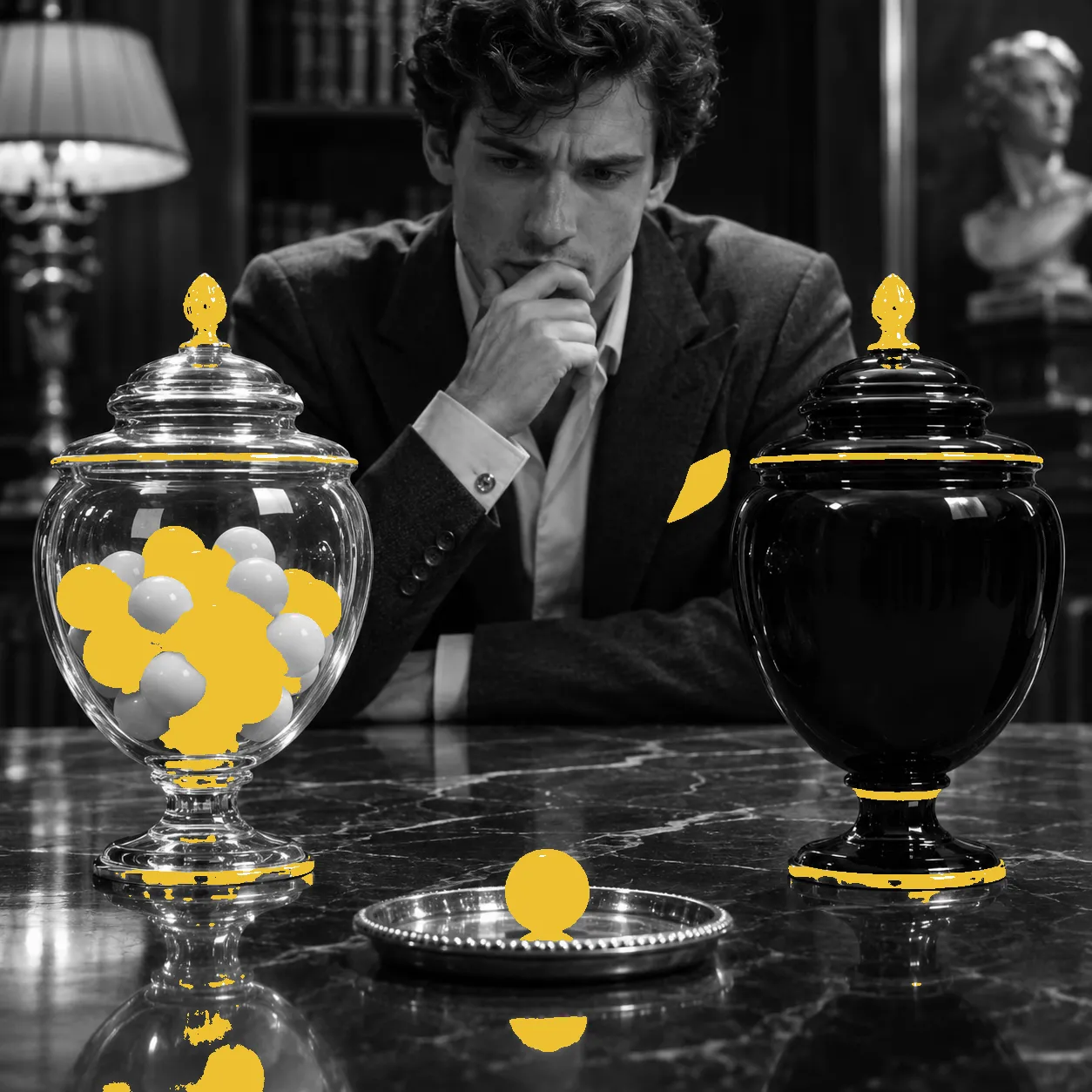
A choice between bets on urns with known and unknown mixes of coloured balls.
What it is
In the two-urn version, one urn holds an even mix of two colours and the other an unknown mix, and most people bet on the known urn. In the three-colour version, an urn holds ninety balls, thirty red and sixty black or yellow in unknown proportions; most people prefer a bet on red to one on black, and a bet on black or yellow to one on red or yellow.
In effect
In the article on ambiguity aversion, the urn problem is the classic demonstration, stated as a finding before the explanations.
What it does not say
It does not show that people are careless with probability; the point is that the usual choices cannot be described by any single set of probabilities.
Sources
- Ellsberg, D. (1961). Risk, ambiguity, and the Savage axioms. The Quarterly Journal of Economics, 75(4), 643-669.
- Machina, M. J., & Siniscalchi, M. (2014). Ambiguity and ambiguity aversion. In Handbook of the Economics of Risk and Uncertainty, 729-807.