The Five Pillars of Mental Toughness
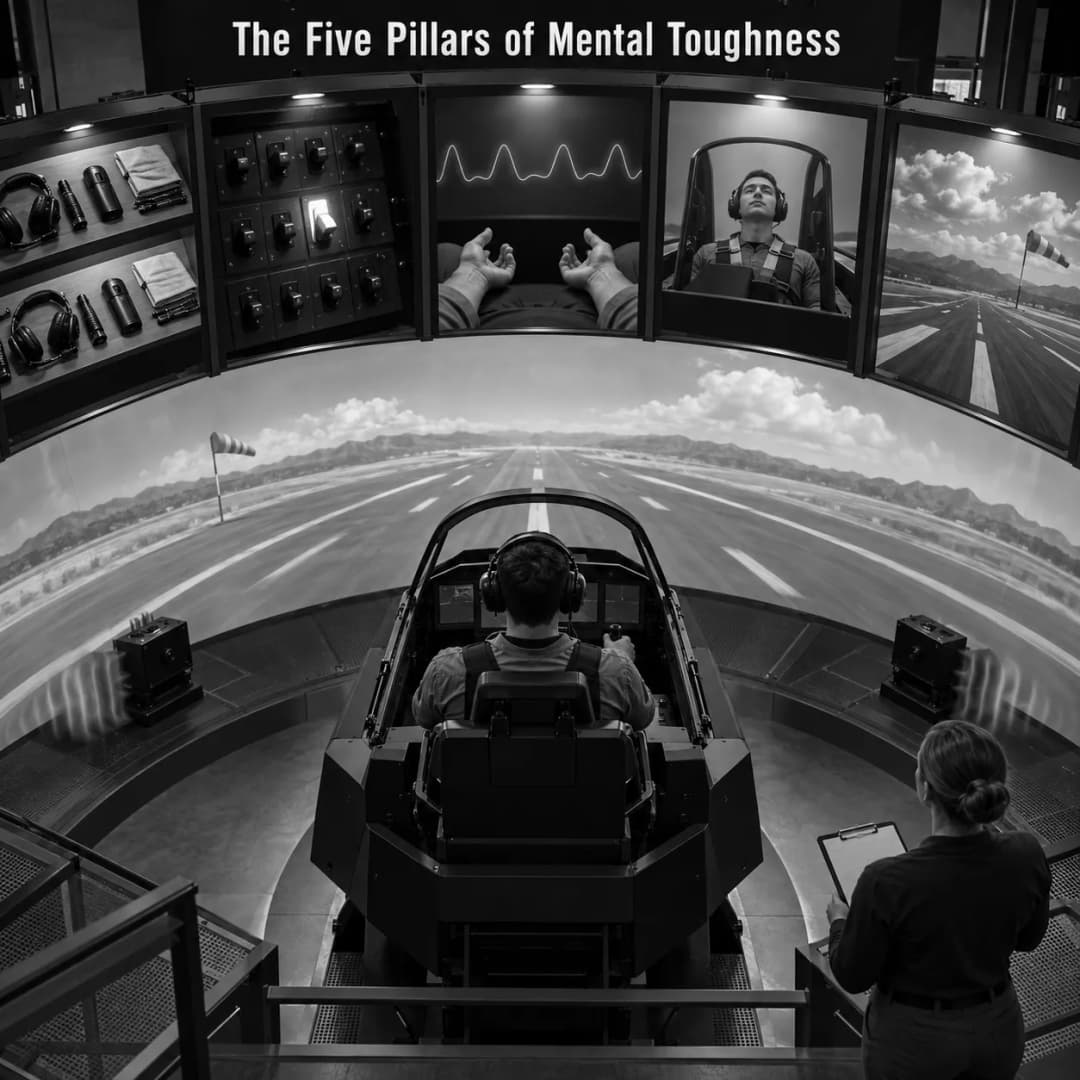
The five pillars of mental toughness are a United States Air Force pilot-training syllabus, described from the inside by Hasard Lee in The Art of Clear Thinking: preparation practised to reflex, focus on the next controllable decision, calming body and mind chiefly through breath control, building confidence through internal dialogue, and multisensory rehearsal. It is an institutional training programme, not a research finding, and the chapter it appears in is the worst-sourced in its book. Nothing on this page is offered as evidence that the programme works.
What it is
The programme was built to replace an older and harsher training culture, and it was run first as a live experiment at one training base.
What can be said with confidence is institutional. The programme existed, was trialled at one base, and was adopted across Air Force pilot training and other Defense Department career fields. Its own evaluation is described honestly as tracking against historical data rather than as a trial: emotional regulation improved, the washout rate fell, and average and below-average students gained most. Institutional adoption is a policy decision, not evidence of effect, and the book's phrasing is careful enough on this point to be quoted.
What has to be separated out is borrowed, and it sits on the same pages. The first pillar's maxim, that we do not rise to our expectations but fall to the level of our training, is commonly credited to Archilochus and has no source in his surviving fragments; it is a modern military saying. The second pillar's practice is contemplative-tradition mindfulness, which in clinical form belongs to Jon Kabat-Zinn. The third pillar's box breathing is popularised through Navy special-forces training and Mark Divine, and the mechanism given for it rests on the triune brain model, which is superseded. The fourth pillar's reframing is cognitive restructuring, which belongs to Aaron Beck. The fifth is credited, uniquely in the chapter, to Second World War aviators. Not one researcher is named anywhere.
In effect
There is one genuinely good sentence in the chapter and one genuinely frustrating one, and they are the same sentence. The syllabus, it says, was built by looking for overlap between accumulated pilot lore and modern cognitive-performance research, and where the two agreed the designers had higher confidence that a principle worked. That is sound method, better than most books of this kind manage. And the research half is never identified, by field, by name or by paper, so the triangulation described cannot be repeated by anybody, including its author.
The protocols in that chapter are quarantined here and should not be carried into anything. Box breathing at five counts each for five minutes and triangle breathing are given with exact counts and no caution of any kind in a mass-market book. Thirty minutes of daily meditation is given as a derived optimum with no data. Nasal-breathing superiority is asserted as settled physiology. And thought-suppression advice, which is sound inside a cockpit for the length of a sortie, is offered without the distinction that the literature suggests suppression backfires as general advice for anxiety. The book draws no line between the cockpit case and the general one.
The author's own hedges are recorded fairly, because they are better than the chapter around them. He says the techniques were not fully effective and were not a replacement for preparation; that mental training is not a substitute for the underlying skill; that what matters is not a specific breathing pattern; and that some pilots are predisposed to handle emotion better than others.
What it does not say
It is not a research claim and no part of this page should be read as one.
It does not show the programme works. The evaluation compared cohorts against historical data with no control group, and no published evaluation was found.
It does not make adoption into evidence. Being taken up across a service is a policy decision.
It does not own its components. Cognitive restructuring belongs to Beck, mindfulness-based practice to Kabat-Zinn, and mental rehearsal to the imagery and mental-practice literature, which is broadly supportive. Each should be cited to its own source and never to this chapter.
It does not carry a dose. The breathing counts and meditation durations in that chapter are quarantined here, and the health and safety standard applies to anything written from them.
Sources
- Lee, H. (2024). The Art of Clear Thinking. Pp. 210 to 216 for the five pillars; p. 210 for the lore-and-research triangulation; pp. 212 to 214 for the protocols, which are quarantined; pp. 216 to 217 for the uncontrolled evaluation; p. 217 for adoption. Origin of the method described at pp. 194 to 195. The chapter carries three bibliography entries.
- Attribution correction, verification pass 2026-09-25: the maxim about falling to the level of your training has no source in Archilochus's surviving fragments and should be treated as a modern saying.
- The borrowed components, to be cited to their own literatures: Beck, A. T., on cognitive restructuring; Kabat-Zinn, J., on mindfulness-based practice; the imagery and mental-practice literature on rehearsal. The triune brain model behind the breathing rationale is superseded. None read here.