The Fundamental Attribution Error
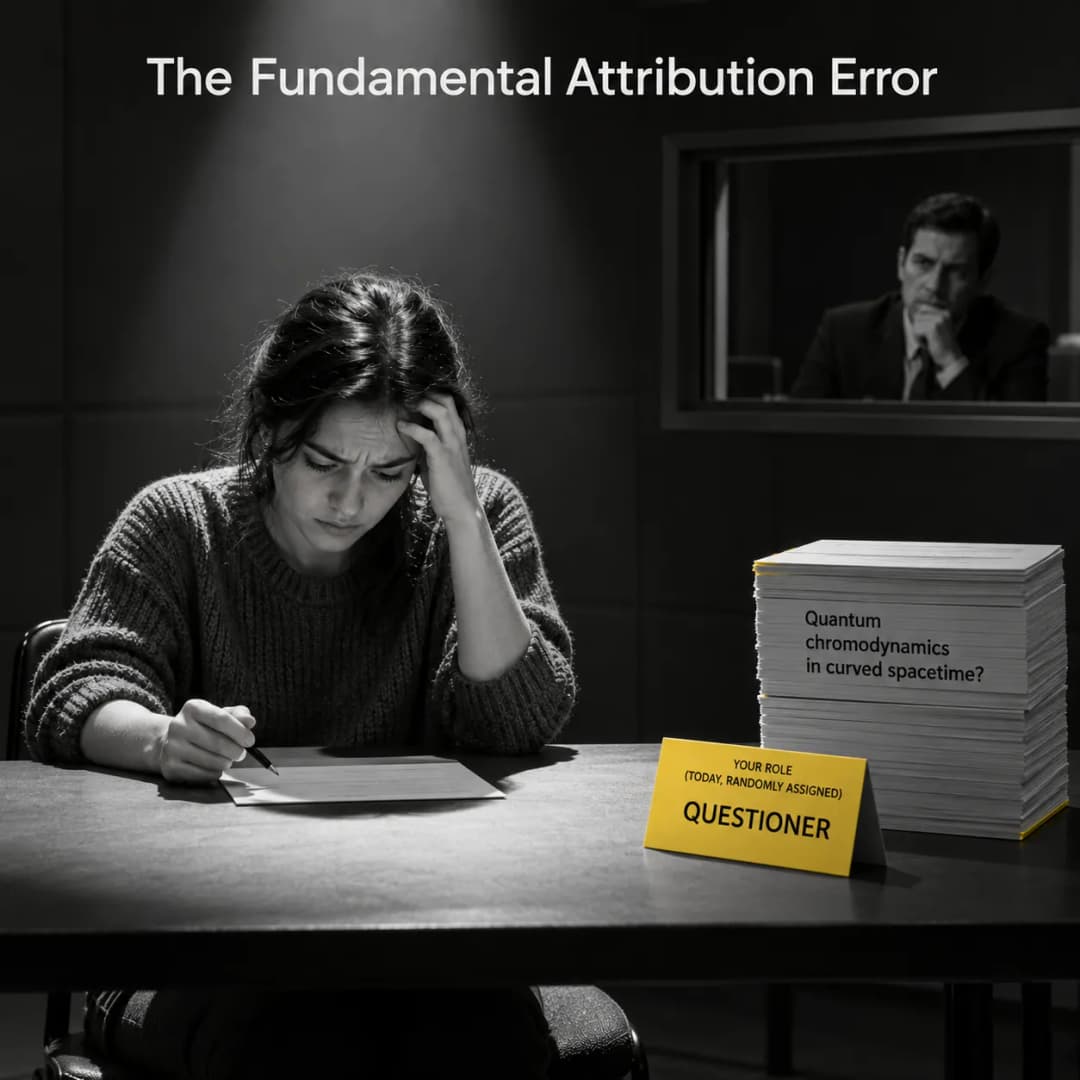
The fundamental attribution error is the tendency to explain what someone did by what they are like, and to underrate the situation that produced the behaviour. The finding behind the name comes from a 1967 study in which readers inferred a writer's attitude from an essay even when the writer had been assigned the position. Lee Ross named the error in 1977, and in the same year Ross and two colleagues showed it in a quiz game with randomly assigned roles. The research supports a narrow pattern that has been demonstrated repeatedly. It does not support the popular slogan that people always blame character and ignore circumstances, and the pattern is weaker in at least one Japanese sample.
What it is
The first demonstration is Edward Jones and Victor Harris's 1967 paper, "The attribution of attitudes". Readers were given essays for or against Fidel Castro and asked what the writer really believed. When the writer had chosen the position freely, readers inferred that he held it. When a debate coach had assigned the position, readers still drew attitude inferences, weaker ones, from behaviour the writer had not chosen. That is how Gilbert and Malone describe the study in their 1995 review.
Ross gave the pattern its name in "The intuitive psychologist and his shortcomings" (1977). In Gilbert and Malone's account, Ross used the term for the tendency to underestimate how much situations shape behaviour, and he argued that it afflicted social psychologists and their research subjects alike.
Gilbert and Malone prefer the term correspondence bias. They define it as drawing inferences about a person's stable dispositions from behaviour that the situation can fully explain. The two names do different work. The older one carries a claim about cause, that situations are underrated. The newer one describes the inference and leaves the cause open. The vault uses both, and treats them as one pattern.
Their review also offers a mechanism. Observers first draw a dispositional inference, which is fast and takes little effort. They then check whether the situation would have produced the behaviour, and correct the inference if it would. The error is what remains when the correction is incomplete or skipped. The review lists four mechanisms in all, one of which is that knowing about a situation can change how the behaviour itself is perceived.
In effect
The clearest everyday-sized demonstration is the quiz game of Ross, Amabile and Steinmetz (1977). Pairs of students drew cards to decide who would be questioner and who contestant, so the assignment was visibly random. Questioners wrote ten difficult questions from their own specialist knowledge, and contestants were usually unable to answer many of them. Both players then rated their own and their partner's general knowledge against the average Stanford student. Contestants rated themselves well below their questioners and rated their questioners well above average. In a second experiment, 48 observers who watched simulated replays of the sessions also rated the questioners far above the contestants. A written quiz given to everyone afterwards showed that the two roles scored about the same.
Culture changes the size of the effect. Miyamoto and Kitayama (2002) found that Americans attributed an essay's position to its writer even when the essay was unpersuasive and the writer had been socially constrained, and that Japanese participants did so less strongly. In their 2018 commentary on the Many Labs 2 project, they report that the original finding replicated: the American sample of 1,586 people showed more correspondence bias than the Japanese sample of 75, a medium-to-large gap. They also note that the project's own headline comparison, between Western and less Western samples, found no difference, and they argue that this comparison blurs real cultural variation. The Japanese sample was small.
The idea has travelled into applied writing. Richard Shotton's The Choice Factory uses it as Bias 1 and draws the lesson that brands need target contexts as much as target audiences. Malcolm Gladwell's The Tipping Point (2000) names it at p. 160 and builds a chapter on the claim that context outweighs character. Bobby Duffy's Generations (p. 32) applies it to blaming the young; the vault treats that application as Duffy's interpretation.
What it does not say
It does not say that character is irrelevant. The claim is about how observers explain behaviour, and Gilbert and Malone are careful about scope: incomplete correction need not produce the bias, ignoring a constraint can sometimes yield an accurate inference, and they say they cannot tell how often the bias occurs.
It does not say that people explain themselves by the situation and others by character. That is the actor-observer asymmetry, a separate claim. Bertram Malle's 2006 meta-analysis of 173 studies found its average effect close to zero.
It does not say that famous situational experiments demonstrate the error. The Good Samaritan study, in which hurry rather than religious motive tracked who stopped, tests what people did, not what observers concluded about them. It also comes from a single study, and this site has not assessed whether it has been replicated.
It is not shown to be universal. The vault's evidence status is robust for the attitude-attribution paradigm, with the cultural qualification above, and the word "fundamental" is the part of the name with the weakest support.
Sources
- Jones, E. E., & Harris, V. A. (1967). The attribution of attitudes. Journal of Experimental Social Psychology, 3(1), 1-24. doi:10.1016/0022-1031(67)90034-0
- Ross, L. (1977). The intuitive psychologist and his shortcomings: Distortions in the attribution process. Advances in Experimental Social Psychology, 10, 173-220. doi:10.1016/S0065-2601(08)60357-3
- Ross, L. D., Amabile, T. M., & Steinmetz, J. L. (1977). Social roles, social control, and biases in social-perception processes. Journal of Personality and Social Psychology, 35(7), 485-494. doi:10.1037/0022-3514.35.7.485
- Gilbert, D. T., & Malone, P. S. (1995). The correspondence bias. Psychological Bulletin, 117(1), 21-38. doi:10.1037/0033-2909.117.1.21
- Miyamoto, Y., & Kitayama, S. (2002). Cultural variation in correspondence bias. Journal of Personality and Social Psychology, 83(5), 1239-1248. doi:10.1037/0022-3514.83.5.1239
- Miyamoto, Y., & Kitayama, S. (2018). Cultural differences in correspondence bias are systematic and multifaceted. Advances in Methods and Practices in Psychological Science, 1(4), 497-498. doi:10.1177/2515245918817076
- Malle, B. F. (2006). The actor-observer asymmetry in attribution: A (surprising) meta-analysis. Psychological Bulletin, 132(6), 895-919. doi:10.1037/0033-2909.132.6.895