The Good Samaritan Study
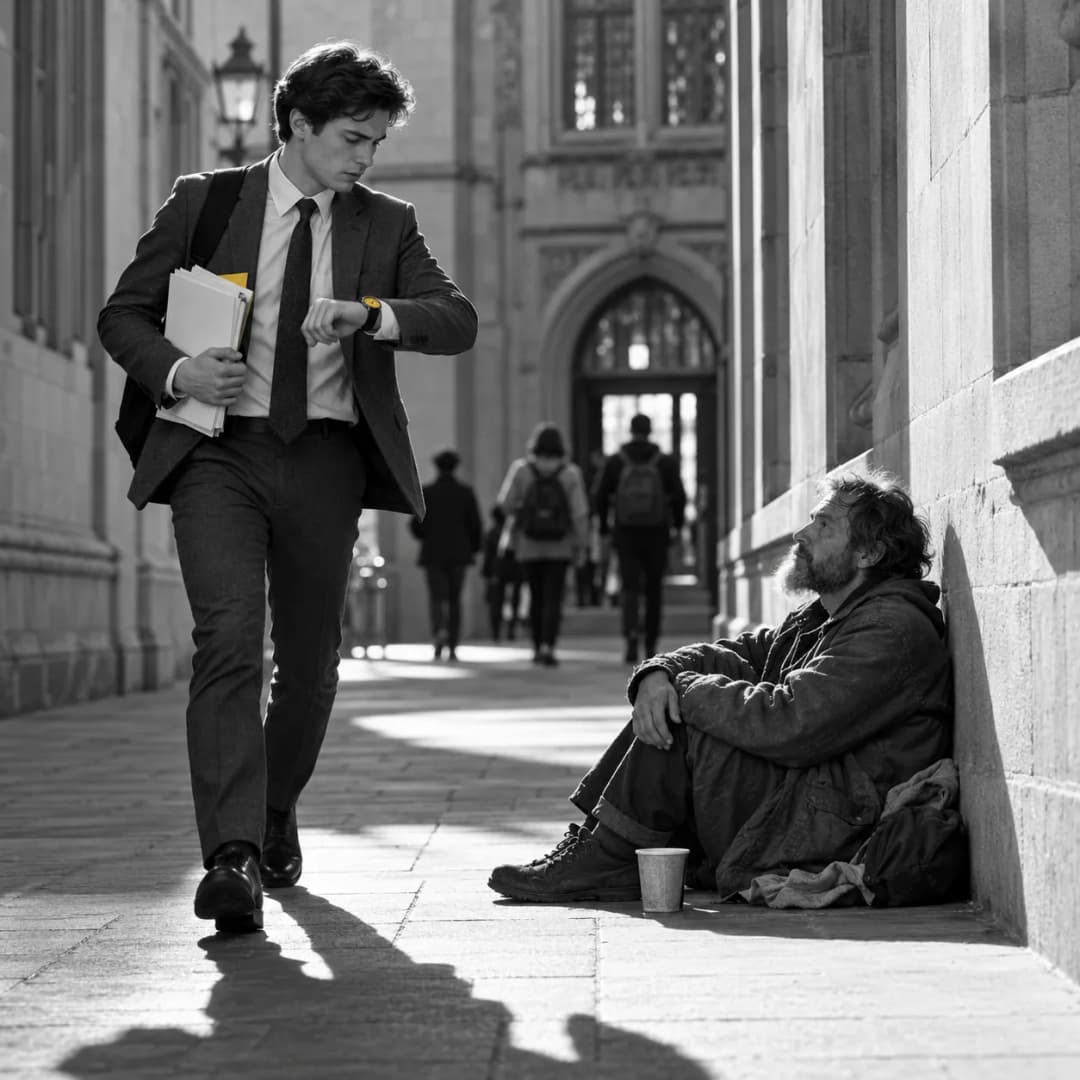
The Good Samaritan study is a 1973 experiment by John Darley and C. Daniel Batson in which people walking between two buildings met a shabbily dressed person slumped by the road. According to the paper's abstract, those in a hurry were more likely to pass without stopping, while the topic of the talk they were about to give made no significant difference. The study is widely used to show that situations shape helping, and this site treats it as a result about behaviour, not about how observers judge other people.
What it is
The paper is "From Jerusalem to Jericho: A study of situational and dispositional variables in helping behavior", published in the Journal of Personality and Social Psychology in 1973 (27(1), 100-108). Its abstract describes an emergency suggested by the parable of the Good Samaritan. Some participants were about to give a short talk on the parable and others a talk on a topic with no helping theme, and this made no significant difference to whether they helped. Religious personality variables did not predict who helped, although the character of the help given was related to type of religiosity.
Malcolm Gladwell tells the study in The Tipping Point (2000, pp. 163-165) as a story of seminary students who passed a slumped, groaning man on the way to give a talk. The seminary setting, the participant count and the percentages in each condition are not in the abstract, and this page does not give them.
In effect
The study is the standard illustration of situational power over helping, and Gladwell uses it in The Tipping Point to argue that context outweighs character. It sits in the same tradition as the bystander experiments associated with John Darley and Bibb Latane, and it appears in the vault's treatment of the power of context.
Its link to the fundamental attribution error is looser than it is usually made to seem. The error concerns the inference an observer draws about another person from constrained behaviour. In the Good Samaritan design the participants were measured on what they did, and nobody was asked what they concluded about a passer-by. It shows that a situational variable moved behaviour, and it leaves the observer's misjudgement untested. Designs such as the Castro essays of Jones and Harris and the quiz game of Ross and colleagues measure the inference itself.
What it does not say
This page rests on the paper's abstract, not its full text. Secondary accounts disagree on basic details, including the number of participants, so none is given here, and the percentages that circulate for the hurried and relaxed groups are not used.
The dispositional result, that religious personality variables did not predict helping, comes from one study, and nobody here has assessed whether it has been replicated. Gladwell presents the study as proof that context beats character. As an illustration of a hurry effect it is vivid. As a measure of how far character matters it is limited by being a single study.
Sources
- Darley, J. M., & Batson, C. D. (1973). "From Jerusalem to Jericho": A study of situational and dispositional variables in helping behavior. Journal of Personality and Social Psychology, 27(1), 100-108. doi:10.1037/h0034449 (abstract read)
- Gladwell, M. (2000). The Tipping Point. Little, Brown, pp. 163-165.