The Habit Share
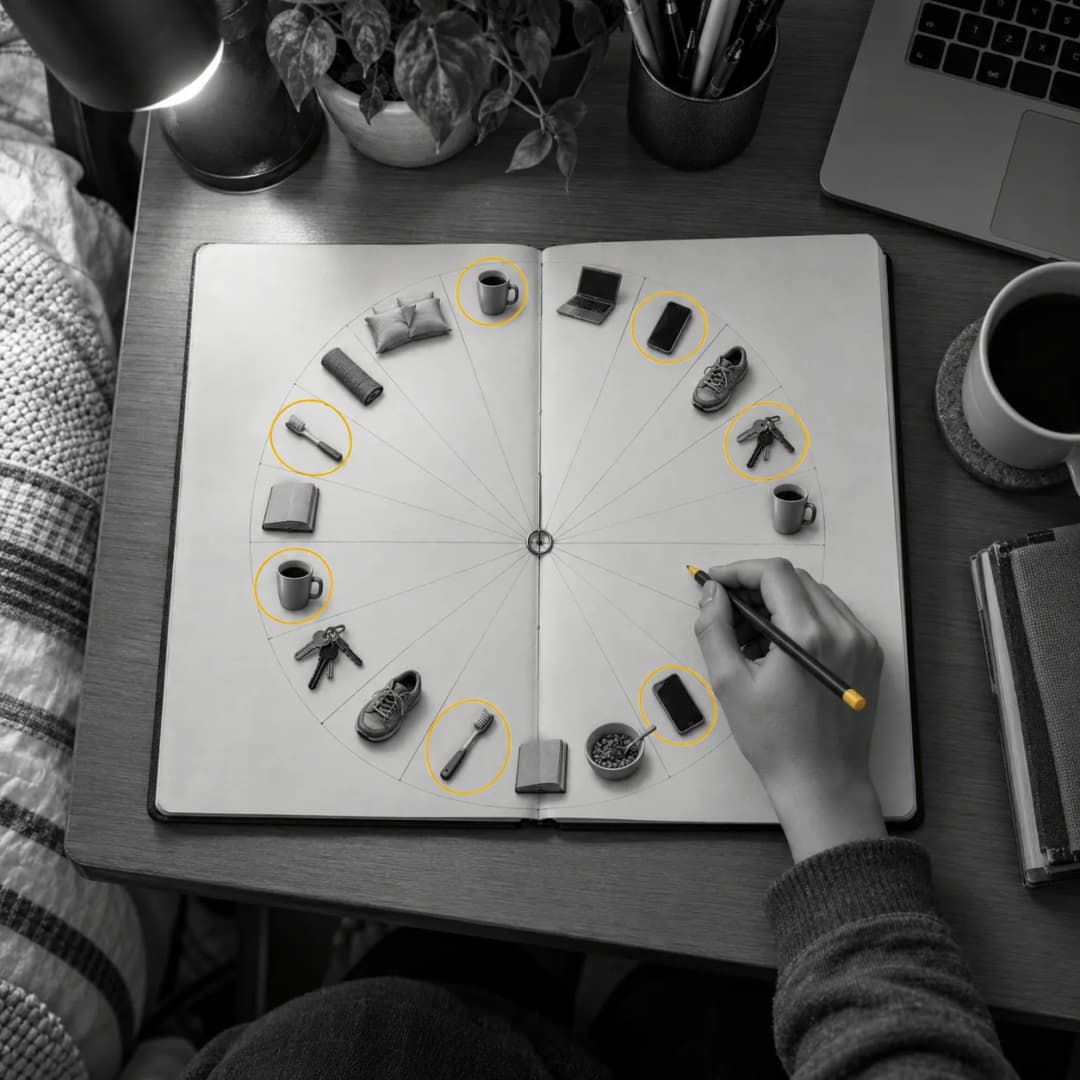
The habit share is the proportion of everyday behaviour held to run on habit, and the number everyone quotes is forty-three per cent. It comes from Wendy Wood, Jeffrey Quinn and Deborah Kashy's 2002 diary studies, where it is the share of hourly entries in the second of two studies, logged by 209 Texas A&M undergraduates over two days. A behaviour counted as a habit if the student reported doing it just about every day and usually in the same place. The first study, same campus, gave thirty-five per cent.
What it is
The figure has a precise origin. Wood, then at Texas A&M and now Provost Professor of Psychology and Business at the University of Southern California, ran two signal-contingent diary studies with Quinn, also at Texas A&M, and Kashy, at Michigan State University. A programmed wristwatch chimed on the hour while participants were awake. They wrote into a pocket booklet what they were doing at that moment, as it happened, rather than recalling it at the end of the day. Nineteen participants in the first study and sixteen in the second were excluded for filling the form in wrongly or retrospectively.
Study 1 ran on seventy undergraduates for one day and asked for the single behaviour at each chime. It gave thirty-five per cent. Study 2 ran on 209 undergraduates on the same campus for two days and asked for every behaviour at each chime. It gave forty-three per cent, with a chi-square of 14.34 on 6,830 entries. The authors explain the gap themselves, and the explanation is about instrument design rather than about habit: asking people to list several behaviours encouraged them to include more of the small routine business a single-answer booklet leaves out. The eight-point difference between the two most-quoted numbers in habit research is a difference between two diary forms.
The criterion is the part that is almost always dropped. In the published paper, habits were defined in the analyses as behaviours participants reported performing just about every day and usually in the same location. Frequency was a three-point rating and location stability a three-point rating. Repetition and place, and nothing else. The mind-wandering clause the figure now travels with is in the paper, but on the other side of the ledger: whether a person's thoughts matched what they were doing was coded as an outcome by two raters, who agreed on eighty-four per cent of the first study's behaviours and eighty-nine per cent of the second's. For habitual behaviour in Study 2, thoughts failed to correspond fifty-one per cent of the time against forty-four per cent corresponding, which is close to a coin toss. The paper's own conclusion is that the habitual mode of behaviour regulation is best characterised by minimal or sporadic cognitive monitoring and not by the complete absence of thought.
The authors' own use of the number also runs opposite to its reputation. They deploy it against an earlier speculation that some ninety-five per cent of daily behaviour is thoughtless, and warn in print that a student sample, heavy with study and novel activity, probably makes their estimate a lower bound. A figure minted as a deflation now circulates as an indictment.
What the sample was doing matters as much as how much of it was habitual. In Study 2, a third of all logged behaviour was coursework and one per cent was paid work. The domain table, given as share of all entries and then share habitual, reads: school work 32 and 32, entertainment and information 14 and 54, social interaction 10 and 47, eating and drinking 7 and 46, hygiene and appearance 4 and 88, transport 4 and 58, sleeping and waking 3 and 81, exercise 1 and 44, working 1 and 55, cleaning 1 and 21, relaxing 1 and 48. A figure derived from a population whose single largest activity is homework is not a fact about adult life, and the authors never claimed it was.
There is one further provenance problem. The trade literature describes three habit-share studies, the third recruited from fitness classes and reported as giving slightly over forty-three per cent across a wide age range. That third study is a Quinn and Wood manuscript which appears to be unpublished, and the 2005 Wood, Tam and Guerrero Witt paper cites it as giving forty-seven per cent. The number that makes the estimate look general rather than student-specific is the one with no published method behind it.
In effect
The two diary forms, and what the gap measures
The cleanest research case is the pair of studies themselves, because they are a natural experiment on instrument design rather than on habit. Same campus, same hourly chime, same criterion of repetition and location. One form asked for one behaviour and produced thirty-five per cent; the other asked for all behaviours and produced forty-three. Nothing about the participants' habits changed between the two. Anybody who quotes forty-three rather than thirty-five has chosen, usually without knowing it, the version of the question that swept in more small routine business. The authors' own headline sentence avoids the problem by giving a range: between a third and a half of all behaviours listed were classified as habits.
The morning commute you cannot describe
In everyday terms the figure is about the journey you took this morning and cannot now account for. On the published criterion, that journey counts as a habit because you make it nearly every day and you make it in the same place, and for no other reason. Whether you were thinking about the road or about a meeting is not what put it in the count. This matters because the moral reading, that nearly half your life is lived by somebody who has stopped paying attention, is not what the measurement supports. Repetition in a stable setting is a mechanism for making an intention cheap to keep, not evidence of a character that has gone slack.
The product team that quotes it in a strategy deck
The figure is a staple of behaviour-change decks, habit-formation apps and retail strategy documents, where it usually arrives as a proportion of a person's day and sometimes as a proportion of their time. It is neither of those: it is a proportion of logged behaviours in a two-day undergraduate diary. A team planning around it is planning around a population whose largest single activity was coursework and whose paid work was one per cent of entries. The useful move for such a team is not to drop the figure but to replace it with the domain row that matches their product, since hygiene ran at eighty-eight per cent habitual and cleaning at twenty-one. The spread between those two rows is larger than the headline, and it is the part that would change a decision.
What it does not say
It does not say that forty-three per cent of your time is habitual. It is a share of logged behaviours, not of minutes, and the two are different quantities.
It does not say that habitual behaviour is thoughtless. Thought correspondence was a measured outcome and came out near even, and the paper explicitly rejects the complete-absence-of-thought reading.
It does not establish a general population figure. Two days, one campus, undergraduates, with a third of logged behaviour being coursework, and the authors stating in print that their estimate is probably a lower bound for the general population rather than a representative value.
It is not updated by the best modern estimate. A 2025 ecological momentary assessment study separates habitual instigation, which starts a behaviour, from habitual execution, which smooths it once begun, a distinction the 2002 studies did not draw. Its figures therefore measure a related but different quantity, and they reach this site only through a university press release rather than the paper, which is why no page is published for that distinction yet.
Who developed it
The measurement is Wendy Wood's, with Jeffrey Quinn and Deborah Kashy, published in the Journal of Personality and Social Psychology in 2002. Wood is the field's leading habit researcher and the author of Good Habits, Bad Habits. The paper itself is careful: it reports both studies rather than the higher one, states its criterion in a single plain sentence, treats mind-wandering as an outcome, and warns about its own sample. The distortion in how the figure circulates belongs to the circulation.
Sources
- Wood, W., Quinn, J. M., & Kashy, D. A. (2002). "Habits in Everyday Life: Thought, Emotion, and Action." Journal of Personality and Social Psychology, 83(6), 1281-1297. doi:10.1037/0022-3514.83.6.1281. Full text read at source.
- Wood, W., Tam, L., & Guerrero Witt, M. (2005). "Changing Circumstances, Disrupting Habits." Journal of Personality and Social Psychology, 88(6), 918-933. The paper that cites the unpublished lifespan manuscript as giving forty-seven per cent.
- Mazar, A., & Wood, W. (2022). "Illusory Feelings, Elusive Habits: People Overlook Habits in Explanations of Behavior." Psychological Science, 33(4), 563-578.
- Rebar, A. L., Vincent, G., Kovac Le Cornu, K., & Gardner, B. (2025). "How habitual is everyday life? An ecological momentary assessment study." Psychology & Health, 41(9), 1507-1532. Article not read; figures from the University of South Carolina press release of 23 September 2025.
- Wood, W. (2019). Good Habits, Bad Habits: The Science of Making Positive Changes That Stick. Farrar, Straus and Giroux. The habit-share passage is at pp. 20 to 24.