The Introspection Illusion
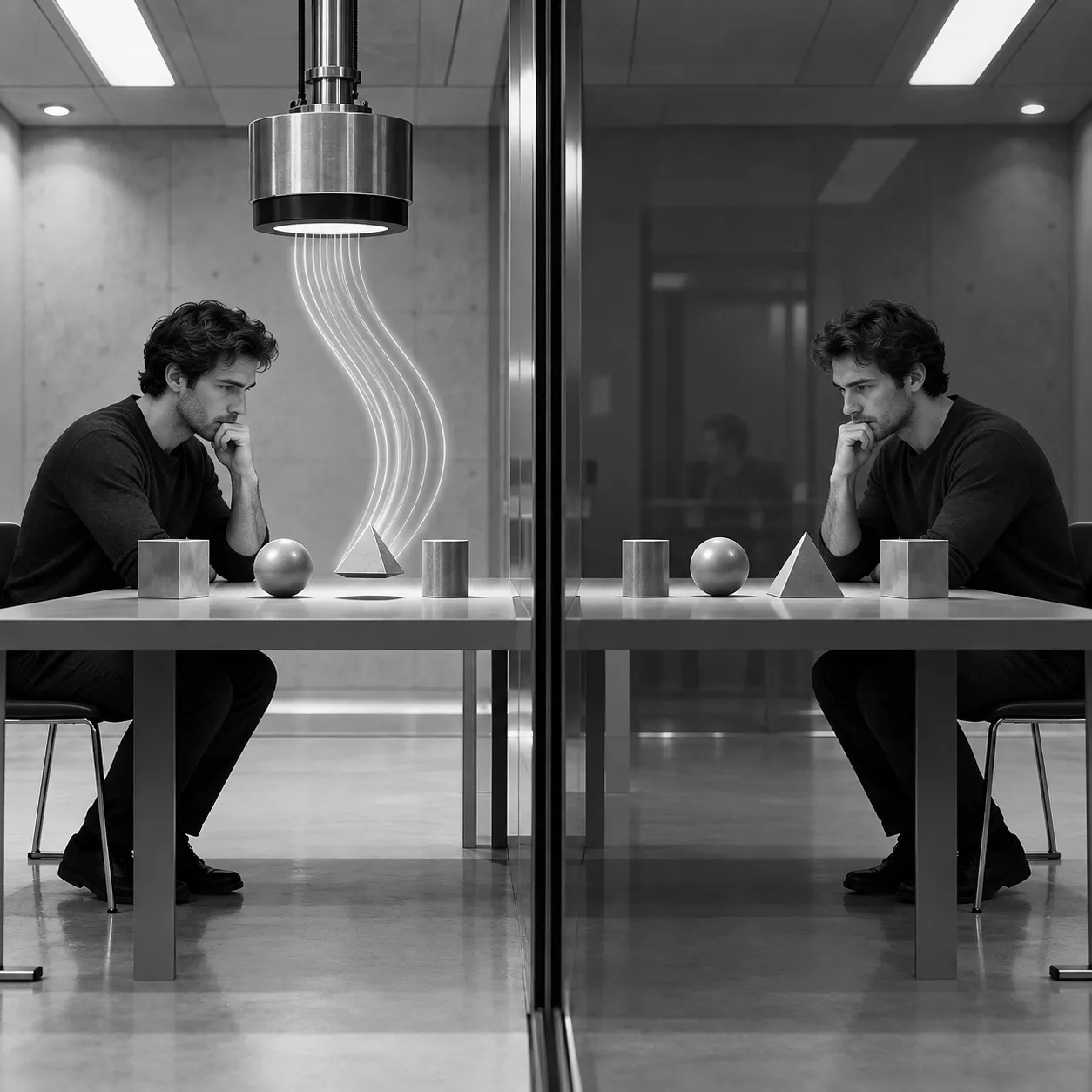
The introspection illusion is Emily Pronin's account of why people judge others to be more conforming than themselves. Her proposal is that people weight introspective evidence heavily when judging their own susceptibility to influence and behavioural evidence when judging somebody else's, so the same person reaches different verdicts about identical conduct. Across five studies, with Jonah Berger and Sarah Molouki in 2007, people rated themselves less susceptible than their average peers and less susceptible than specific peers in specific instances of conformity.
What it is
The asymmetry is about which evidence is available rather than about vanity, because judging yourself you have access to a stream of reasons, intentions and deliberations, none of which mentions the sign on the wall, while judging somebody else you have only what they did, so if influence is invisible from the inside and visible from the outside then one honest procedure applied to two targets produces two different answers. The studies cover areas ranging from consumer purchases to political views, and the authors argue the effect is not simply social desirability. The specific-peer result is the part that makes it more than ordinary self-flattery, since rating yourself above an average peer is unremarkable while watching a particular person in a particular situation and still rating yourself less susceptible than them is not. It is the mechanism half of a pair, because W. Phillips Davison named the pattern in 1983 as the third-person effect, people denying that media influence them while granting that others are influenced, and the introspection illusion is a proposal about why that pattern exists.
In effect
It predicts exactly the shape of Jessica M. Nolan and colleagues' household result, where the message that moved behaviour most was rated least motivating by the households it moved, because if a person's verdict on what moved them is built from introspection and the influence left no introspective trace then the rating and the meter reading come apart without anybody being dishonest. It also predicts the asymmetry in how people discuss advertising, nudges and defaults, since the effect on others is assumed while the effect on oneself is assessed from the inside and found absent. The practical use is to stop treating a self-report of susceptibility as evidence about susceptibility, because it is evidence about what the person can introspect, which is a different quantity and the one they have access to.
What it does not say
It does not establish the mechanism, because what the five studies measure is a difference between self-judgement and other-judgement, which is consistent with the introspective-weighting account without ruling out rivals, so the mechanism is Emily Pronin's proposal and is labelled as hers. The data are self-report throughout, which is the awkward part of a theory about the limits of self-report, since no behavioural measurement sits inside those five studies and the behavioural half of this argument comes from field experiments run by other people on other outcomes. It does not say people have no introspective access, because Adam Morris and colleagues found in 2025, across five studies, that people were often highly accurate about their own choice process, more accurate than a sample of decision scientists predicted and more accurate than informed third-party observers, in a domain of value-based multi-attribute choice rather than social influence, so the two results are not in contradiction and both are on this site. And it is narrower than the sixty-year argument it sits inside, because Richard E. Nisbett and Timothy D. Wilson's 1977 claim was that there may be little or no direct introspective access to higher-order cognitive processes at all, and that general question is unsettled while the narrower one, whether people can detect another person's influence on a decision they made alone, has field experiments behind it.
Sources
- Pronin, E., Berger, J., & Molouki, S. (2007). 'Alone in a Crowd of Sheep: Asymmetric Perceptions of Conformity and Their Roots in an Introspection Illusion.' Journal of Personality and Social Psychology, 92(4), 585-595. doi:10.1037/0022-3514.92.4.585. Abstract read in full. An unpublished 2020 honours thesis reporting a related replication is not cited as one.
- Nolan, J. M., Schultz, P. W., Cialdini, R. B., Goldstein, N. J., & Griskevicius, V. (2008). 'Normative Social Influence is Underdetected.' Personality and Social Psychology Bulletin, 34(7), 913-923. doi:10.1177/0146167208316691. Full text read.
- Morris, A., Carlson, R. W., Kober, H., & Crockett, M. J. (2025). 'Introspective access to value-based multi-attribute choice processes.' Nature Communications, 16(1), 3733. doi:10.1038/s41467-025-59080-y. Abstract read in full.
- Nisbett, R. E., & Wilson, T. D. (1977). 'Telling more than we can know: Verbal reports on mental processes.' Psychological Review, 84(3), 231-259. doi:10.1037/0033-295X.84.3.231. Abstract read; Nisbett first author.
- Davison, W. P. (1983). 'The Third-Person Effect in Communication.' Public Opinion Quarterly, 47(1), 1-15. doi:10.1086/268763. Abstract not read.