The Left-Digit Effect
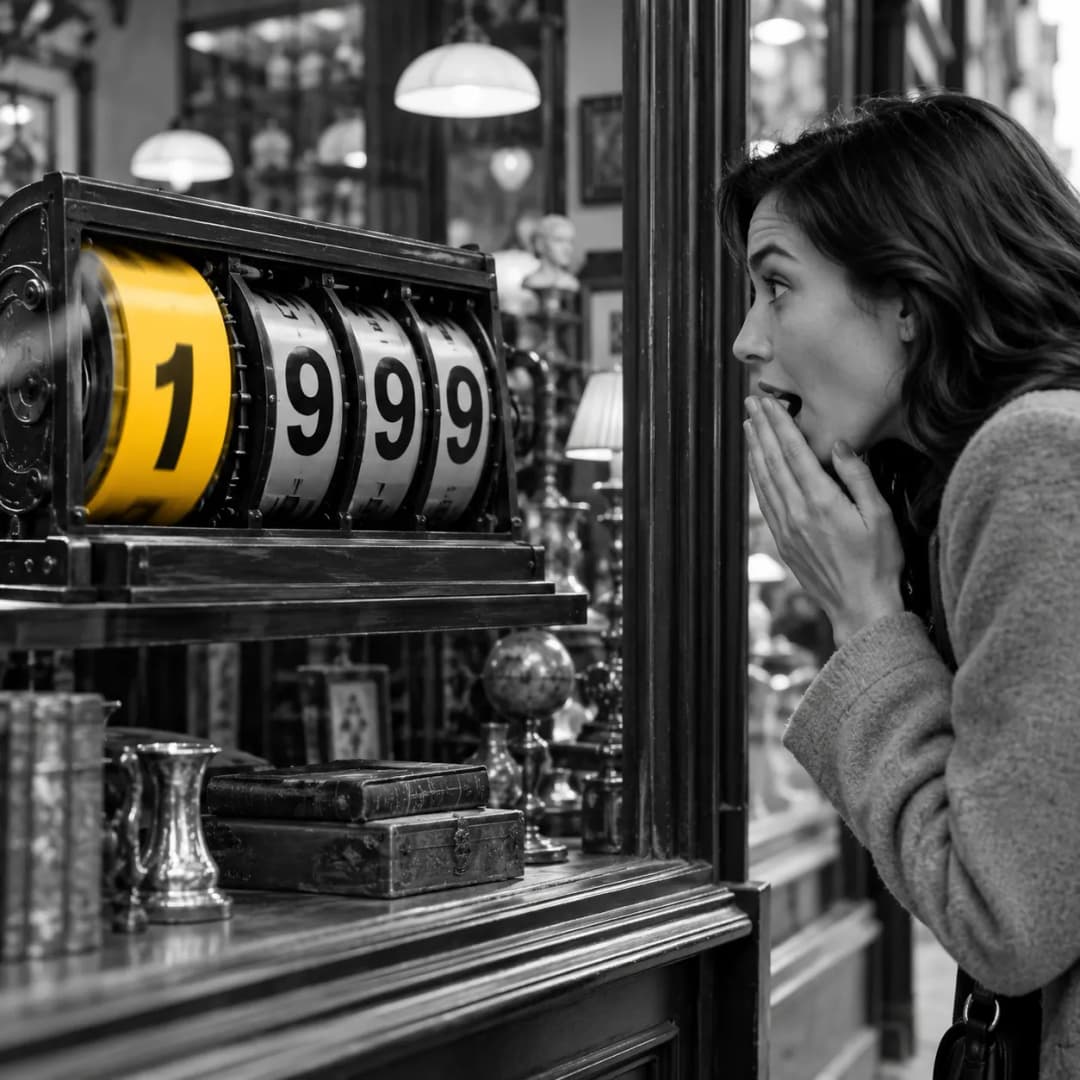
The leftmost digit of a number carries more weight than its place in the number warrants. A price of 2.99 reads as nearer two than three, and a car showing 10,000 miles is priced as if it were in a different band from one showing 9,999.
What it is
A multidigit number is not read as a whole. People give the leftmost digit extra weight, so a small change that alters that digit counts for more than a larger change that leaves it alone. In shops this is the usual explanation for prices ending in 99: such a price is the highest one that keeps the lower first digit.
Manoj Thomas and Vicki G. Morwitz tested the idea in five experiments published in the Journal of Consumer Research in 2005. They report that a nine-ending price is perceived as smaller than a price one cent higher only when the leftmost digits of the two prices differ. They also report that the effect depends on how close the compared prices are, both numerically and psychologically, and that it appears with other multidigit numbers as well as with prices.
By that rule, 2.99 against 3.00 is a case where the first digit changes, and 3.59 against 3.60 is not.
In effect
Three bodies of evidence point the same way, each from a different setting.
Used cars. Nicola Lacetera, Devin Pope and Justin Sydnor analysed more than 22 million wholesale used-car transactions and reported left-digit bias in how odometer readings are processed. Sale prices drop discontinuously at 10,000-mile thresholds, with smaller drops at 1,000-mile thresholds. They report that the pattern appears to come from final customers rather than professional agents, and that it occurs in a market with large stakes and easily observed information.
Field demand. Eric T. Anderson and Duncan Simester reported three field experiments in which a retailer varied price endings. A price ending in 9 raised demand in all three. The effect was stronger for new items than for items sold in earlier years and weaker when the retailer also used sale cues.
Scanner data. Avner Strulov-Shlain used retail scanner data on 3,500 products sold by 25 US chains and estimated that consumers respond to a one-cent increase from a price ending in 99 as if it were an increase of more than 20 cents. He reports that retailers set prices as though the bias were much smaller, and estimates that they forgo between 1 and 4 per cent of potential gross profits.
What it does not say
It does not say that every price ending in 9 raises sales. The rule depends on the leftmost digit changing, and Anderson and Simester found the gain varied with the item and with the cues around the price.
It does not say what shoppers infer about a shop from its price endings. The measures above are perceived price size, sale price and quantity bought. Richard Shotton's small street test of chocolate at 79p or 80p, reported in The Illusion of Choice, asked about taste ratings and found no significant difference, but it gives no sample size and covers one product.
The mechanism is also a description of how numbers are read, not a claim that shoppers are unaware of price endings. The Why We Project rates the concept as mixed: the direction is well supported across settings, and no single figure carries from one category to another.
Sources
- Thomas, M., & Morwitz, V. (2005). Penny wise and pound foolish: The left-digit effect in price cognition. Journal of Consumer Research, 32(1), 54-64. doi:10.1086/429600
- Lacetera, N., Pope, D. G., & Sydnor, J. R. (2012). Heuristic thinking and limited attention in the car market. American Economic Review, 102(5), 2206-2236. doi:10.1257/aer.102.5.2206
- Anderson, E. T., & Simester, D. I. (2003). Effects of $9 price endings on retail sales: Evidence from field experiments. Quantitative Marketing and Economics, 1(1), 93-110. doi:10.1023/A:1023581927405
- Strulov-Shlain, A. (2023). More than a penny's worth: Left-digit bias and firm pricing. The Review of Economic Studies, 90(5), 2612-2645. doi:10.1093/restud/rdac082
- Shotton, R. (2023). The Illusion of Choice. Harriman House.