The Less-Is-Better Effect
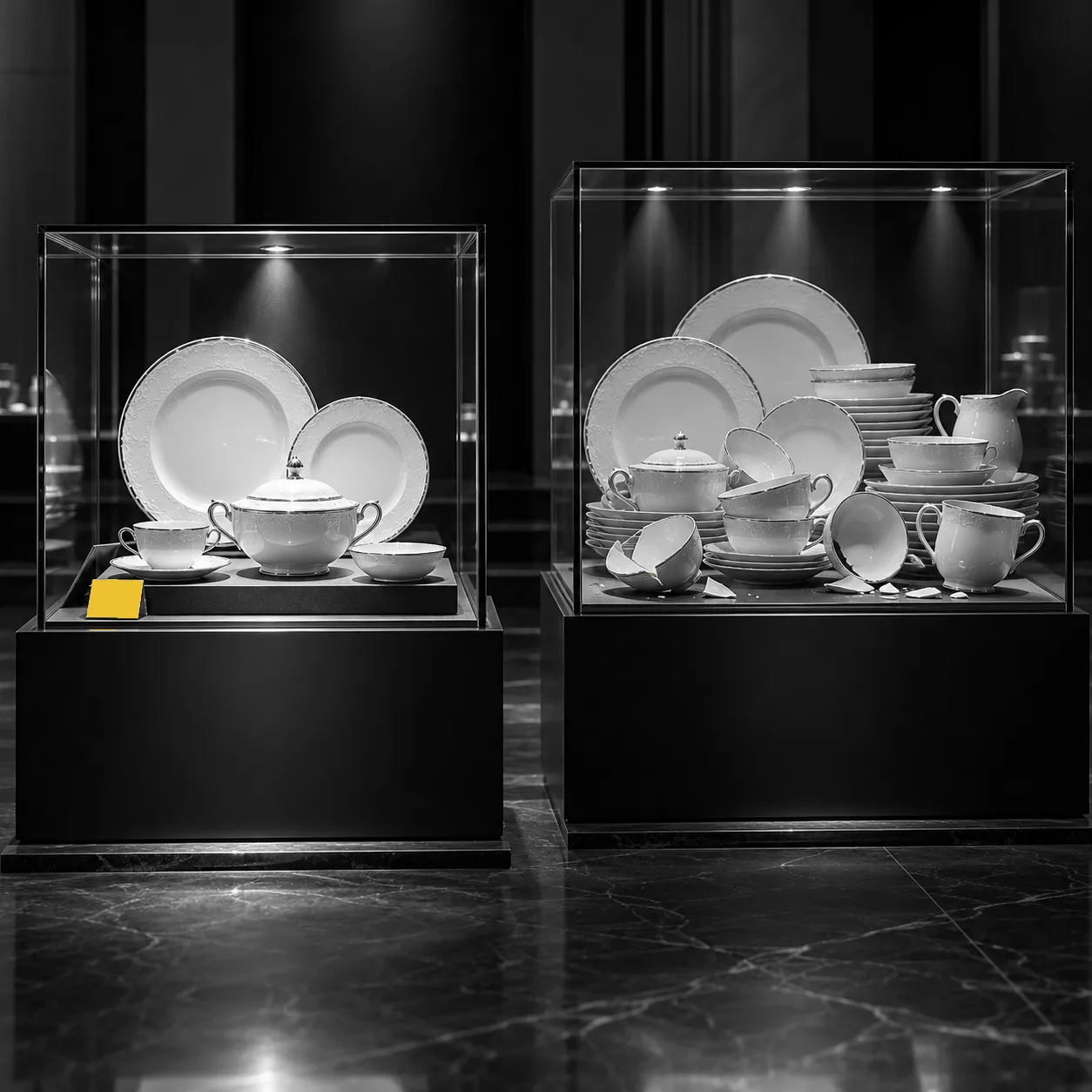
The less-is-better effect is Christopher Hsee's name for a reversal. Judged on its own, an option of lower total value can be priced above an option of higher total value, and when the two are seen side by side the order flips back. The standard demonstration, from a 1998 paper in the Journal of Behavioral Decision Making, uses two dinnerware sets: 24 intact pieces, and 40 pieces of which some cups and saucers were broken. Shown one set, people paid more for the 24 intact pieces. Shown both, they paid more for the 40. A 2023 preregistered replication reproduced the first result clearly and the second only as a non-significant lead, so the effect is best described as well supported in separate evaluation and weaker in joint evaluation.
What it is
The effect is a statement about how the evaluation context changes a price or a preference. In separate evaluation a person sees one option and has to judge it against whatever standard comes to mind. In joint evaluation the options are on the table together and the comparison supplies a standard. Hsee's 1998 paper, titled Less is better: When low-value options are valued more highly than high-value options, reported that the two contexts can produce opposite rankings of the same two options.
In the dinnerware case the higher-value set was the larger one. Forty pieces, even with some broken, held more intact pieces than 24, and people who saw both sets priced it higher. People who saw only the larger set priced it lower than people who saw only the 24-piece set did. The reversal depends on the context, and the options themselves did not change.
The effect sits close to what Daniel Kahneman calls WYSIATI, the habit of judging from what is in view as though it were the whole case. A person pricing one set has no second set in view to register what the missing comparison would have shown. The two ideas are related rather than identical. WYSIATI is a general label for judgment from partial evidence, and the less-is-better effect is a specific, measurable pattern in which a comparison reverses a ranking. The article on this site that sets them side by side, Do We Judge Products on Too Little, treats the dinnerware study as one of three pieces of evidence for the family of findings that the label covers.
In effect
In Hsee's original study of dinnerware, 104 participants were divided between separate and joint evaluation. Shown one set, they put a price on the 24-piece set of 32.69 dollars and on the 40-piece set of 23.25 dollars, a difference of more than nine dollars in favour of the smaller set (effect size d of about 0.97). Shown both sets, they priced the 40-piece set at 32.03 dollars and the 24-piece set at 29.70, a smaller gap in the opposite direction (d of about 0.37).
The 2023 replication, published in Collabra: Psychology, was a preregistered close replication and extension of three of Hsee's studies with 403 participants recruited and 400 analysed. For the dinnerware study, separate evaluation produced 33.70 dollars for the 24-piece set and 23.96 for the 40-piece set, an effect of 0.76 in standardised terms. Joint evaluation produced 30.35 and 31.67, a difference in the predicted direction that was not statistically significant. When participants in the joint condition were asked which set they would pay more for, 59 per cent chose the 40-piece set and 41 per cent the 24-piece set.
The replication also asked how the sets looked. In separate evaluation the 40-piece set was rated less attractive than the 24-piece set, 3.91 against 4.63, and drew less positive feeling about its price. In joint evaluation the 40-piece set was still rated less attractive, 3.57 against 4.19, and drew more negative feeling, 3.66 against 4.22. People could prefer to pay more for the larger set while finding it less appealing.
What happens in a shop is a matter of inference from this work. A product seen alone on a page or a shelf is judged without the comparison that a competitor's listing would supply, so the pattern gives a reason to expect that evaluation context matters to price. The studies were run with students and online participants judging dinnerware, and none of them observed purchases.
What it does not say
It does not say that less is better in general. The effect is a reversal between two evaluation contexts, shown here for one pair of dinnerware sets, in which one option has more pieces and also has broken ones.
It does not rest on a clean replication of every part. The 2023 authors found support for less-is-better in all three of Hsee's studies they ran, and weaker support for the more-is-better result in joint evaluation. The dinnerware joint-evaluation difference, which points the right way, did not reach significance in their sample.
It is not evidence about real purchasing. Participants stated prices for sets they were shown, and the studies do not show how the effect behaves when a person is spending money, has a budget or can search for alternatives.
It does not establish why the reversal happens. The replication's extensions, the attractiveness and affect ratings, describe how people reacted to the sets and do not isolate a mechanism.
It does not make the broader WYSIATI family of findings a single tested effect. The dinnerware study is one piece of evidence about how missing comparisons shape judgment, alongside mock-jury and consumer-attribute experiments.
Sources
- Hsee, C. K. (1998). Less is better: When low-value options are valued more highly than high-value options. Journal of Behavioral Decision Making, 11(2), 107-121. The original dinnerware study, with figures as reported in the 2023 replication.
- Vonasch, A. J., et al. (2023). "Less is better" in separate evaluations versus "more is better" in joint evaluations: Mostly successful close replication and extension of Hsee (1998). Collabra: Psychology, 9(1). doi:10.1525/collabra.77859. Preregistered, 403 recruited and 400 analysed, replicating Hsee's studies 1, 2 and 4.
- Vault notes: The Less-Is-Better Effect; WYSIATI. Article: Do We Judge Products on Too Little (2026).