The Limbic System
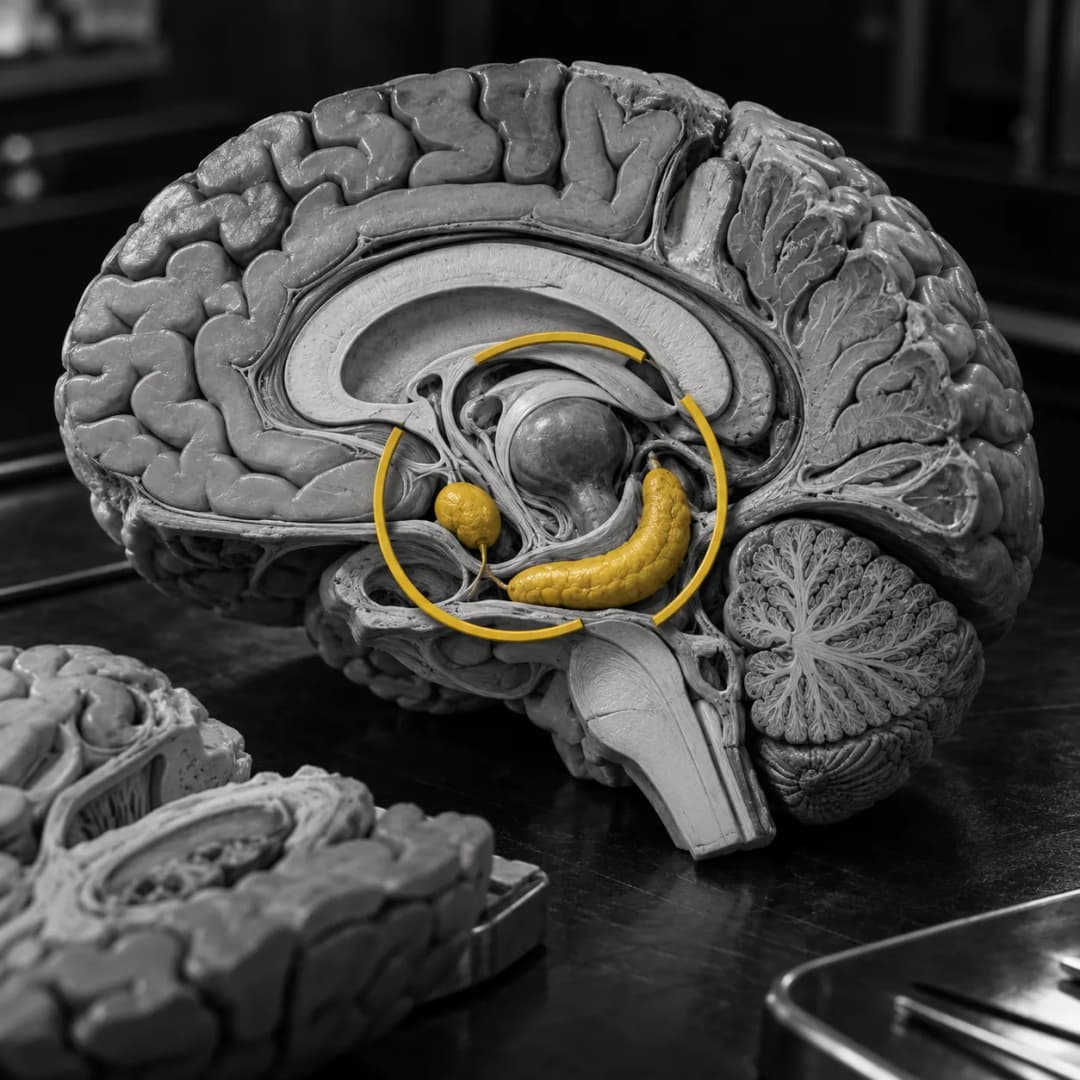
The limbic system is the name for a ring of structures, usually the amygdala, hippocampus, cingulate cortex and hypothalamus and their connections, treated as a single system for emotion. The structures are real and matter a great deal for emotion and memory. The contested part is the claim that they form one emotional system, and the critics of that claim include researchers who work on those very structures. The phrase survives in textbooks and clinical writing as shorthand for a historical grouping, and it should be read that way.
What it is
The anatomy comes first. Pierre Paul Broca named the "limbic lobe" in 1878 for a ring of cortex around the brainstem. Paul MacLean took the idea further in 1952, folding Broca's ring together with subcortical nuclei into a single "limbic system" and proposing it as the substrate of emotion. MacLean later made it the middle storey of the triune brain, the model in which a reptilian complex, a limbic system and a neocortex were added in that order and could act semi-independently.
Two things have been kept apart on this site because they are constantly run together. The triune brain, with its claim that brains were built by adding layers, is rejected by researchers who study nervous-system evolution. The limbic system is a surviving component of that story, and it is criticised separately. Saying the triune brain is wrong is uncontroversial. Saying the limbic system does not exist overstates the case, because the amygdala, the hippocampus and the cingulate cortex exist, are richly interconnected and matter for emotion and memory.
What is disputed is the grouping. A set of regions earns the name of a system when it has consistent structural and functional criteria and does one job. The critics argue that the limbic regions meet neither test.
In effect
Joseph LeDoux, the neuroscientist at New York University whose work on the amygdala did much to establish how the brain handles threat, argues that there is no single emotional system in the brain. On his account the concept lacks consistent structural and functional criteria, and the regions conventionally placed inside it are not unique to emotion or motivation. Rolf Kötter and Niels Meyer wrote in 1992 that the limbic system is a non-empirical explanatory concept for poorly understood brain functions, which is the sharpest short statement of the objection. Alf Brodal, earlier, described it as substituting naming for understanding. Lisa Feldman Barrett argues in How Emotions Are Made (2017) that the regions MacLean grouped are general-purpose hubs, involved in language, concepts and stress regulation as well as emotion, and not an emotion module.
A 2019 review in Neuroscience and Biobehavioral Reviews by Luiz Pessoa, Loreta Medina, Patrick Hof and Ester Desfilis approaches the same ground from comparative anatomy. Surveying neural organisation across vertebrates, they argue that association and integration are features of every vertebrate brain. They identify large-scale systems involving the midbrain, hypothalamus, thalamus, basal ganglia and amygdala that are shared across vertebrates and interact extensively at several levels, and they conclude that cognition, emotion and motivation are inseparable because each depends on combining incoming signals. That is a long way from an emotional layer that takes over when feeling runs high.
The phrase matters in marketing because it carries the old picture into current advice. In popular usage "limbic" stands for the fast, emotional, buying part of the brain, and it sits beside the "old brain" and the "lizard brain" in the same story. Seth Godin's 2010 description of the lizard brain places it "near the top of your spinal cord, near the amygdala", which borrows the limbic region's geography for a creature the comparative evidence does not support. The article Is the Lizard Brain Real in Marketing follows that route.
One claim attached to the limbic system fails more clearly than the rest: that it has no capacity for language. The claim is false as stated. The hippocampus, limbic on anyone's list, is central to verbal memory and word learning, and subcortical aphasia is a recognised clinical entity. There is a caveat, and it does not rescue the claim: the basal ganglia and thalamus, which contribute to speech initiation and to lexical selection, are not standardly counted as limbic. Either way the picture is of distributed language processing with subcortical involvement, not a mute deep brain with words sealed in the neocortex.
What it does not say
It does not say that the amygdala, hippocampus, cingulate cortex or hypothalamus are unimportant. They are among the best-studied structures in the brain and the research on them continues.
It does not say that emotion has no biology. The case against the limbic system is a case against a particular map, one region group, one job, one evolutionary storey. Emotion remains a subject of active neuroscience, studied through distributed networks and through the shared systems the 2019 review describes.
It does not say the word has no use. Textbooks and clinical writing still use limbic as shorthand for a ring of structures with a shared history. The defensible line is that the grouping is a historical convenience rather than a functional unit, which is a weaker claim than either "it is the emotional brain" or "it does not exist".
It does not make the limbic system the home of decisions made on feeling. The better-supported work on how feeling bears on choice is Antonio Damasio's somatic marker hypothesis, whose mechanism is cortical: the ventromedial prefrontal cortex, which is prefrontal cortex and not limbic. That hypothesis has itself been critically reviewed, notably by Barnaby Dunn and colleagues, so it is live rather than settled. Anyone who wants to say that feeling precedes justification should go to Damasio's work and not through this concept.
Sources
- MacLean, P. D. (1990). The Triune Brain in Evolution: Role in Paleocerebral Functions. New York: Plenum Press. The 1952 coining of "limbic system" and Broca's 1878 "limbique" are recorded in the vault note on this concept after an external verification pass; the original papers were not reopened for this page.
- The critiques by Joseph LeDoux, by Rolf Kötter and Niels Meyer (1992) and by Alf Brodal are recorded in the vault note after that pass; the originals were not reopened for this page. Barrett, L. F. (2017). How Emotions Are Made: The Secret Life of the Brain. Boston: Houghton Mifflin Harcourt.
- Pessoa, L., Medina, L., Hof, P. R., and Desfilis, E. (2019). "Neural architecture of the vertebrate brain: implications for the interaction between emotion and cognition." Neuroscience and Biobehavioral Reviews, 107, 296-312. doi:10.1016/j.neubiorev.2019.09.021. Read at the level of the abstract.
- Godin, S. (2010, 25 January). Mixergy interview, "How To Produce Like A Linchpin By Understanding Your Lizard Brain". https://mixergy.com/interviews/linchpin-lizard-seth-godin/
- Vault note: [[The Limbic System]]. Evidence status contested; the sceptical side is the mainstream one in research neuroscience.