The Metric Black Hole
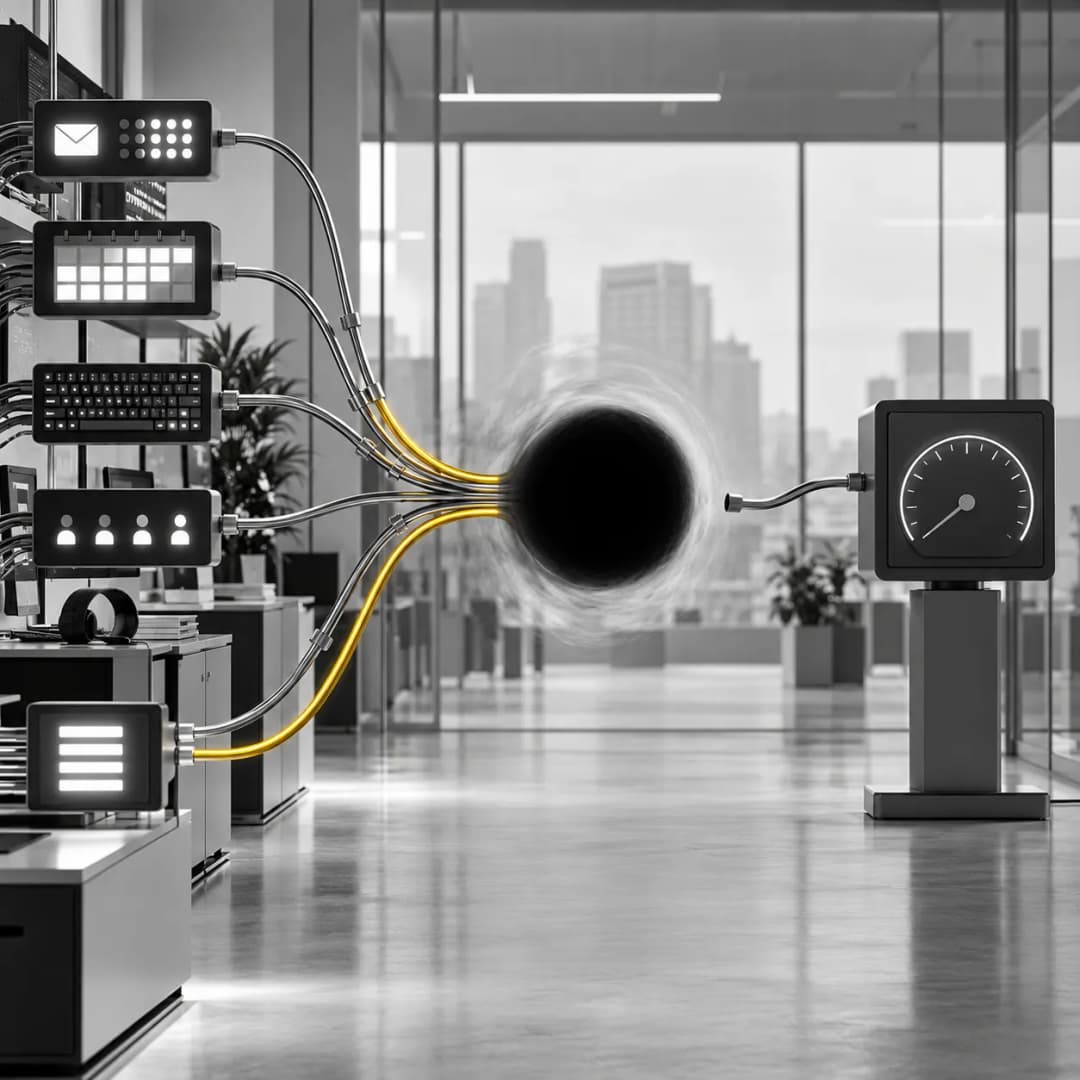
The metric black hole is Cal Newport's name, from page seventy of Deep Work, for the region of knowledge work where the effect of any given behaviour on the bottom line cannot be measured, so nobody checks it. If answering an email within four minutes cannot be shown to cost a firm anything, nothing stops it. The symmetry the phrase leaves unstated is the important half: the same missing measure leaves the claim that depth would outperform just as unmeasured.
What it is
The idea is about why bad working habits survive. In a factory, the cost of a behaviour shows up in units per shift. In an office, almost nothing does. A knowledge worker's contribution to a firm's results is mediated by so many other people, decisions and accidents that no individual habit can be isolated and priced. So the habits are not selected by results. They are selected by whatever else is available, and what is available is the appearance of effort: visible responsiveness, a fast reply, a full calendar.
Newport's own illustrations carry the point. At pages 53 to 55 he reports Tom Cochran, then chief technology officer at Atlantic Media, timing his own email and extrapolating across the company to arrive at well over a million dollars a year in processing cost, roughly 95 cents a message, a figure Newport reaches through a blog post Cochran wrote for the Harvard Business Review site. Newport is fair about the limits of one man measuring his own inbox and scaling it to a firm, and the million-dollar figure is still what a reader carries away. Alongside it, Piketty is quoted at page 55 on the general difficulty of measuring an individual's contribution to output. The coinage itself sits at pages 55 to 56, and the concession that no hard metrics exist is at page 70.
The honest turn is on that page, and it cuts both ways. If nothing in this region can be measured, then the recommendation cannot be measured either. The book uses the absence in one direction, to explain why shallow work wins, and does not note that it applies with equal force to its own prescription. What follows at pages 70 to 71 is a chain rather than a finding: depth is hard, shallowness is visible, the internet is presumed good, nothing can be measured, therefore depth is rare, therefore rare is valuable, therefore go deep. Each step is plausible. None is a measurement.
What makes this more than a debating point is that we went looking for the missing measure. Twice, in extended searches: meeting-free-day evaluations with a control group or a staggered adoption design, focus-time interventions tested against commits or tickets closed, randomised or controlled trials of protected time in knowledge work from 2023 to 2026, and calendar-reduction interventions evaluated as natural experiments inside firms. Nothing came back that measures output.
The shape of what does exist is the finding. The better the design, the further the outcome measure drifts from work. The strongest randomised test of the prescription itself, Das Swain and colleagues at CHI in 2023, measures self-rated performance, significant only within a ninety per cent confidence interval. The strongest design in knowledge work, Chen and Chan's four-week randomised field experiment with 217 participants in Information Systems Research, measures work time, which its own abstract calls time spent working, and finds that complete blocking backfires while partial blocking helps. The only randomised study with a real output measure, Marotta and Acquisti's experiment on piece-rate crowdworkers, has remained an unpublished working paper for eight years. The only causal evidence on objective output sits in manual labour. And the founding study of the whole prescriptive tradition, Leslie Perlow's 1999 field study, measured productivity by asking seventeen engineers to rate it on a five-point scale, after the daily tracking logs were abandoned as inaccurate.
Two absences sit underneath all of that, and both were searched rather than assumed. No meta-analysis of work interruptions against task performance exists; the integrative review that covers 247 publications, by Puranik, Koopman and Vough in 2020, says in its own voice that inconsistent definitions reduce generalisability, lead to conflicting findings and hinder knowledge development, which is why it pools nothing. And no randomised controlled trial of time blocking was found. The right way to write either is that none has been found and here is how hard we looked.
The cleanest instance is not in business at all. The profession with the most control over its own calendar, the strongest incentive to produce countable output and a century of institutional interest in the question has never run a controlled trial of giving its members uninterrupted time. Everything reachable on protected academic writing time is a single group measured before and after, or a descriptive count of papers.
In effect
Fruit harvesting, where the measure exists and the answer is not the expected one
The black hole is defined by what is missing, so the useful research example is a place where the measure is present. Pradeep K. Pendem, with P. I. Green and B. R. Staats, published productivity records from 211 harvesters covering 117,581 truckloads of fruit across 9,819 worker shifts in Manufacturing and Service Operations Management in 2022, analysed with an instrumental variable approach. With a real output measure in hand, interruption stops being one thing with one sign. They identify a class they call a pause, which supplies physical respite and limits attention shift, and find that pauses improve productivity in both the short and the long term, while breakdowns and travel across field hurt it. Their own summary is that various work interruptions can have positive or negative effects on workers' productivity.
The limit must travel with the finding: fruit harvesting is physical labour and the beneficial mechanism is physical rest, which does not transfer to a desk. What transfers is the shape of the question. Where the measure exists, the answer is a taxonomy. Where it does not, the trade has a single number with a single sign.
The inbox nobody can price
The everyday version is the four-minute reply. A person who answers every message quickly is visibly diligent, and nobody in the organisation can say what the habit costs, because the only instruments available are the ones that count activity. The reverse is equally unpriced: the colleague who closes the mail client for two hours cannot show what the two hours produced either, and is exposed to a charge of being unresponsive that the quick replier never faces. The asymmetry is not that one habit is measured and the other is not. It is that both are unmeasured, and only one of them looks like work from the outside.
Asked in 2006 whether there must be a cost to productivity from interruption, Gloria Mark, whose stopwatch ethnography produced most of what is known about the frequency of it, answered: "There must be, but we don't know what [it is]." Twenty years and two rounds of searching later, that is still the accurate answer.
Focus Time, and the metric a vendor can actually reach
Product design shows the same gap from the inside. Microsoft's Viva Insights sells a feature advertised as Focus Time, which pre-emptively books protected blocks and suppresses notifications during them. Its effect was tested properly, by Das Swain and colleagues at CHI in 2023, in a randomised experiment on eighty-nine workers who had never had it, with forty-eight in treatment over three weeks. The performance result is a self-rating, estimate 1.265, t = 1.768, p = 0.081, which the paper describes as significant within a ninety per cent confidence interval, and the behavioural measure nearest to output, daily engagement on coding and development, moved slightly downward and not significantly.
The companion case is the pair of figures that circulate about meeting-free days, 78 per cent less meeting volume and 22 per cent more focused work, printed on slide 18 of Microsoft's own New Future of Work Report 2022. The cited artefact exists and is cited correctly: a 2021 Microsoft Research Summit talk by Brian Houck, a Microsoft productivity engineer, whose published abstract contains no numbers, no sample and no method beyond "a mix of methods", and describes itself as a practitioner's perspective on Microsoft's own engineers. The slide renders that as "Studies have shown". A reduction in meetings on days designated meeting-free is close to tautological in any case; the interesting figure is the 22 per cent, and it has no definition attached anywhere on the public record.
What it does not say
It does not say that knowledge work is unmeasurable in principle, only that the firm-level link between a particular behaviour and the bottom line has not been measured, and that the people recommending behaviours mostly have not tried.
It does not say that uninterrupted concentration is worthless or that time blocking does not work. Absence of measurement is not evidence of absence. Our verification pass on Deep Work holds that its central practical claim, that the ability to concentrate without interruption is both valuable and increasingly rare, does not depend on any of the citations that failed. A book can be badly sourced and still be right, and on its main thesis that one is.
It is not a research finding. The evidence status here is not-a-research-claim. This is Newport's own analysis of workplace behaviour, bolded on the page as a principle and supported by one executive's blog post and a quotation from an economist. No survey, no firm-level study, and no attempt to test whether managers who can measure behave differently from managers who cannot. It is plausible, well argued, and not a finding, and the same honesty applies to the extension of it on this page.
Nor does it license the opposite prescription. Chen and Chan's finding that complete blocking reduced time spent working is about work time, not output, and their own policy conclusion is calibrated and phased controls rather than all-or-nothing bans. Pendem and colleagues' pauses are physical rest in a field, not a licence to check messages. The honest position is that the quantity in the productivity claim has never been measured by anyone, in either direction.
One figure is deliberately absent from this page. Deep Work recommends a shallow-work budget of 30 to 50 per cent at page 232, justified at the ceiling by a stated psychological distaste and at the floor by what bosses will begin to worry about. Two feelings and no source, so we never repeat it as a finding or a recommended ratio.
Who developed it
The phrase is Cal Newport's, coined in Deep Work in 2016 at pages 55 to 56 and used at page 70. The symmetry argument on this page, that the same absence leaves his own claim unmeasured, is The Why We Project's, and the evidence ladder is assembled from the work of Leslie Perlow, Vedant Das Swain, Pradeep K. Pendem and Gloria Mark.
Sources
- Newport, C. (2016). Deep Work: Rules for Focused Success in a Distracted World. Piatkus, ISBN 978-0-349-41190-3. Cochran at pp. 53 to 55, Piketty at p. 55, the coinage at pp. 55 to 56, the concession at p. 70, the inference chain at pp. 70 to 71, the shallow-work budget at p. 232. Read in full from photographs on 13 September 2026.
- Perlow, L. A. (1999). "The Time Famine: Toward a Sociology of Work Time." Administrative Science Quarterly, 44(1), 57 to 81. doi:10.2307/2667031. Complete article read in full at source; sole author.
- Das Swain, V., Hernandez, J., Houck, B., Saha, K., Suh, J., Chaudhry, A., Cho, T., Guo, W., Iqbal, S. T., & Czerwinski, M. (2023). "Focused Time Saves Nine: Evaluating Computer-Assisted Protected Time for Hybrid Information Work." Proceedings of CHI 2023. doi:10.1145/3544548.3581326. Complete article read in full at source.
- Chen, Z., & Chan, J. (2026). "Less Is Not Always More: The Impact of Social Media Block Intensity and Immediacy on Work Time." Information Systems Research, published online 8 April 2026. doi:10.1287/isre.2023.0493. Full abstract read at source via Crossref; full text not read.
- Marotta, V., & Acquisti, A. (2018). "Interrupting Interruptions: A Digital Experiment on Social Media and Performance." SSRN working paper 3283951. doi:10.2139/ssrn.3283951. Abstract read at source; the PDF was not opened. Still unpublished.
- Pendem, P. K., Green, P. I., & Staats, B. R. (2022). "The Microstructure of Work: Understanding Productivity Benefits and Costs of Interruptions." Manufacturing and Service Operations Management, 24(4), 2202 to 2220. doi:10.1287/msom.2021.1053. Full structured abstract read at source via Crossref; full text not read.
- Puranik, H., Koopman, J., & Vough, H. C. (2020). "Pardon the Interruption: An Integrative Review and Future Research Agenda for Research on Work Interruptions." Journal of Management, 46(6), 806 to 842. doi:10.1177/0149206319887428. Full abstract and the complete reference list read at source via Crossref; full text not read. Covers 247 publications and is not a meta-analysis.
- Robison, J. (2006). "Too Many Interruptions at Work?" A Q and A with Gloria Mark. Gallup Business Journal, 8 June 2006. Complete interview read in full at source.
- Microsoft Research (2022). Microsoft New Future of Work Report 2022. Read in full at source and searched exhaustively. Not peer reviewed, and published by a company that sells meeting software. Slide 18 for the meeting-free-day figures, slide 28 for its summary of Laker and colleagues.
- Houck, B. (2021). "Happy and productive hybrid developers: How to have it all!" Talk, Microsoft Research Summit 2021, 19 October 2021. The session page was read; the video is cookie-gated and was not viewed, and there is no transcript.