The Parable of the 38 Witnesses
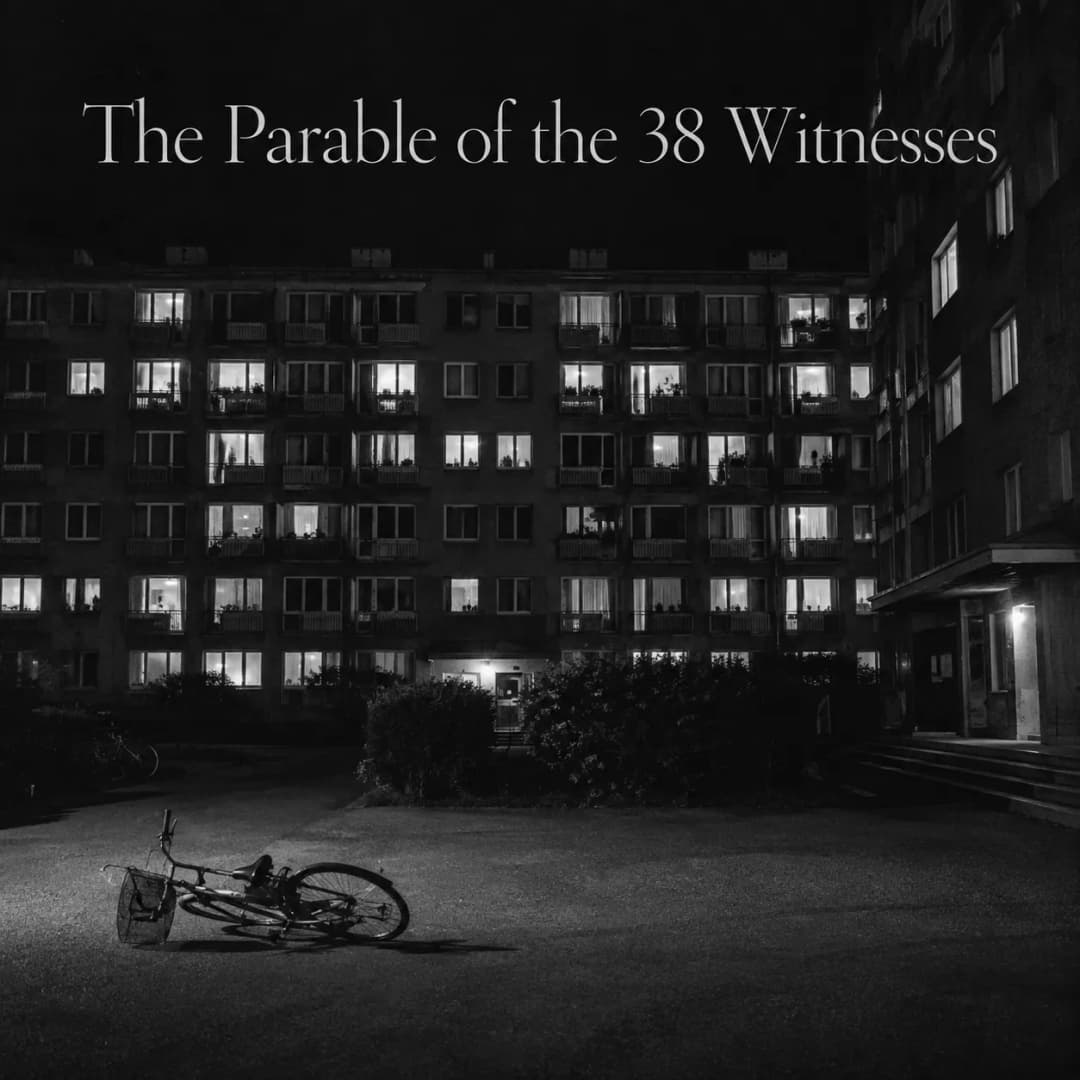
The story is that 38 neighbours watched Kitty Genovese murdered in Queens in 1964 and did nothing. It illustrated the bystander effect in textbooks for forty years. Rachel Manning, Mark Levine and Alan Collins went to the trial record, the police files and the press reports and published the result in American Psychologist in 2007. They found no evidence for any of the story's three claims: not for 38 witnesses, not for witnesses observing the murder, and not for their inaction.
What it is
Three claims carried the story. There were 38 witnesses. They watched the murder. They did nothing. Manning, Levine and Collins checked all three against the archive and none of them is supported.
The figure of 38 appears nowhere in the police records. The attack happened in two parts, roughly ten minutes apart, and the fatal second one took place in a vestibule that almost nobody could have seen into. At least two neighbours telephoned the police. One man shouted from a window and drove the attacker off, which is the reason there was a second attack at all rather than a single continuous one. A friend came down and held Kitty Genovese while she died.
That last detail is worth sitting with, because the version that circulated for four decades has a woman dying alone while a street full of people declines to look. She did not die alone. The story did not merely exaggerate a real pattern of indifference. It inverted several of the specific things that happened.
What the parable did have was utility. It arrived as newspaper coverage, it was vivid, it named a city and a victim, and it supplied a founding anecdote for a research programme that was just then getting under way. A discipline that had an experimental effect to explain acquired a story that appeared to demonstrate it in the wild, and the story travelled with the experiment into every introductory textbook. Manning, Levine and Collins describe the result as a parable, and the word is chosen carefully. A parable is a narrative that carries a moral, and it does not need to have happened.
The correction does not touch the experiments. Darley and Latané's work is sound and the effect they found in the laboratory is real, which is covered on The Bystander Effect. The illustration was false while the experiment was good, and those two facts have to be held at the same time. It is a cleaner failure than the ones catalogued under The Replication Crisis, because nothing about the science failed here. What failed was the anecdote the science was taught with, and the discipline's willingness to keep repeating it for forty years without anyone opening the file.
In effect
Research: what the archive said (Manning, Levine and Collins)
The 2007 paper in American Psychologist is the primary source, and its method is the reason it settled the question. Manning, Levine and Collins did not survey opinion or re-analyse data. They went to the trial record, the police files and the contemporary press reports, and worked through what could actually be established about the night. The absence of the number 38 from the police records is the single most damaging finding, because that figure is the entire load-bearing element of the story as it is usually told. Everything else follows: the two-part structure of the attack, the vestibule, the calls that were made, the man at the window, the friend on the stairs.
Everyday life: a story that is easier to remember than the correction
The parable is still in circulation, and it is worth being honest about why. It is short, it is vivid, it names a place and a person, and it delivers a verdict about modern life that a lot of people already hold. The correction is none of those things. It is a citation to a journal article, it consists of a series of qualifications, and its conclusion is that a famous story about human indifference was mostly wrong. Corrections lose to parables in ordinary conversation, which is not a fact about this case but a fact about how anything gets remembered.
Commerce: the textbook and the lecture theatre
The commercial mechanism that kept this alive was publishing. Introductory psychology textbooks are a large market, chapters are inherited from edition to edition, and a vivid opening anecdote is exactly the kind of asset that survives a revision because nobody has a reason to touch it. The parable was in those chapters for forty years, and it reached a very large number of students who were being taught, in the same course, that claims should be checked against sources. Manning, Levine and Collins published in 2007. The story is still teachable material, and it is now teachable for a different reason.
What it does not say
It does not say that nobody was murdered or that the case was fabricated. Kitty Genovese was killed in Queens in 1964. What the paper contests is the account of the witnesses, not the crime.
It does not say the bystander effect is false. Darley and Latané's laboratory experiments are sound, replicated, and unaffected by any of this. The parable was the illustration attached to the research, and demolishing an illustration leaves the research standing.
It does not establish exactly how many people heard or saw anything. The paper's finding is that the evidence does not support the three claims the story rests on, which is a statement about what can be shown rather than a competing count. Reporting a corrected number would repeat the original error in the other direction.
It does not identify a single culprit. The paper describes a story assembled by a newspaper and adopted by a discipline, and the adoption is the part psychology is answerable for. Naming an individual reporter or an individual psychologist as the author of the error would be tidier than the evidence allows.
Who developed it
The correction is the work of Rachel Manning, Mark Levine and Alan Collins, published in American Psychologist in 2007. Manning is first author. Levine also appears on the 2020 CCTV study that reversed the field version of the effect, which makes him one of the few people to have dismantled both the founding story and the received reading of the finding. Kitty Genovese has a page here because a woman who became an illustration is owed the correction under her own name.
Sources
- Manning, R., Levine, M. & Collins, A. (2007). "The Kitty Genovese Murder and the Social Psychology of Helping: The Parable of the 38 Witnesses." American Psychologist, 62(6), 555-562. No evidence for 38 witnesses, that witnesses observed the murder, or that they remained inactive.
- Darley, J. M. & Latané, B. (1968). The bystander intervention experiments. The research the parable was attached to, and which it does not affect.
- Philpot, R., Liebst, L. S., Levine, M., Bernasco, W. & Lindegaard, M. R. (2020). "Would I Be Helped? Cross-National CCTV Footage Shows That Intervention Is the Norm in Public Conflicts." American Psychologist. The field evidence on what bystanders do.
- Where this came from
- No book in this library is the source of this concept. It entered the vault from The Courage Problem, built from primary sources rather than from a book.