The Photo-Impairment Effect
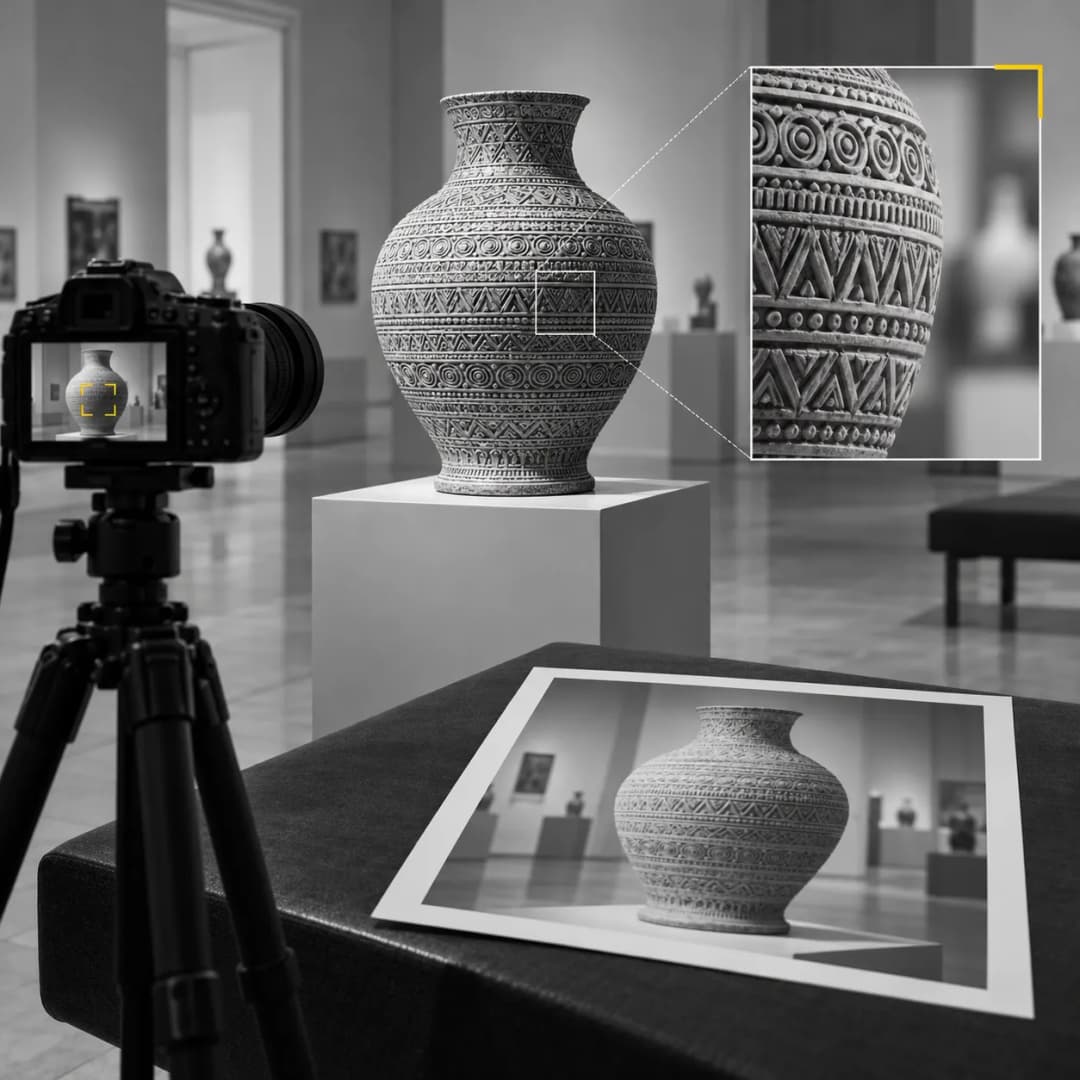
The photo-impairment effect is Linda Henkel's 2014 finding that people remember less visual detail about an object they photographed than about one they only looked at. It has replicated several times, including under preregistration, so it is not a casualty of the replication crisis. It also reverses, on the visual channel, when participants choose their own subjects, which is what Alixandra Barasch, Kristin Diehl, Jackie Silverman and Gal Zauberman found in 2017. What causes it remains genuinely unresolved.
What it is
Linda Henkel, the sole author of the original paper, took undergraduates round the Bellarmine Museum of Art at Fairfield University and had them photograph some objects and merely observe others. The next day they were tested. Visual detail accuracy ran .55 for photographed objects against .64 for observed ones in her first experiment, with 27 participants analysed. Recognition that an object had been encountered at all was .88 against .91. Free recall showed no difference whatever, .47 against .48, and she reports the null and drops it.
The second experiment is what makes the paper worth citing rather than merely quoting. Every object got 25 uninterrupted seconds of viewing, with photographing time added on top, so a photographed object received more total exposure than an observed one and still lost detail. Photographing the whole object cost accuracy, .38 against .44 for observed. Zooming in on a specified part did not, at .46. That control is the explanation: the effect is about what the act does to attention during encoding, not about cameras as devices. Anyone citing this finding as proof that photographs destroy memory has discarded the only part of it that explains anything.
And there is a result in that experiment almost nobody quotes. Memory for which room an object had been in ran .67 for whole-photo, .74 for observed and .45 for the zoom condition. The condition that protected detail memory had by far the worst memory for location, and Henkel reads it as the cost of the attention that protected the detail. Her own line on the zoom finding is that what the person remembered was not necessarily what the camera captured: the camera's eye is not the mind's eye.
Henkel also named her own untested boundary condition, in print, before anybody tested it. Future research, she wrote, should examine whether similar effects appear when people are free to choose what to photograph, since people tend to photograph what they value. Barasch, Diehl, Silverman and Zauberman tested exactly that in 2017, in the same journal, and found the reverse. Their author note states that all four contributed equally and that the order of authorship is alphabetical, so the paper is theirs jointly rather than hers in the usual sense. Across one field study, three laboratory studies and two supplementary studies, pooled photo-taking produced a positive effect on visual memory of d = 0.54, with a 95 per cent confidence interval of 0.45 to 0.63, and a smaller negative effect on auditory memory of d = 0.26, interval 0.16 to 0.36. The channel matters: better for what the camera was pointed at, worse for the audio commentary playing while it was pointed.
So the record on the effect itself is good and the record on its scope and cause is split. Julia Soares and Benjamin Storm replicated the impairment in 2018 at d = 0.70 and d = 0.58, in the second case with the viewing timer starting only after the photograph was taken, so the camera conditions again had more exposure. Baike Li and colleagues, in press at the same journal, replicated it a third time across three experiments with preregistered stopping rules, and found it survived when photographing required only a single Bluetooth button press, which removes most of the operational demand an attentional account would need.
Henkel's own proposed mechanism was offloading, the idea that photographing lets you dismiss the object and let the camera remember for you. That account has now been tested directly twice and the two tests disagree. Soares and Storm removed future access to the photographs, by sending them through Snapchat, which does not save them, and by immediate deletion. The impairment survived at full size, and in the Snapchat condition it was larger, at d = 1.21. Li and colleagues removed future access by telling one group the photographs would be inaccessible, and the impairment was eliminated in that group while appearing in the group told the photographs would be available. Both studies are preregistered or power-planned, both sit in the same journal, and they point opposite ways on the same manipulation. The honest position is that the mechanism is open.
In effect
In research: the Bellarmine Museum tour, and the paper that tested its missing condition
Henkel's two experiments are small, undergraduate and set in one museum, with samples of 27 and 46. That is worth saying plainly before anything is built on them. What the paper has instead of scale is design: the counterbalancing, the added photographing time, the zoom control and the location-memory measure. Barasch and colleagues' field study answers it on a larger sample and a real exhibit, with 294 participants analysed on a self-guided tour of an Etruscan collection with an audio guide, no warning of a memory test, visual recognition at 66.51 per cent with a camera against 59.83 without, and auditory recognition at 75.34 against 77.93, which was not significant. Two controls make their result hard to dismiss. In one study, visual memory was better than no-camera whether participants expected the photographs to be saved or deleted, and the two camera conditions did not differ. In another, taking merely mental photographs produced the same visual benefit, so the effect is not the button press.
In everyday life: the visitor who got the brushwork and lost the room
The practical shape of this finding is not that photographing a painting makes you forget it. It is that photographing reallocates what you encode. The zoom condition protected the detail and recorded the worst memory for where the object had been. Camera-holders in the 2017 studies remembered even the aspects they never photographed better than people with no camera at all, at d = 0.26. Someone who walks a gallery taking pictures is likely to leave with a sharper record of the pictures and a vaguer one of the gallery, and with a slightly worse record of whatever the audio guide was saying. Soares and Storm added the detail that makes this worth telling a reader: afterwards, 52 per cent of their participants said photographing helps them remember and only 19 per cent correctly said it impairs memory, and of those who said it helps, 62.5 per cent had just remembered less about the paintings they photographed.
In commerce and product design: the delete button as an experimental instrument
The mechanism research runs on consumer products. Snapchat was chosen by Soares and Storm precisely because the platform does not retain the image, which turned a product decision into a manipulation of expected future access. Li and colleagues used a Bluetooth shutter button to strip the act of photographing down to one press. For anyone designing an experience rather than a study, the commercially useful finding comes from the same team that found the memory reversal: Kristin Diehl, Gal Zauberman and Alixandra Barasch reported in 2016, across three field and six laboratory experiments, that photo-taking raises enjoyment of positive experiences, operating through engagement, weaker when the experience is already engaging or when photographing gets in the way. Their own limit on their own result is that the same engagement went with worse evaluations of negative experiences. An attraction that encourages photography is buying engagement and visual memory, and paying in attention to everything the camera is not pointed at.
What it does not say
It does not say that photo-taking destroys memory. The impairment is specific to visual detail about photographed objects under instructed photography, free recall showed no difference in the original experiment, and the zoom condition removed the effect entirely.
It does not say that photo-taking improves memory either. Barasch and colleagues found an improvement on the visual channel and a reliable decline on the auditory one, at a short delay, with no revisiting of the photographs, and in contexts they themselves describe as unusually visually salient. State the channel or state nothing.
It does not say the effect failed to replicate. It replicated in Soares and Storm 2018, in Soares and Storm's 2022 multiple-photographs paper, and in Li and colleagues' three experiments, and it is reported as replicating in Lurie and Westerman 2021 and, conditionally, in a 2017 study that found it for manual photographs but not for an automatic wearable camera. The 2021, 2022 and 2017 papers are held here at record or secondary-quotation level and have not been read in the original, and a d = 1.25 figure attributed to Lurie and Westerman's first experiment reaches us through a later paper's description of it rather than from their own text.
And it does not settle the offloading account in either direction. Two well-conducted studies removed expected access to the photographs and got opposite results. Until that is resolved, the effect is a reliable finding with a contested cause, which is a more useful thing to tell a reader than a tidy explanation would be.
Sources
- Henkel, L. A. (2014). "Point-and-Shoot Memories: The Influence of Taking Photos on Memory for a Museum Tour." Psychological Science, 25(2), 396-402. doi:10.1177/0956797613504438, published online 5 December 2013. Read in full at source. Sole author, stated in the paper's own author-contributions note.
- Barasch, A., Diehl, K., Silverman, J., & Zauberman, G. (2017). "Photographic Memory: The Effects of Volitional Photo Taking on Memory for Visual and Auditory Aspects of an Experience." Psychological Science, 28(8), 1056-1066. doi:10.1177/0956797617694868. Read in full at source. Their author note states that all four contributed equally and that the order of authorship is alphabetical.
- Soares, J. S., & Storm, B. C. (2018). "Forget in a Flash: A Further Investigation of the Photo-Taking-Impairment Effect." Journal of Applied Research in Memory and Cognition, 7, 154-160. Read in full at source. Soares is first author.
- Li, B., Gilbert, S. J., Yu, Y., Ju, Y., Tang, B., Yang, C., & Liu, M. (in press). "Photo-Taking Impairment in Recognition Memory: Comparing Attentional Disengagement and Cognitive Offloading Accounts." Journal of Applied Research in Memory and Cognition. doi:10.1037/mac0000287. Accepted manuscript retrieved and searched for the abstract, the condition means and the discussion of Soares and Storm; the full General Discussion was not read. Li is first author, not Gilbert.
- Diehl, K., Zauberman, G., & Barasch, A. (2016). "How taking photos increases enjoyment of experiences." Journal of Personality and Social Psychology, 111(2), 119-140. doi:10.1037/pspa0000055. Publisher record and press material only; the full text was not read. Diehl is first author of this paper, unlike the 2017 one.
- Lurie, R. E., & Westerman, D. L. (2021). "Photo-taking impairs memory on perceptual and conceptual memory tests." Journal of Applied Research in Memory and Cognition, 10(2), 289-297. doi:10.1016/j.jarmac.2020.11.002. Bibliographic record and secondary quotation only; not read in the original.
- Soares, J. S., & Storm, B. C. (2022), on multiple photographs per object, Psychonomic Bulletin and Review, doi:10.3758/s13423-022-02149-2. Record only, not read. And Niforatos and colleagues (2017), on manual against automatic wearable photography, reported in Soares and Storm's discussion and not read in the original.
- Rosen, C. (2024). The Extinction of Experience. United Kingdom Vintage text, p. 157, where the finding reaches a general readership and the author volunteers that it has been replicated twice, most recently in 2021. That claim was checked here: it is defensible and undercounts.