The Pseudo-Environment
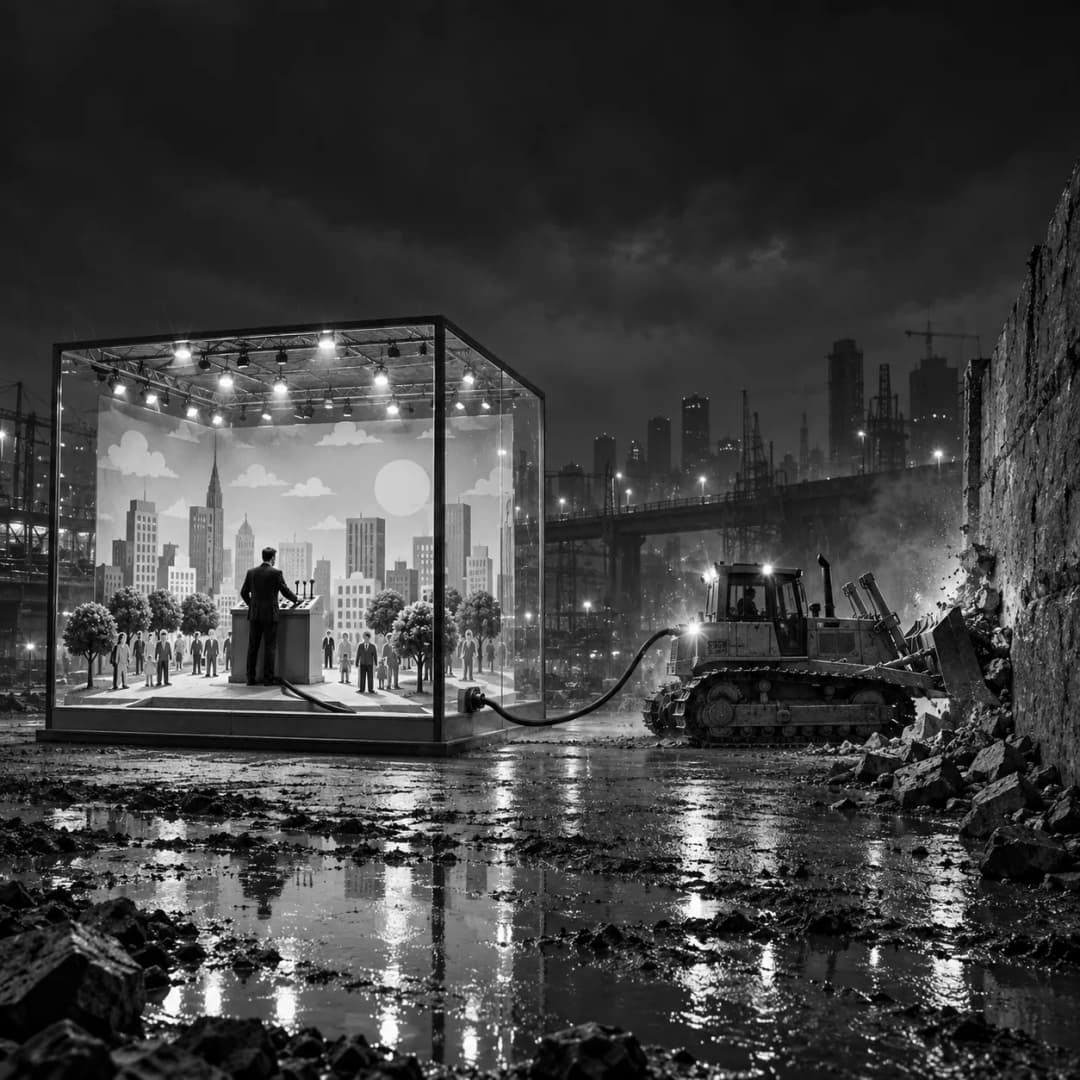
The pseudo-environment is Walter Lippmann's term, from Public Opinion in 1922, for a representation inserted between a person and the world. His claim is structural: behaviour responds to the representation, while the consequences of that behaviour land in the world. The passage sits in Part I, Chapter I, section 3, in the chapter titled 'The World Outside and the Pictures in Our Heads'. The edition the vault read is the Project Gutenberg text, which has no page numbers, so no page number is ever attached to a quotation from it.
What it is
Lippmann's own words are worth having exactly: in all these instances, he writes, we must note particularly one common factor, which is the insertion between man and his environment of a pseudo-environment, to that pseudo-environment his behaviour is a response, but because it is behaviour the consequences, if they are acts, operate not in the pseudo-environment where the behaviour is stimulated but in the real environment where action eventuates. He names the cost of the mismatch immediately afterwards, as the sensation of butting one's head against a stone wall, of learning by experience, and witnessing what he calls Herbert Spencer's tragedy of the murder of a beautiful theory by a gang of brutal facts. And he draws a line against reading the idea as a theory of lying, writing that by fictions he does not mean lies but a representation of the environment which is in lesser or greater degree made by man himself. The unit is a population rather than a perceiver, because the point is not that one person misreads one ambiguous thing, which is a different argument in a different part of the book, but that a whole population can share a supplied representation of something none of them has first-hand access to.
In effect
The idea is the seed of cultivation research, which is the one major media literature that tried to measure Lippmann's structure directly. Gerbner's programme coded what television showed and then asked people what they believed about the world, which is an attempt to put a number on the pictures in our heads.
The asymmetry is the usable part. If behaviour answers to the representation while results arrive from the world, then a well-run organisation can be competent at managing its representation and still collide with the world, and the collision is the only correction the structure provides.
Section 3 is also where the Joffre hero-worship material and the Miss Sherwin passage sit, which makes it the right locus for anything about what a mass audience does with a figure it has only ever seen on a screen.
What it does not say
Lippmann has no finding, because the only controlled demonstration anywhere in the twenty-eight chapters is the Göttingen staged brawl, taken at third hand, and it measures eyewitness accuracy rather than belief formation, so he supplies a frame and the evidence for or against anything built on it has to come from the modern literature; he should never be cited for a psychological result. It licenses no dose-response claim, because nothing in the passage says that more exposure produces more distortion, which is cultivation's claim rather than his and is precisely the claim the critics attack. It licenses no direction of causation either, since the paragraph describes a structure and does not test whether a representation makes people fearful or fearful people seek out a representation, and that ambiguity is the one the selection objection turns on while Lippmann never touches it. And it is not a theory of deception, as he says himself, so treating the pseudo-environment as a synonym for propaganda misreads the sentence distinguishing fictions from lies; one related correction belongs here, that the phrase about the manufacture of consent is Lippmann's own, at Part V, Chapter XV, section 4, and not Bernays's, whose Propaganda came six years later.
Sources
- Lippmann, W. (1922). Public Opinion. Part I, Chapter I, section 3, for the pseudo-environment passage, the stone-wall sentence and the distinction between fictions and lies. Part V, Chapter XV, section 4, for the manufacture of consent. Read in full in the vault from Project Gutenberg ebook 6456, which has no page numbers, so part, chapter and section are cited and no page number is given.
- Gerbner, G., & Gross, L. (1976). 'Living with Television: The Violence Profile.' Journal of Communication, 26(2), 172-199. doi:10.1111/j.1460-2466.1976.tb01397.x. The empirical descendant, cited here for what it attempted rather than for what it showed.