The Sad-Film Paradox
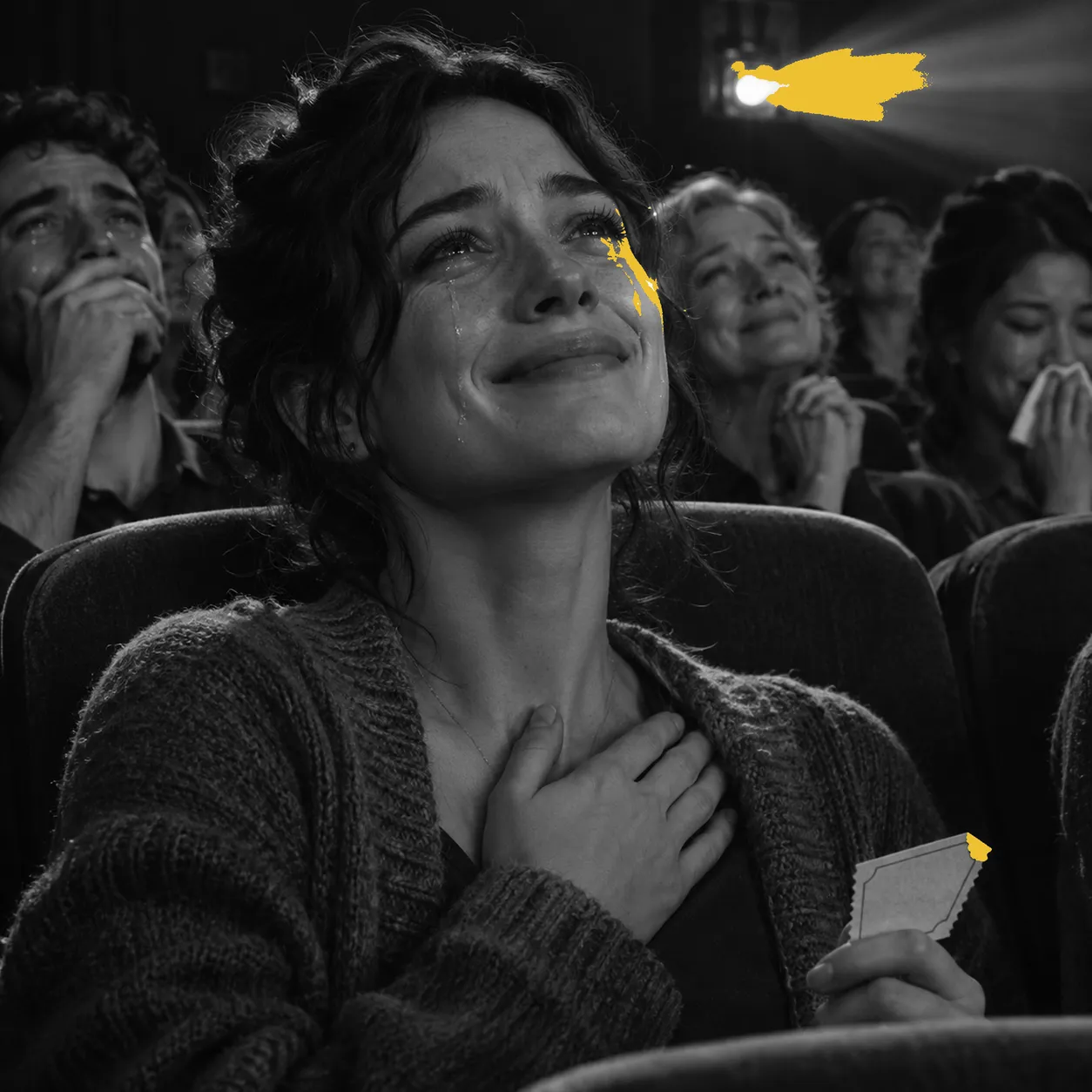
The sad-film paradox is the puzzle of how a negative emotion such as sadness can go together with liking and pleasure. Julian Hanich and colleagues proposed in 2014 that being moved accounts for most of the link in viewers of sad film clips.
What it is
If sadness is unpleasant, people should avoid sad films. They do not. The sad-film paradox is the puzzle of how a negative emotion such as sadness can go together with liking and pleasure.
Julian Hanich and colleagues tested the puzzle in a cinema in 2014. Seventy-six participants watched 38 clips in which a character or group learned of a death. Sadness and enjoyment were strongly positively correlated, and the feeling of being moved almost fully carried that link. The authors concluded that people enjoy sad films because they like being moved.
The finding turns the paradox from a contradiction into a question about which feeling is doing the work: sadness itself, or the feeling of being moved that sadness can feed.
In effect
In the article on why we like sad films, the paradox opens the question and being moved answers it. Across the clips, sadness and enjoyment rose together, and the sense of being moved explained nearly all of the connection. The article then asks what makes a sad scene moving and not only sad, and turns to the idea that enjoyment has more than one form.
For a viewer the practical reading is that choosing a sad film is not a choice of misery. Many people seek the feeling of being moved, and a sad story is one dependable way to reach it.
What it does not say
It does not say that sadness is pleasant by itself, or that people seek sadness for its own sake. The studies measured reported feeling, not motive. They do not show why being moved feels good, or whether every viewer responds the same way. The clips all showed a death, so the findings do not cover every kind of sad film.
It also does not say how a person should feel after watching a sad film, and it makes no claim about wellbeing.
Where it comes from
The puzzle of enjoyable negative emotion is old in the study of tragedy and art, and no single originator is traced here for the name used by this site. The 2014 cinema study by Julian Hanich and colleagues is the work from which the article takes its account, and it appeared in Psychology of Aesthetics, Creativity, and the Arts.
What the research found
The 2014 study found the pattern described above: a strong positive link between sadness and enjoyment, almost fully mediated by being moved.
A 2017 study by Jonna Vuoskoski and Tuomas Eerola moved the question to music. In their first experiment, 308 participants heard five sad excerpts, and the positive link between felt sadness and liking was fully mediated by being moved. In the second, 27 excerpts varied in sadness and beauty. The account in which being moved mediates the effect of sadness on liking received stronger support than an account in which beauty does.
Two further lines of work place the finding in context. Mary Beth Oliver and Anne Bartsch proposed in 2010 that appreciation is a gratification complementary to enjoyment. Across three studies, especially with serious, poignant and pensive films, a measure of appreciation sat alongside measures of fun and suspense and alongside moving, thought-provoking experiences, and was linked to perceived enduring effects. Oliver and Arthur Raney (2011) developed measures of hedonic motives, which concern pleasure, and eudaimonic motives, which concern meaning and truth-seeking. Four studies supported the measures, and the motives predicted preferences for entertainment that produces distinct emotional experiences.
Where opinion differs
Two accounts compete to explain why sad material is liked. One places the weight on being moved, the feeling that the studies above found to carry the link. The other places it on beauty or on meaning, which the 2017 music study tested directly and found less well supported. A third view, from the work on appreciation, treats the pleasure of a sad film as a different kind of satisfaction from fun, one tied to meaning and lasting effect. These views overlap and are not presented here as opponents. They are best read as different cuts through the same experience, and the studies were of films and music in laboratory and cinema settings.
How this site uses it
The Why We Project uses the sad-film paradox as the opening question of its piece on why we like sad films, and being moved as the answer the studies support. It reads the book Your Brain on Art by Susan Magsamen and Ivy Ross as a frame only, in which an experience of art draws on sensory, reward and meaning-making systems together. The application of that frame to a sad scene is the article's interpretation.
Sources
- Hanich, J. and colleagues (2014), Psychology of Aesthetics, Creativity, and the Arts 8(2), 130-143.
- Vuoskoski, J. K. and Eerola, T. (2017), Frontiers in Psychology 8, 439.
- Oliver, M. B. and Bartsch, A. (2010), Human Communication Research 36(1), 53-81.
- Oliver, M. B. and Raney, A. A. (2011), Journal of Communication 61(5), 984-1004.
- Magsamen, S. and Ross, I., Your Brain on Art.