The Strange Situation
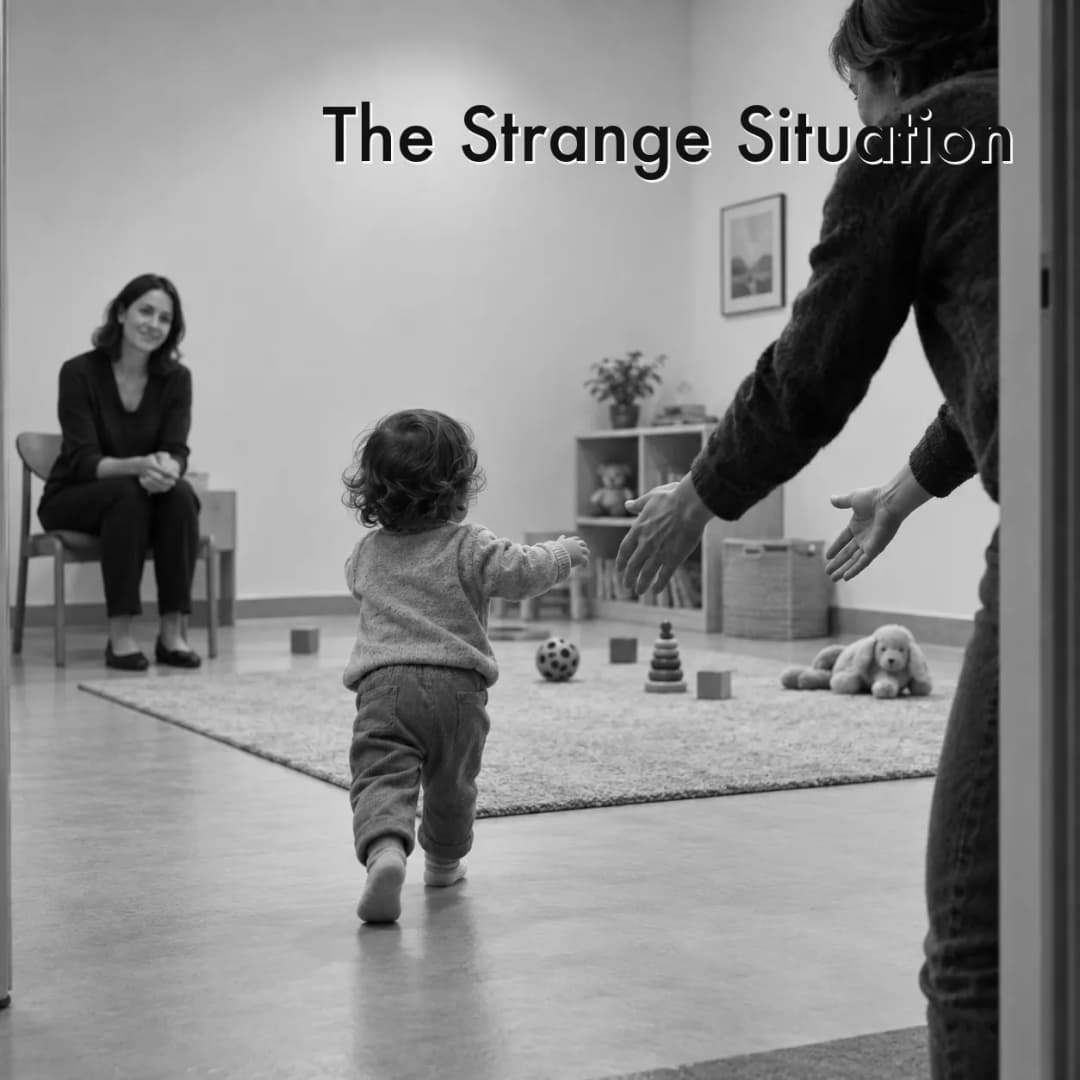
Twenty minutes, one playroom, one stranger, and two separations. It is the instrument that made attachment measurable, it is the source of every attachment style word you have heard, and it agrees with itself only weakly when run on the same babies six months apart.
What it is
Mary Ainsworth and Barbara Wittig designed it in the late 1960s. A parent and a one-year-old enter an unfamiliar room with toys. A stranger comes in. The parent leaves. The parent returns. It happens twice, in eight short episodes.
The design insight is what gets scored. Not how much the baby cries during the separation, which turns out to say little, but what the baby does in the first seconds after the door opens.
Some go to the parent, settle quickly and return to the toys. Some barely acknowledge the parent, staying with the toys with an indifference that measurement shows to be effortful rather than genuine. Some cannot settle at all, seeking contact and resisting it in the same movement. Mary Main and Judith Solomon added a fourth in 1990, for babies whose behaviour contradicts itself or briefly freezes.