The Uncanny Valley
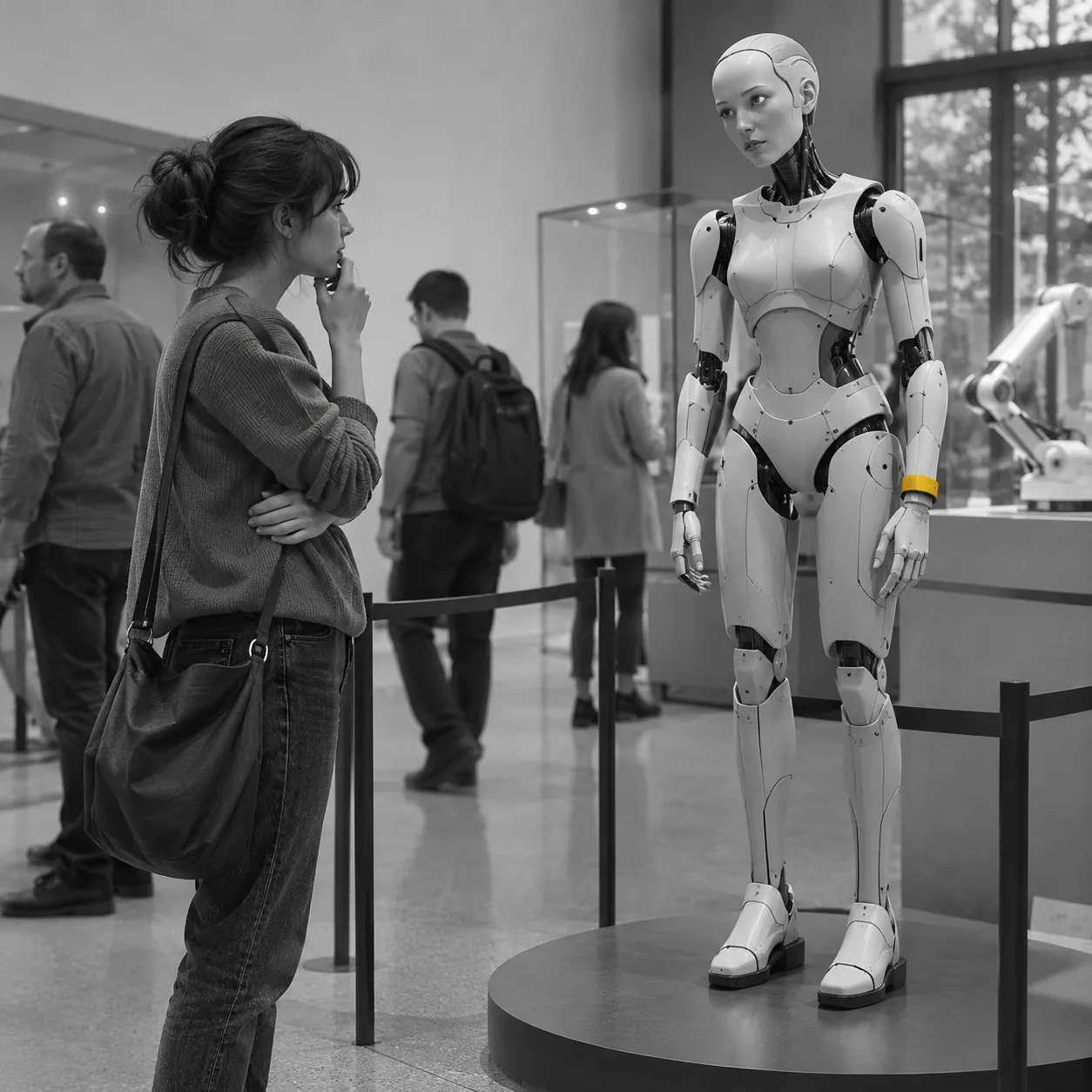
A proposed dip in affinity for figures that look almost, but not fully, human.
What it is
Masahiro Mori, a robotics professor, proposed in a 1970 essay that feeling towards a human-like robot would turn sharply from empathy to unease as its appearance became realistic but still fell short of lifelike; an authorised English translation appeared in 2012. Jari Kätsyri and colleagues reviewed the evidence in 2015 and found little consistent support for near-human appearance alone causing eeriness, and support for perceptual mismatch. Maya Mathur and David Reichling found the dip in likability ratings for 80 real robot faces in 2016, and in an investment game it also shaped trust. Alexander Diel and colleagues pooled 72 studies in 2021 and found face distortion produced the largest effect, while Martina Mara and colleagues pooled 49 studies in 2022 and found likability rose with human likeness at low and medium levels, with too few highly human-like robots studied to judge the top of the scale.
In effect
In the article on the uncanny valley, the dip is the reason an almost-human face can feel wrong when a cartoon or a real face does not.
What it does not say
It is not a settled law of perception; the evidence points more to mismatched features than to closeness to human appearance alone.
Sources
- Mori, M., MacDorman, K. F., & Kageki, N. (2012). The uncanny valley [From the Field]. IEEE Robotics & Automation Magazine, 19(2), 98-100.
- Kätsyri, J., Förger, K., Mäkäräinen, M., & Takala, T. (2015). A review of empirical evidence on different uncanny valley hypotheses: Support for perceptual mismatch as one road to the valley of eeriness. Frontiers in Psychology, 6, 390.
- Mathur, M. B., & Reichling, D. B. (2016). Navigating a social world with robot partners: A quantitative cartography of the Uncanny Valley. Cognition, 146, 22-32.
- Diel, A., Weigelt, S., & MacDorman, K. F. (2021). A meta-analysis of the uncanny valley's independent and dependent variables. ACM Transactions on Human-Robot Interaction, 11(1), 1-33.
- Mara, M., Appel, M., & Gnambs, T. (2022). Human-like robots and the uncanny valley: A meta-analysis of user responses based on the Godspeed scales. Zeitschrift für Psychologie, 230(1), 33-46.
- Burnett, D. The Idiot Brain.