The Watching Eyes Effect
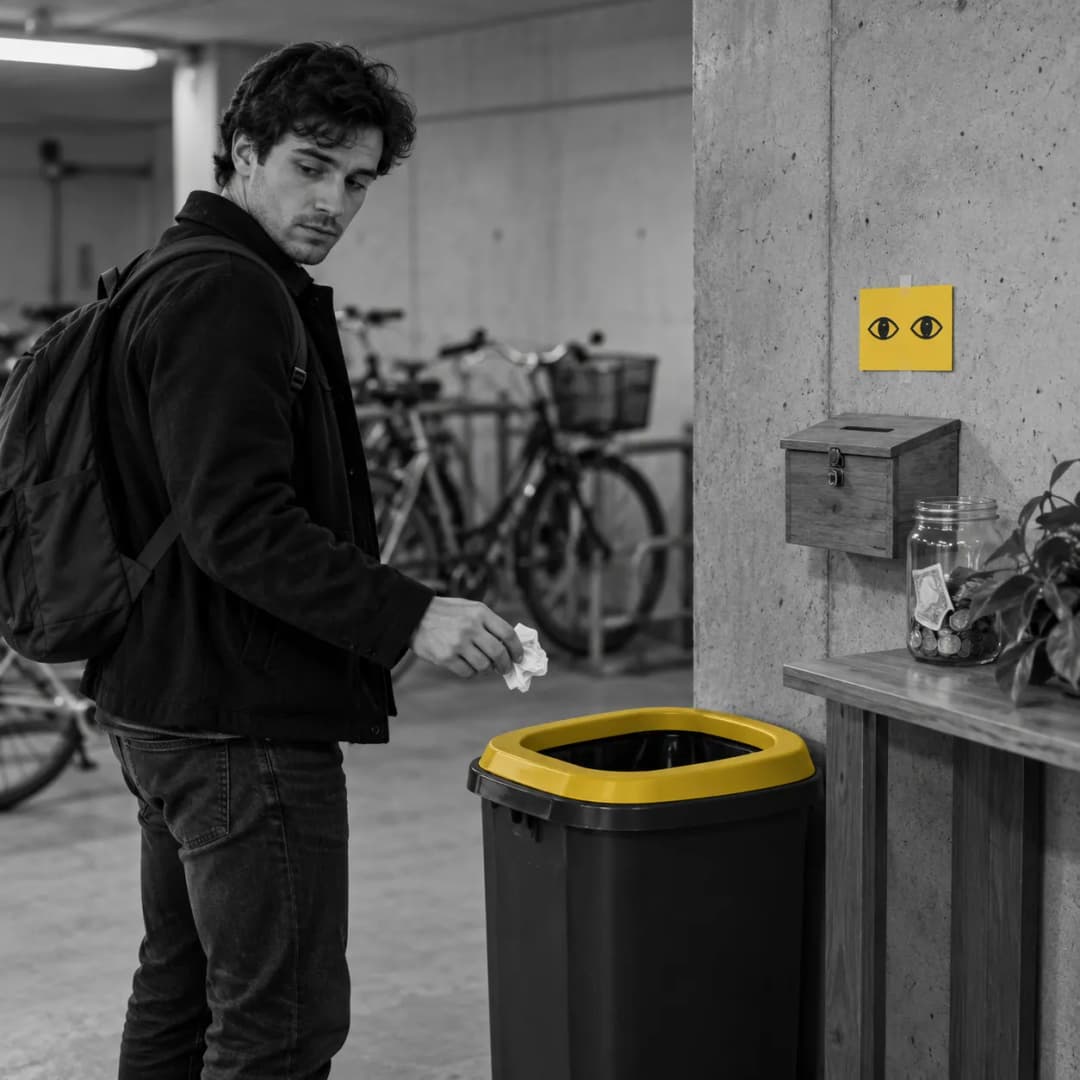
The watching eyes effect is the claim that people behave better when something resembling a pair of eyes is present, even a crude drawing. The evidence is split by what is measured. Pooled studies find no lift in generosity, and a smaller body of work links eye images to fewer small acts of rule-breaking. The original coffee-room result, about 2.76 times as much money for milk under a pair of eyes, comes from one room over ten weeks.
What it is
The effect belongs to a family of findings in which cues of being observed change behaviour even when nobody is observing. The cue can be a photograph of a face, a stylised pair of eyes, a poster, or a drawing too simple to be mistaken for a person. The explanation usually offered is that people are built to care about their reputation, so a cue that resembles a watcher triggers some of the same caution as a real one. The Elephant in the Brain uses the effect on p. 60 as evidence that people are built to evade norms when they believe they are unobserved.
The best-known demonstration is a field study by Melissa Bateson and colleagues, published in Biology Letters in 2006. In a university coffee room, a notice above an honesty box alternated weekly for ten weeks between a pair of eyes and a picture of flowers. The eye images varied in sex and head orientation, but all looked directly at the viewer. The price list asked 30 pence for tea, 50 pence for coffee and 10 pence for milk. Per litre of milk consumed, people paid £0.417 in the eye weeks and £0.151 in the flower weeks, about 2.76 times as much.
That figure made the effect famous, and it is the source of most later claims. It is a real result from one room, with ten swaps of the poster and no observer present.
In effect
The effect behaves differently depending on the behaviour it is asked to change.
On generosity, the pooled evidence is negative. Northover, Pedersen, Cohen and Andrews published two meta-analyses in Evolution and Human Behavior in 2017. One combined 26 experiments and about 2,700 participants and looked at how much people gave. The other combined 27 experiments and nearly 20,000 participants and looked at whether they gave anything at all. Both found no evidence that artificial surveillance cues increase generosity, and the authors concluded that scepticism is warranted. A preregistered dictator game by Rotella and colleagues, published in PLoS ONE in 2021, pointed the same way. Participants reported feeling more observed when decisions were public, yet they gave no more when decisions were public or when eye images were present.
On antisocial behaviour, the record is better. A systematic review and meta-analysis by Dear and colleagues, published in Evolution and Human Behavior in 2019, combined 15 experiments from 13 papers, with 2,035 participants. Photographs or stylised images of eyes were associated with a 35 per cent reduction in the risk of antisocial behaviour. The authors set that against the 16 per cent reduction that systematic reviews estimate for CCTV cameras, and argued that eye images were a cheap candidate for crime-reduction policy.
The best-known field test of that kind is the Newcastle bicycle study, published in PLoS ONE in 2012 by Daniel Nettle, Kenneth Nott and Melissa Bateson. Signs with watching eyes and a related verbal message were placed above bicycle racks at three high-theft sites, and reported thefts were followed for twelve months before and after. Thefts fell 62 per cent at the signed sites, while the rest of the campus saw a 65 per cent increase. The authors allowed that the signs might have displaced offending to places without them.
Real observers are a separate question. A 2018 meta-analysis of 117 papers by Bradley, Lawrence and Ferguson found a small positive link between observability and prosocial behaviour (r = 0.141). The link was stronger when a passive observer was present than when participants only perceived that they were being watched. That review covered observability in general, not eye pictures.
What it does not say
It does not say that people give more when they see eyes. The meta-analyses and the preregistered test found no such effect, and this library's reading is that the effect on generosity is far weaker than the 2006 coffee-room result suggested.
It does not say the Newcastle bicycle study is conclusive. Tom Stafford, writing in Mind Hacks in 2013, raised four concerns. No sign carried the message without the eyes, so the study cannot separate the two. Thefts rose at nearby unsigned spots, so the effect was local. A thief warned that some bikes are watched can simply choose an unwatched rack, which is a rational choice and not an unconscious response. And owners who care about security may have chosen the signed racks. The study's own authors recommended the signs as an adjunct to other measures.
It does not say the 35 per cent figure is settled. It rests on 15 experiments, and the authors of the review note earlier doubts about the effect on generosity.
It does not say anything about other cues that share the family. The God-priming literature is one example. Its own authors' 2016 meta-analysis found the effect reliable only among existing believers and absent among non-believers, and a Japanese replication in 2017 found nothing. That is a separate finding with a separate record.
The effect is also easy to over-read from one citation. The Elephant in the Brain presents it in its main text as an established result and discloses the contrary meta-analyses only in a Chapter 4 endnote, which most readers will not open.
Sources
- Bateson, M., Nettle, D., & Roberts, G. (2006). Cues of being watched enhance cooperation in a real-world setting. Biology Letters, 2(3), 412-414. doi:10.1098/rsbl.2006.0509
- Northover, S. B., Pedersen, W. C., Cohen, A. B., & Andrews, P. W. (2017). Artificial surveillance cues do not increase generosity: two meta-analyses. Evolution and Human Behavior, 38(1), 144-153. doi:10.1016/j.evolhumbehav.2016.07.001
- Rotella, A., Sparks, A. M., Mishra, S., & Barclay, P. (2021). No effect of "watching eyes": An attempted replication and extension investigating individual differences. PLoS ONE, 16(10), e0255531. doi:10.1371/journal.pone.0255531
- Bradley, A., Lawrence, C., & Ferguson, E. (2018). Does observability affect prosociality? Proceedings of the Royal Society B, 285(1875), 20180116. doi:10.1098/rspb.2018.0116
- Dear, K., Dutton, K., & Fox, E. (2019). Do "watching eyes" influence antisocial behavior? A systematic review & meta-analysis. Evolution and Human Behavior, 40(3), 269-280. doi:10.1016/j.evolhumbehav.2019.01.006
- Nettle, D., Nott, K., & Bateson, M. (2012). Cycle thieves, we are watching you: Impact of a simple signage intervention against bicycle theft. PLoS ONE, 7(12), e51738. doi:10.1371/journal.pone.0051738
- Stafford, T. (2013). Did the eyes really stare down bicycle crime in Newcastle? Mind Hacks, 16 May 2013.
- Simler, K., & Hanson, R. (2018). The Elephant in the Brain. Oxford University Press, p. 60 and Chapter 4 endnotes.