The WEIRD Critique
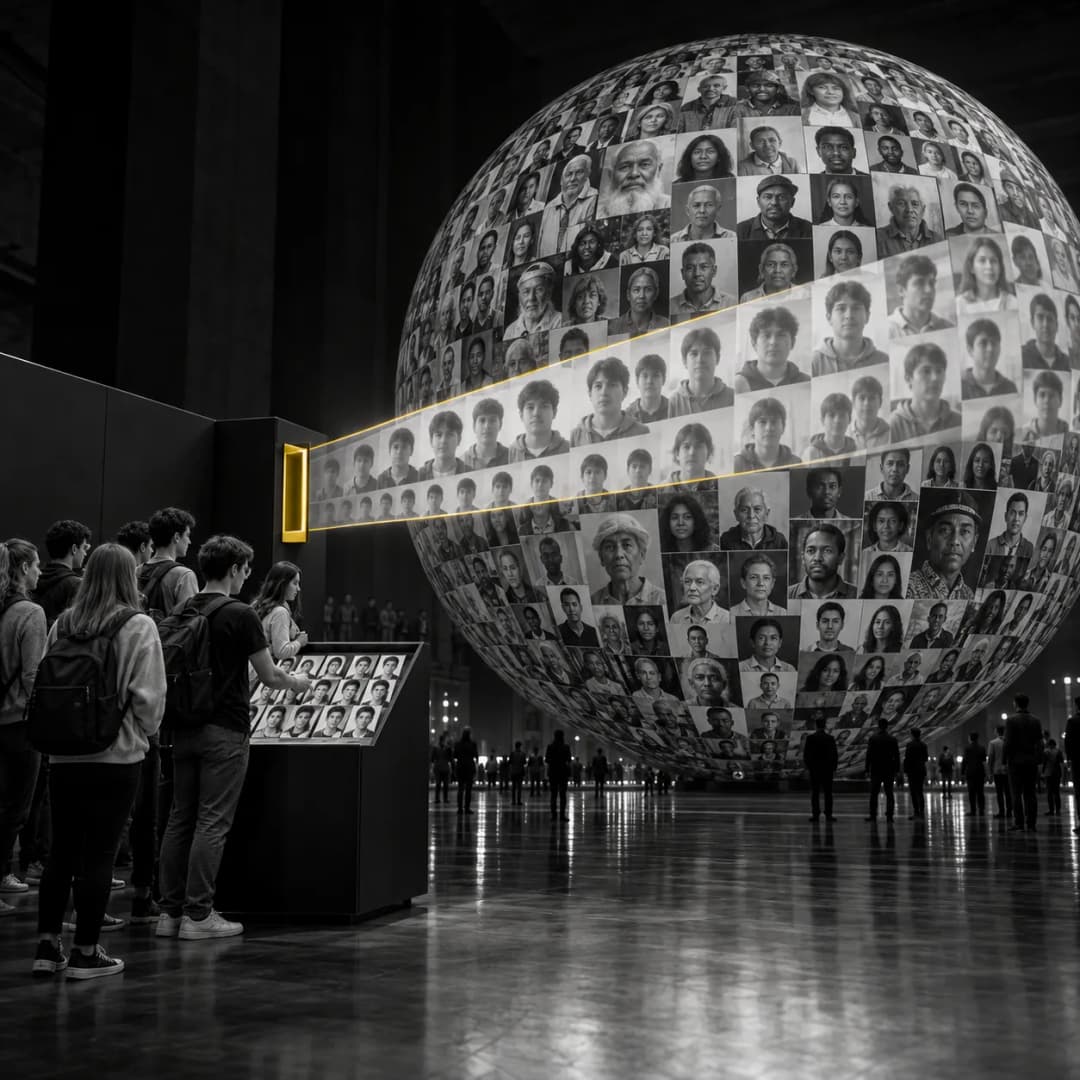
The WEIRD critique is the claim that behavioural science has described a narrow slice of humanity and reported the result as a description of people. Joseph Henrich, Steven Heine and Ara Norenzayan named it in 2010, from counts showing 96 per cent of subjects drawn from Western industrialised countries. Three audits over the following fifteen years agree the composition has barely moved. Whether the narrowness makes findings wrong is a separate and much weaker claim, and the same 2010 paper lists the domains where populations look alike.
What it is
WEIRD stands for Western, educated, industrialised, rich and democratic. The critique has two halves that are usually run together and should not be, because one is a count and the other is a hypothesis.
The first half is composition, and it is a count. Across the top journals of six subdisciplines of psychology between 2003 and 2007, 96 per cent of subjects came from Western industrialised countries and 68 per cent came from the United States. Those countries hold 12 per cent of the world's population. In the same paper's reckoning, a randomly selected American undergraduate is more than four thousand times more likely to be a research participant than someone outside the West. A separate count, within the Journal of Personality and Social Psychology, found 67 per cent of American samples composed solely of undergraduates in psychology courses. Both counts belong to Jeffrey Jensen Arnett's 2008 audit, which Henrich, Heine and Norenzayan cite in the sentence that reports them, and which this publication has not read in the original.
The second half is generalisability, and it is a hypothesis. It says that findings established on that slice may not describe the species, because the slice is unusual. The 2010 paper's strongest material here is comparative: industrialised populations sit at the extreme end of the distribution on visual illusions, on fairness in economic games, on folkbiological cognition and on spatial cognition, and the paper's own section on outliers among outliers reports that university students are anomalous even within their own countries, with non-student American adults in one dictator-game comparison offering a mean 47 per cent of the stake against undergraduate freshmen's 32 per cent.
The two halves have different standing, and that distinction is the most useful thing on this page. Composition has been counted three times across twenty years by three different teams, and it has barely moved. Generalisability has been tested a few times, and the answer depends heavily on what gets to count as a different culture.
The counter-case is in the same 2010 paper, in a section almost nobody quotes. Section 3.6 lists the domains in which small-scale and industrialised societies look alike: the perspective drawing illusion, where perception varies little across the populations studied; colour perception; the explicit false-belief task, passed in every population studied though at ages ranging from four to at least nine; analog numeracy, which operates similarly in two Amazonian societies with very limited counting systems; psychological essentialism, across Madagascar, Brazil, Wisconsin, rural Ukraine, Chile, Detroit and Mongolia; and facial emotion recognition, where the authors report a main effect across populations accounting for 58 per cent of variance against 9 per cent for cultural specificity. That last figure is their report of a 2002 meta-analysis which this publication has not read, and it is attributed accordingly.
And the authors have since cautioned against the strong form of their own label. A 2024 commentary co-authored by all three of them records that the WEIRD backronym was intended as a rhetorical device rather than as a measure, and that decomposing its letters into country-level indicators is a poor way to test whether culture moderates an effect. A critique whose own originators ask you not to operationalise it that way is a critique worth stating carefully.
In effect
In research: Many Labs 2, the counter-case at full strength
Richard Klein and 185 colleagues ran 28 published findings with protocols peer reviewed in advance, across 125 samples, 15,305 participants and 36 countries and territories. Exploratory comparisons revealed little heterogeneity between WEIRD and less WEIRD cultures, and variability in effect sizes tracked which effect was studied more than where it was studied. The authors label the cultural comparison exploratory themselves. The 2024 reply, co-authored by the three originators of the critique, notes that 39 per cent of that pool was United States-based and that participants came mostly from university subject pools and online labour platforms. Both sides are arguing about composition, and they twice call the project a milestone.
In the audits: slightly less American, not wider
Amber Gayle Thalmayer, Caterina Toscanelli and Arnett re-counted the same six journals for 2014 to 2018 and found authors and samples a little over 60 per cent American, down from over 70 per cent, with the change coming almost entirely from other English-speaking and Western European countries. Eleven per cent of the world's population is now represented in those journals and 89 per cent still is not, with majority-world authors and samples at 4 to 5 per cent. Leah Petrutiu and colleagues, in a preregistered open-access audit of five British Psychological Society journals for 2021 to 2023, coded 1,293 samples at 67.6 per cent Western, with 13.1 per cent naming no country at all, and say the real figure could be as high as eighty per cent.
In commerce: two products with the same invoice
A buyer of a consumer finding is being sold one of two things. In the first, the effect is a fact about people, and it will survive contact with a market in Lagos or Jakarta. In the second, it is a fact about educated Anglophone adults who answer questionnaires for money. Both arrive described the same way, at the same price, and the composition of the sample is the only part of the document that distinguishes them. Nobody is pricing them differently, and most agency decks do not report the country the participants were in.
What it does not say
It does not say that a finding measured on a narrow sample is false. The composition claim is a count and does not license that inference, and the generalisability claim has been tested too few times, on too contested a definition of culture, to support it either. A narrow sample is a reason to withhold confidence rather than grounds to assume the result is wrong.
It does not say that nothing travels. The 2010 paper's own section 3.6 lists several domains where populations look alike, and the largest multi-site replication project to date found little heterogeneity between WEIRD and less WEIRD samples on the effects it tested.
It is also not a measure. Its own originators record that the backronym was a rhetorical device, and that splitting its letters into country-level indicators is a poor way to test cultural moderation.
And it says nothing about any individual researcher's care or motives. The best available explanation of the pattern's persistence is an incentive rather than negligence: restricting a crowdsourced sample to one country lowers variance, and lower variance makes an effect easier to detect.
Sources
- Henrich, J., Heine, S. J., & Norenzayan, A. (2010), "The weirdest people in the world?", Behavioral and Brain Sciences 33(2-3), 61-83, doi:10.1017/S0140525X0999152X. The target article was read in full; the retrieved text ends inside the Discussion, the reference list was not in it, and the open peer commentaries published alongside it were not retrieved, so no work cited by this paper is confirmed through it.
- Arnett, J. J. (2008), "The neglected 95%: Why American psychology needs to become less American", American Psychologist 63(7), 602-614. The source of both headline counts. Located but not read, and nothing is quoted from it.
- Thalmayer, A. G., Toscanelli, C., & Arnett, J. J. (2021), "The neglected 95% revisited", American Psychologist 76(1), 116-129, doi:10.1037/amp0000622. Abstract and public significance statement read in full; full text not retrieved.
- Petrutiu, L., Birney, M. E., Cooke, R., & Stewart, S. (2026), "WEIRD but Also Inconsistent", International Journal of Psychology 61(2), e70168, doi:10.1002/ijop.70168. Read in full, open access and preregistered.
- Klein, R. A., and 185 colleagues (2018), "Many Labs 2", Advances in Methods and Practices in Psychological Science 1(4), 443-490, doi:10.1177/2515245918810225. Abstract read in full; the body was retrieved only in part, and the paper's own account of its WEIRDness coding was not recoverable.
- Schimmelpfennig, R., Spicer, R., White, C. J. M., Gervais, W. M., Norenzayan, A., Heine, S., Henrich, J., & Muthukrishna, M. (2024), "The Moderating Role of Culture in the Generalizability of Psychological Phenomena", Advances in Methods and Practices in Psychological Science 7(1), 1-6, doi:10.1177/25152459231225163. Read in full, CC-BY. Schimmelpfennig and Spicer share first authorship.