The Yerkes-Dodson Curve
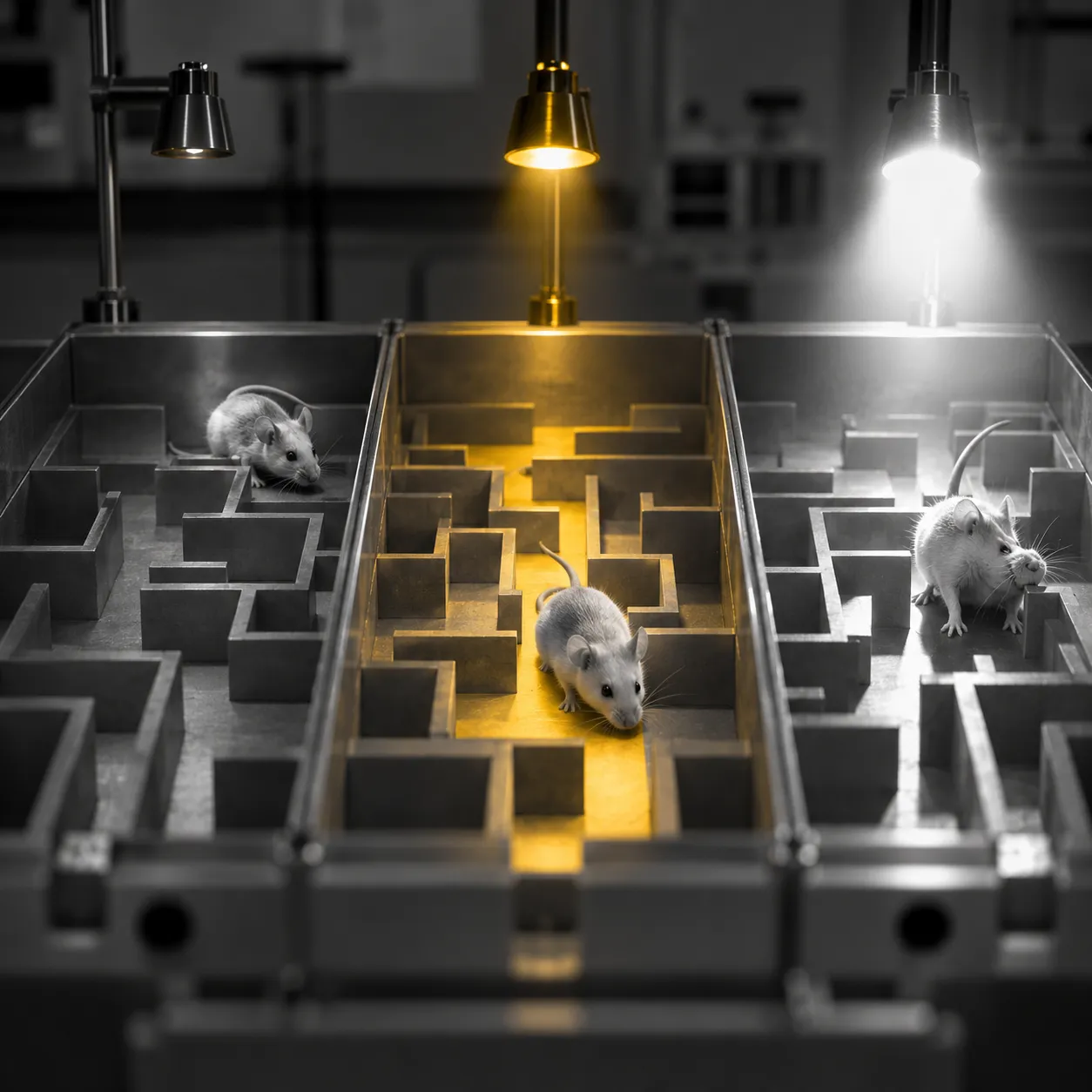
The Yerkes-Dodson curve is the inverted U linking arousal to performance: performance rises as arousal rises, up to a point, and then falls. It comes from a 1908 experiment by Robert Yerkes and John Dodson in which Japanese dancing mice learned to tell a white chamber from a black one under electric shock. The popular version, in which a moderate level of emotional arousal is best for any person doing any job, goes well beyond what that experiment measured.
What it is
Yerkes and Dodson published their paper in 1908 in the Journal of Comparative Neurology and Psychology, in a paper on how the strength of a stimulus relates to the speed of habit formation. The animals were Japanese dancing mice. The task was a discrimination between a white and a black chamber, with an electric shock as the penalty for choosing wrongly. The researchers varied how strong the shock was and how difficult the discrimination was.
Learning sped up as the shock got stronger and then slowed at the strongest level. The inverted U appeared in the harder version of the task, and the best level of shock depended on the difficulty of the discrimination: the peak arrived earlier for harder tasks than for easier ones.
The idea is often called a law. This site uses the word curve, because the finding comes from one experiment on one species with one kind of stimulus, and a law promises a generality nobody has measured.
In effect
The shape has been carried into accounts of human stress, sport, management and examination performance. The 1908 paper measured none of those. What the experiment supports is narrower and still useful: the link between activation and performance need not run in a straight line, and where the peak falls depends on how hard the task is.
What it does not say
It does not say that people perform best at a moderate level of arousal. It does not locate the peak for any human task, because the paper did not study people. It does not show that stress and arousal are the same thing, since the manipulation was electric shock and the measure was learning speed in a discrimination task.
A working account of acute stress degrading complex performance exists in separate literature on prefrontal function. Where a claim about people is needed, that literature, and not the mouse experiment, is the place to cite.
Sources
- Yerkes, R. M., & Dodson, J. D. (1908). The relation of strength of stimulus to rapidity of habit-formation. Journal of Comparative Neurology and Psychology, 18(5), 459-482. doi:10.1002/cne.920180503