Third Places
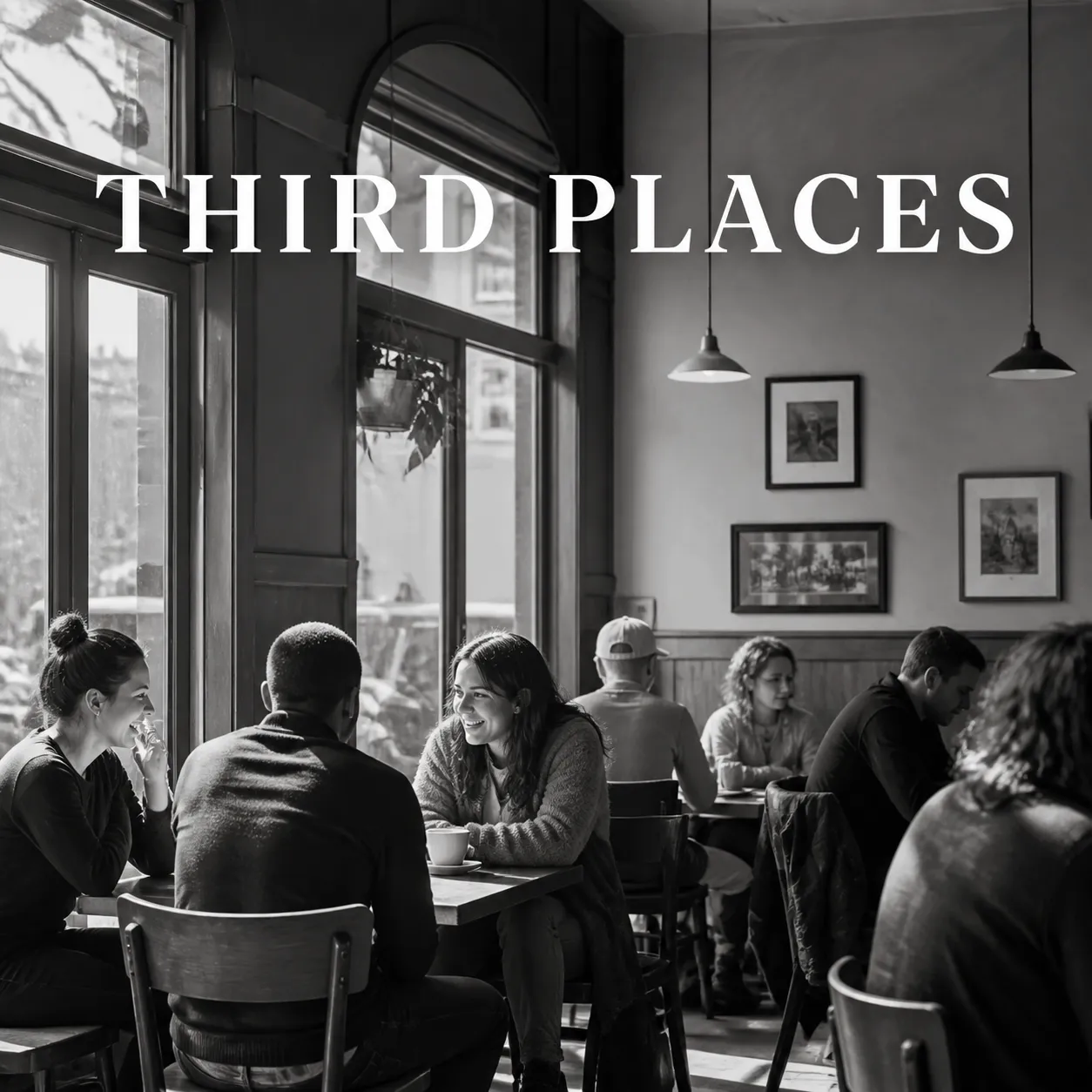
Ray Oldenburg's term, from The Great Good Place (1989), for the social anchor that is neither home, the first place, nor work, the second. Cafés, pubs, barbershops, gyms, churches, community centres, the regular bench in the park: any space where people gather repeatedly without an agenda qualifies, provided it meets a checklist Oldenburg laid out in detail. Third places is a sociological framework rather than an experimental finding, and it names the structural remedy that the diagnosis of digital loneliness keeps reaching for.
What it is
Most people's daily geography sorts easily into two categories. There is home, where you live and are responsible for the people in it, and there is work, where you are paid and evaluated. Ray Oldenburg's contribution, in The Great Good Place (1989), was to argue that a third category does real and separate work in a person's life, and that modern design was quietly building it out of existence.
A third place is anywhere people gather regularly for the sake of gathering rather than for any errand the space is nominally for. The coffee is not really the point of the café; the haircut is not really the point of the barbershop. Oldenburg set out what a space needs in order to function this way. It has to be neutral ground, somewhere nobody is hosting and nobody has to be a guest. It has to act as a leveller, checking rank and job title at the door. Conversation has to be the main activity, not a byproduct of some other task. It has to be accessible and accommodating, open to being dropped into without an invitation or a reservation. It needs regulars, whose presence sets the tone more than the owner's. It should keep a low profile rather than announcing itself. The mood should be playful rather than solemn. And the whole of it should function as a kind of home away from home, familiar enough that showing up feels like arriving rather than visiting.
Strip out any one of those conditions and the space tends to drift. It stops being a place a person belongs to and becomes a venue they visit, which is a smaller and more replaceable thing. A wine bar with excellent wine and no regulars is not a third place in Oldenburg's sense, no matter how often somebody goes there; a diner where the same six people show up every morning, and the coffee starts before they ask for it, is one, however plain the coffee happens to be.
This is a taxonomy rather than a hypothesis, which is why it sits in the not-a-research-claim category on this site rather than robust or contested. There is no sample size to report and no effect that could fail to replicate, because Oldenburg was not testing a prediction. He was naming a pattern he thought social life had stopped protecting, and the value of the framework is descriptive: it gives a vocabulary for diagnosing why a space that looks social on paper does not actually produce belonging in practice. That diagnostic use is what connects it directly to Digital Loneliness, which describes the felt cost of not having enough third places, and to Belonging, the underlying need Oldenburg's checklist is really describing the conditions for.
In effect
The eight-point checklist as a filter, not a vibe
The value of Oldenburg's list is that it turns "this place has a nice atmosphere" into something closer to a test. A shared open-plan office kitchen, for instance, can look like a third place on the surface: people gather there, there is coffee, there is conversation. But it usually fails the neutral-ground and leveller conditions, since a junior employee and their manager are not on equal footing there, and almost nobody treats the space as accessible outside working hours. Running a candidate space through the eight conditions, rather than judging it on ambience alone, is the practical use of the framework.
The neighbourhood gym and the Saturday-morning run club
The third places that hold up in practice tend to be smaller, denser and physically a little inconvenient rather than frictionless. Independent cafés where the regulars get acknowledged by name, run clubs that default to a 7am Saturday start whatever the weather, neighbourhood gyms where the same fifteen or so people turn up three times a week: none of these are optimised for convenience. The friction is doing the work. It is what produces the recognition that makes a space feel like it belongs to the people in it, rather than the other way round.
Starbucks and the drift into a pickup counter
Starbucks explicitly tried to position itself as America's third place, and for a stretch it partly succeeded. What eroded it was not a change in the coffee but a change in the conditions Oldenburg specified: laptops turned tables into private workstations rather than shared ground, the drive-through removed the conversation entirely, and mobile ordering let a customer arrive, collect and leave without an interaction long enough to register as one. None of those changes were hostile to the third-place idea on purpose. They were optimisations for speed and convenience that happened to remove, one at a time, the conditions the checklist requires. Most Starbucks locations now function as transactional pickup counters, which is a different kind of place entirely, however similar the signage.
What it does not say
Third places is not a predictive theory. It does not say which specific people will suffer from lacking one, and it offers no measurement of how much a third place is worth compared with, say, a single strong friendship. It is also not a ranking: Oldenburg's eight conditions are presented together as a description of what tends to co-occur in spaces that work, not as a scored checklist where a space needs to clear some threshold of points. A space can be a strong third place while being unusually weak on one condition and unusually strong on another.
It is worth being clear, too, that this is one framework among several addressing a similar decline in associational life; Robert Putnam's Bowling Alone is often mentioned alongside it as a parallel diagnosis, though the two books approach the question from different angles and this site treats them as separate sources rather than interchangeable. Third places describes a category of physical and social space. It does not, on its own, explain why that category has been shrinking, only what tends to be lost when it does.
Who developed it
Ray Oldenburg, a sociologist, introduced the concept in The Great Good Place (1989). He does not yet have a dedicated page on this site.
Sources
- Oldenburg, R. (1989). The Great Good Place.
- Where this came from
- 3 books in this library carry this concept, which is corroboration worth knowing about, though these authors read each other and often draw on the same experiments, so it is not independent confirmation.