True and Illusory Halo
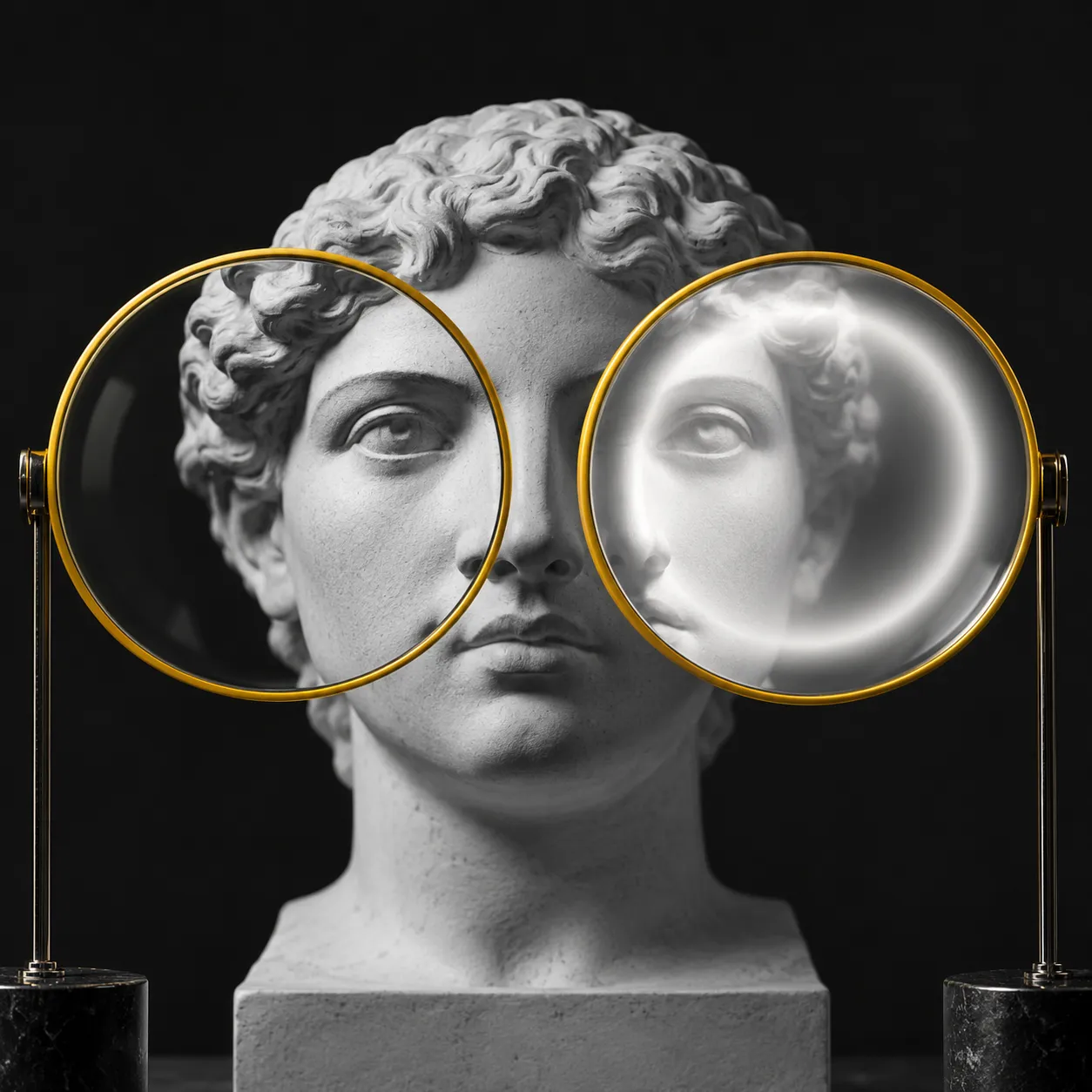
True halo is agreement among a person's ratings that reflects real links between their qualities. Illusory halo is agreement produced by the rater's overall impression, which spreads to qualities the rater has not checked. When one person is rated on several attributes, the ratings tend to move together, and the ratings alone do not say which kind of agreement they show. A 1993 critical analysis in the Journal of Applied Psychology argued that the two are confounded in most data, and recommended a pause in using halo measures as outcomes in applied research.
What it is
The halo effect is usually described as an error of the judge. Edward Thorndike gave it its name in 1920, after reading army superiors' ratings of officers for physique, intelligence, leadership and character, and finding that the ratings agreed more closely than he thought separate qualities would. On that view, a high score on one quality leaks into the others, and the agreement among the scores is the symptom.
The difficulty is that some qualities do go together. A person who is careful in one task may well be careful in another, and a person with a good memory may also be good at arithmetic. If a rater scores such a person highly on both, the agreement may be accurate. The two readings predict the same pattern in a table of ratings: scores that rise and fall together.
Kevin Murphy, Robert Jako and Rebecca Anhalt set this out in their 1993 paper, Nature and consequences of halo error: a critical analysis. Their abstract describes the definition that dominated researchers' thinking for most of the century. It held that halo error was common, that it was an error of the rater with true and illusory components, that it inflated correlations among rating dimensions because a general evaluation influenced specific judgments, and that it had negative consequences and should be avoided or removed. The authors reviewed research showing that all the major elements of this conception were either wrong or problematic. Because the true and illusory components remained confounded, and because the consequences of halo errors were often unclear, they suggested a moratorium on the use of halo indices as dependent measures in applied research. They also asked for studies that take account of the context in which judgments are formed and that more clearly separate actual halo errors from the apparent halo effect.
This page uses the two terms as they appear in that abstract, as the parts of the older definition. It does not credit them to one person.
In effect
A research case: the filmed instructor
The cleanest way to find illusory halo is to hold the person constant and change only the impression. In 1977 Richard Nisbett and Timothy Wilson staged two videotaped interviews with the same college instructor, who spoke English with a European accent. In one he was warm and friendly, in the other cold and distant. Viewers of the warm version rated his appearance, mannerisms and accent as appealing, and viewers of the cold version rated the same attributes as irritating. The authors concluded that global evaluations of a person can alter evaluations of their attributes even when there is enough information to judge them independently. The viewers were also unaware of the influence, and those who saw the cold instructor believed the influence ran the other way. Because the man and his accent were identical in both films, the difference in ratings cannot come from a real difference in his attributes.
An everyday case: the colleague who is good at everything
Suppose a manager rates an engineer highly on technical skill, communication and reliability. If the engineer is in fact strong in all three, the agreement is true halo, and a manager who marked the engineer down on two of them to avoid looking biased would be wrong. If the manager had seen only one excellent presentation and let it set the other two scores, the same table of marks would be illusory halo. Nothing in the three numbers distinguishes the cases. What distinguishes them is how the manager came by each score.
A commerce case: the rating form
Organisations that rate people on many dimensions, such as performance reviews and interview scorecards, are the setting where the distinction has practical weight. A form that reports high agreement among its dimensions invites the conclusion that raters are being careless. The 1993 analysis cautions against drawing that conclusion from the agreement alone. Procedures such as the structured interview are aimed at the illusory part rather than at the correlation: each dimension is scored on its own evidence, before the scores are combined, so an early impression has less room to set the later ones.
A further finding points the same way. A 1992 paper by Murphy and Anhalt studied how stable halo errors were when the people rated, the behaviour observed, or both were changed. In a laboratory study, halo errors were highly unstable when either the people rated or the behaviours varied, and moderately stable only when both were kept the same. In a field study of teacher ratings, stability was again very low. The authors read this as showing that halo error is not a stable characteristic of the rater or of the people rated, but is partly a characteristic of the particular rating situation.
What it does not say
It does not say the halo effect is a myth. The filmed instructor shows that an overall impression can move ratings of attributes that should be independent of it, and the viewers did not notice. What the confound limits is the inference from correlated ratings alone.
It does not say that agreement among ratings is always accurate. True halo is possible, not guaranteed, and a rater who lets one strong impression set every score is still making an error even when the person happens to be strong across the board.
It does not provide a method for splitting the two kinds in a given data set. The 1993 authors call for research that separates actual halo errors from the apparent halo effect, which describes a task still to be done and not a finished tool.
It does not attribute the two terms to Murphy and his co-authors. They appear in the abstract as parts of the earlier definition, and their paper is a critique of that definition.
Who developed it
No single person. Thorndike named the underlying phenomenon in 1920 (Edward Thorndike). The confound between the true and illusory components was argued at length in 1993 by Kevin Murphy and colleagues. The experiment that most cleanly shows the illusory kind comes from Richard Nisbett and Timothy Wilson.
Sources
- Murphy, K. R., Jako, R. A., & Anhalt, R. L. (1993). Nature and consequences of halo error: a critical analysis. Journal of Applied Psychology, 78(2), 218-225. doi:10.1037/0021-9010.78.2.218
- Murphy, K. R., & Anhalt, R. L. (1992). Is halo error a property of the rater, ratees, or the specific behaviors observed? Journal of Applied Psychology, 77(4), 494-500. doi:10.1037/0021-9010.77.4.494
- Nisbett, R. E., & Wilson, T. D. (1977). The halo effect: evidence for unconscious alteration of judgments. Journal of Personality and Social Psychology, 35(4), 250-256. doi:10.1037/0022-3514.35.4.250
- Thorndike, E. L. (1920). A constant error in psychological ratings. Journal of Applied Psychology, 4(1), 25-29. doi:10.1037/h0071663