Underdetected Influence
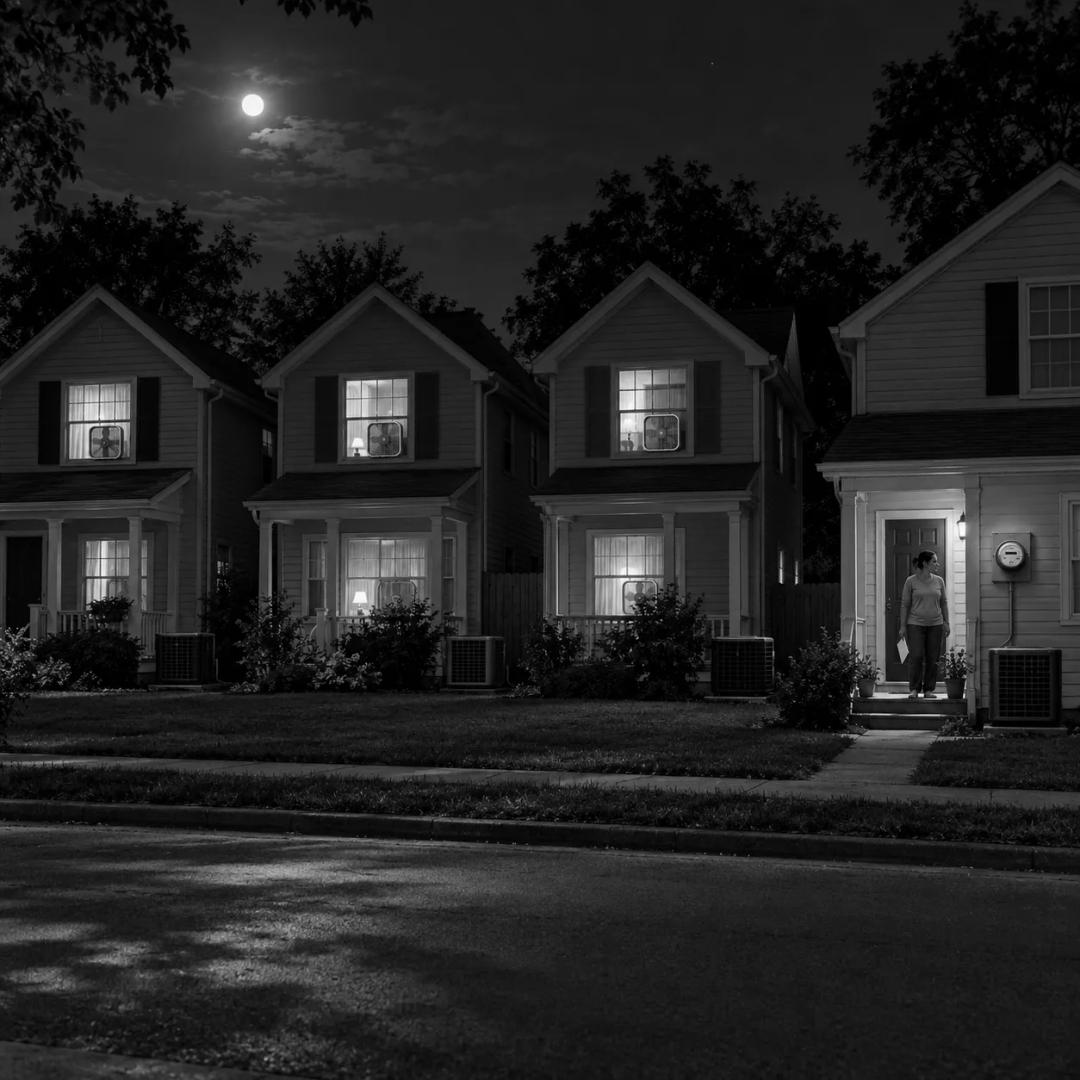
Underdetected influence is an influence that changes behaviour measurably while being rated least important by the people it changed. The term comes from Jessica M. Nolan and colleagues' 2008 paper, and the result is the cleanest instance there is. In a field experiment on household electricity, the group given a descriptive norm used the least power and rated that same message the least motivating of all the messages tested. The gap is measured directly, on the same households, and nobody needs to be concealing anything for it to hold.
What it is
Jessica M. Nolan and colleagues' 2008 paper has two studies, and the first surveyed eight hundred and ten Californians by telephone, finding that descriptive normative beliefs were more predictive of behaviour than were other relevant beliefs even though respondents rated such norms as least important in their conservation decisions. The second is the field experiment, which started from nine hundred and eighty-one households in San Marcos, California, interviewed five hundred and nine afterwards and analysed three hundred and seventy-one.
Door hangers urged the use of fans instead of air conditioning in four reason conditions plus a control: the descriptive-norm card reported that seventy-seven per cent of San Marcos residents often used fans instead of air conditioning, the self-interest card offered savings of up to fifty-four dollars a month, the environmental card the prevention of up to two hundred and sixty-two pounds of greenhouse gases a month, and the fourth appealed to social responsibility. The two numbers are the concept, because households in the descriptive-norm condition used less electricity in the short term than the other conditions combined, at an adjusted mean of 12.97 against 14.17, while the same households rated those messages least motivational, at 1.76 on the scale against 2.07 for the environmental condition, with the difference significant against the environmental and the social-responsibility cards.
In effect
It is narrower than self-deception and much easier to evidence, because all it requires is two measurements on the same people, one of behaviour and one of rated motivation, in a design where they can come apart, so no claim about concealment is needed and none is made. The authors' own reading is the modest one and the right one, that people relied on their a priori theories of what should motivate someone to conserve energy, and that although people may not believe the behaviour of others should motivate them to conserve energy, it does. Emily Pronin's work supplies a candidate mechanism for the asymmetry, since across five studies people judged others to be more conforming than themselves, including against specific peers in specific instances, and she proposes that people weight introspective evidence more heavily when judging their own susceptibility than when judging anyone else's, so if influence is invisible from the inside and visible from the outside then the same honest procedure gives different answers depending on who is being judged. The most useful property of the design is that it could have come out flat, because had the ratings matched the meter readings there would have been no finding, which is more than can be said for a theory of hidden motives that accommodates any result.
What it does not say
It does not say people are hiding their motives from themselves, because what was measured is a rated motivation against a metered behaviour, which is compatible with a hidden motive and establishes none, so the theories that explain it by concealment are not tested by it. It does not say people never know why they chose, since Adam Morris and colleagues found across five studies in 2025 that people were often highly accurate about their own choice process, more accurate than a sample of decision scientists predicted and more accurate than informed third-party observers, with their stated conclusion being that these results challenge notions that we are strangers to ourselves, in a domain of value-based multi-attribute choice rather than social influence, so both results stand. The effect is small and the literature it sits in is selected, being one field experiment, three hundred and seventy-one households, a short-term outcome and an adjusted difference of about one and a fifth kilowatt hours, and Stefano DellaVigna and Elizabeth Linos's comparison of a hundred and twenty-six nudge-unit trials covering twenty-three million people against the published literature found 1.4 percentage points against 8.7, with about seventy per cent of the gap attributed to selective publication amplified by low power, a discount every figure from an academic field experiment carries including this one. And the general question about introspective access is not settled by it, because Ben Newell and David Shanks's critical review concluded there is little convincing evidence of unconscious influences on decision making, naming inadequate procedures for assessing awareness as a principal cause of its inflated explanatory role, while commentators on the same paper worry that it could be read as ruling such influences out; the narrow claim here survives all of that, resting on two measurements rather than on a theory of the unconscious.
Sources
- Nolan, J. M., Schultz, P. W., Cialdini, R. B., Goldstein, N. J., & Griskevicius, V. (2008). 'Normative Social Influence is Underdetected.' Personality and Social Psychology Bulletin, 34(7), 913-923. doi:10.1177/0146167208316691. Full text read from the open copy at the California State University San Marcos repository.
- Pronin, E., Berger, J., & Molouki, S. (2007). 'Alone in a Crowd of Sheep: Asymmetric Perceptions of Conformity and Their Roots in an Introspection Illusion.' Journal of Personality and Social Psychology, 92(4), 585-595. doi:10.1037/0022-3514.92.4.585. Abstract read in full.
- Morris, A., Carlson, R. W., Kober, H., & Crockett, M. J. (2025). 'Introspective access to value-based multi-attribute choice processes.' Nature Communications, 16(1), 3733. doi:10.1038/s41467-025-59080-y. Abstract read in full; open access.
- DellaVigna, S., & Linos, E. (2022). 'RCTs to Scale: Comprehensive Evidence from Two Nudge Units.' Econometrica, 90(1), 81-116. doi:10.3982/ECTA18709. Abstract read from the Econometric Society listing.
- Newell, B. R., & Shanks, D. R. (2014). 'Unconscious influences on decision making: A critical review.' Behavioral and Brain Sciences, 37(1), 1-19. doi:10.1017/S0140525X12003214. Abstract read.
- Davison, W. P. (1983). 'The Third-Person Effect in Communication.' Public Opinion Quarterly, 47(1), 1-15. doi:10.1086/268763. Credited with naming the effect; abstract not read.