Verified Purchase Architecture
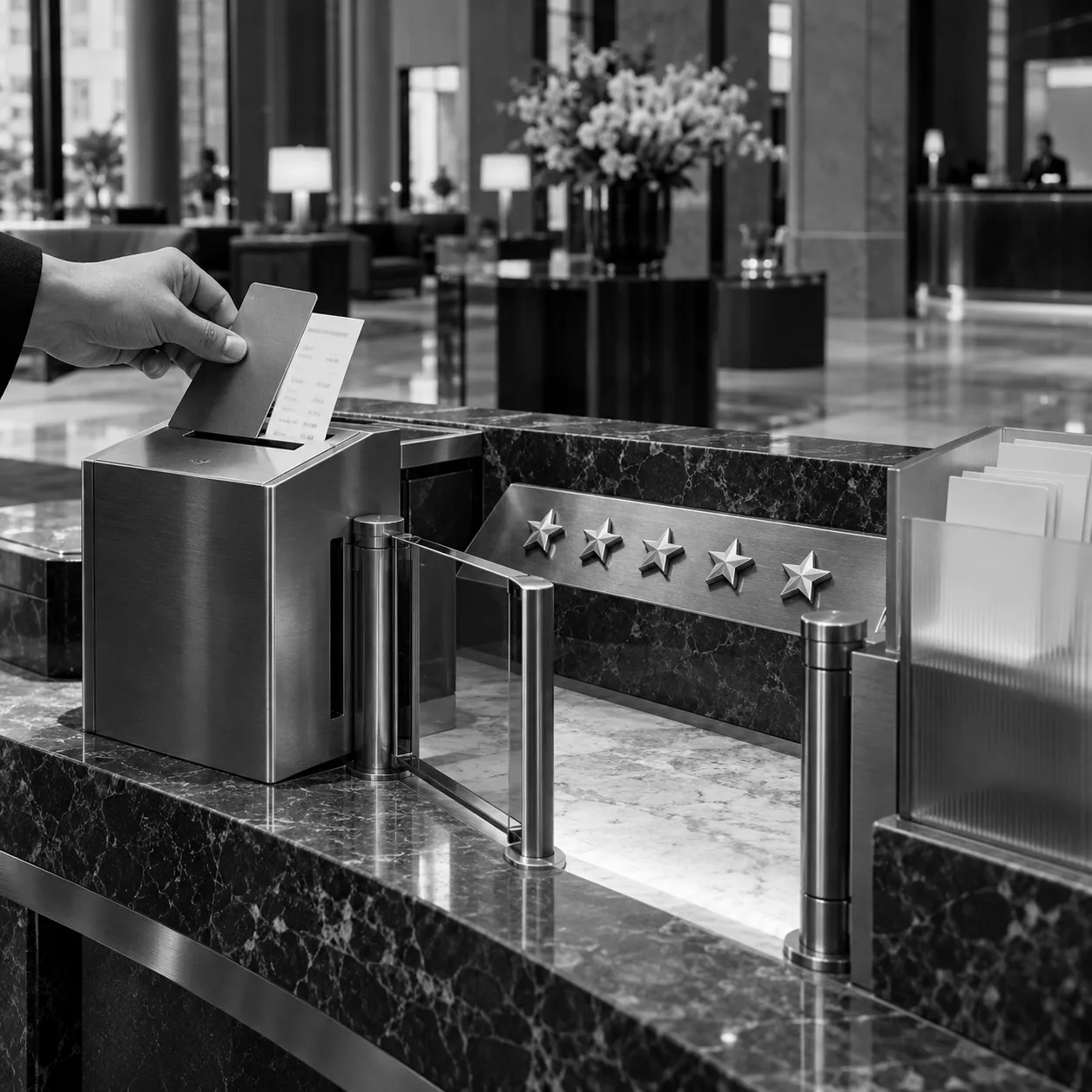
Verified purchase architecture is a posting rule that requires proof you actually transacted before you are allowed to review. It is the least glamorous idea on a review page and among the most useful, because it changes the cost of faking rather than trying to detect fakes after the fact. The practical reader's version: before you weigh an average, ask who was permitted to add to it.
What it is
Dina Mayzlin, Yaniv Dover and Judith Chevalier did not test the rule directly. They compared the same hotels across two platforms with different posting rules, one open to anybody and one requiring a booking through the site, and found the pattern of suspicious reviews concentrated on the open side exactly where their incentive model predicted. Hotels with most to gain from faking had relatively more positive reviews on the open platform, and their immediate neighbours had relatively more negative ones. The practical rule follows from the contrast rather than from an experiment: a system that requires proof of transaction is harder to game than one that does not.
In effect
Andrey Fradkin, Elena Grewal and David Holtz supply the companion lesson, that posting rules shape the number in ways that have nothing to do with fraud. Hiding each party's Airbnb review until both had submitted produced more reviewing, less retaliation and reciprocation, and lower ratings, with no change in the underlying stays. Both results point the same way: a star rating is the output of a mechanism, and the mechanism is a design choice somebody made.
What it does not say
It does not tell you how much verification helps. Nobody in this material ran an experiment switching verification on and off; the Mayzlin result is an across-platform comparison with an incentive model behind it, which is strong for inferring manipulation and silent on how much a posting rule removes. Harder to game is not ungameable: verification raises the price of a fake review, it does not abolish the market for one. And it does nothing at all about the distortion that needs no bad actor, which is that unhappy buyers tend not to review.
Sources
- Mayzlin, D., Dover, Y., & Chevalier, J. (2014). 'Promotional Reviews: An Empirical Investigation of Online Review Manipulation.' American Economic Review, 104(8), 2421-2455. doi:10.1257/aer.104.8.2421. An across-platform comparison, not a test of verification; hotels, reviews and dates not stated in the abstract.
- Fradkin, A., Grewal, E., & Holtz, D. (2021). 'Reciprocity and Unveiling in Two-Sided Reputation Systems: Evidence from an Experiment on Airbnb.' Marketing Science, 40(6), 1013-1029. doi:10.1287/mksc.2021.1311. Size of the ratings change not stated in the abstract.