Villain Similarity Effect
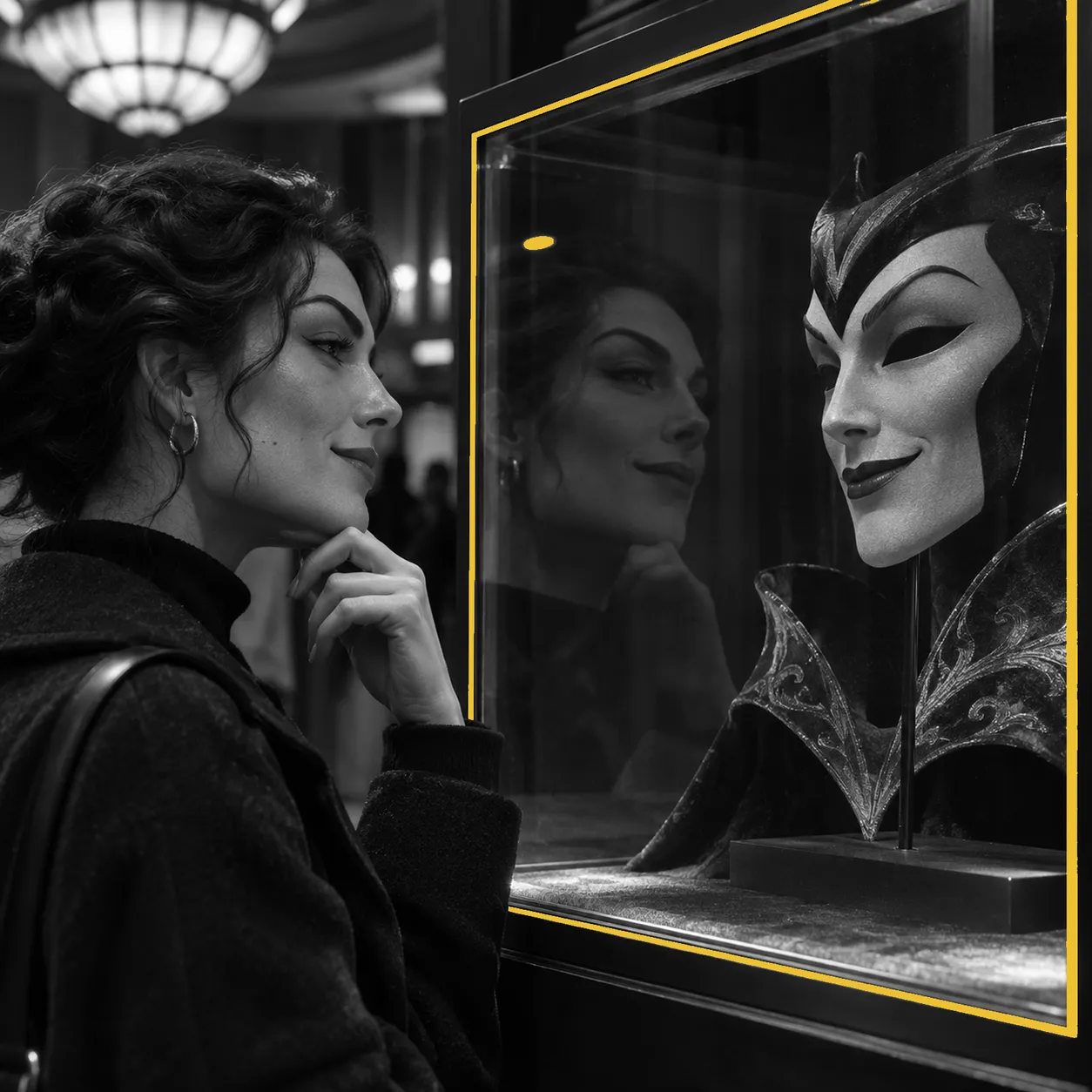
The villain similarity effect is being drawn to villains who resemble us. Rebecca Krause and Derek Rucker analysed records from an online character-quiz site with about 232,000 registered users and found that people preferred villains who resembled them; five laboratory experiments with 1,685 participants followed.
What it is
The villain similarity effect is the finding that people are drawn to fictional villains who resemble them. It runs against a common expectation. Earlier psychology suggested that people avoid being like negative figures, so a company or storyteller might hide a villain's resemblance to the audience. Rebecca Krause and Derek Rucker, of Kellogg School of Management at Northwestern University, reported the opposite in 2020.
They analysed records from CharacTour, an entertainment discovery site with profiles for more than 5,500 fictional characters and about 232,000 registered users. Users took a quiz describing their personality traits and received match scores for characters. For each character the researchers counted fans and how many of them shared the character's traits. As a character's score on a trait rose, so did the share of fans with that trait. The pull toward similar characters was strongest for villains. Five laboratory experiments with 1,685 participants followed.
In effect
In the article on why we love villains, the same resemblance that people avoid in real people drew them to characters. The effect is described in plain terms: we are drawn to characters who are like us, and that includes the ones written to be dark.
The article reads the result as a fact about fiction and not about villainy. A villain is safe to resemble because the story contains the consequences.
What it does not say
It does not say that fans approve of villains' actions or want to behave like them. It does not identify which traits are responsible: the records do not show which behaviours or traits people found attractive in villains. The quiz data come from one site, and the figures for the laboratory work come partly from the research news coverage of the paper.
It also does not say that people prefer a villain to a hero. The data show that similarity draws people to both, and that the pull is strongest for villains.
Where it comes from
The study is Krause and Rucker's 2020 paper in Psychological Science, titled Can Bad Be Good? The Attraction of a Darker Self. Krause was a doctoral student at Kellogg and Rucker is a professor of marketing there. The project began as a question about how consumers respond to characters in books, films and marketing. CharacTour was founded by Kimberly Foerster, a Kellogg alumna. The fan counts and trait scores were drawn from the site, with character traits scored on numerical scales and language analysis applied to character dialogue from scripts.
What the research found
The site data showed that, for heroes and villains alike, a higher trait score in a character went with a higher share of fans having that trait. The villains included characters such as Maleficent, the Joker and Darth Vader, and the comparison group included characters such as Sherlock Holmes, Joey Tribbiani and Yoda. Users were drawn to similar non-villains as expected and were most drawn to villains who were similar to them.
Two experiments are reported in detail. In the first, 100 university students judged how uncomfortable someone might feel on being matched with different kinds of characters. A match with a fictional villain was rated less uncomfortable than a match with a real-life villain, with mean ratings of 3.81 and 4.92 on a seven-point scale. In the second, 397 participants were divided in two. A group made to feel that resembling a villain was socially risky, by reading a report and imagining a first date, was less interested in a film when told the villain was like them. A group without that threat was slightly more interested. The authors read this as showing that the pull toward similar villains depends on the story feeling socially safe.
Where opinion differs
The authors offer two ways to read the result. One is that similarity is appealing in itself because it gives a shared basis for understanding. The other is that fiction lets people explore parts of themselves, such as rebelliousness, that they seldom express in real life. They raised the safe-exploration idea for further research, and the present data do not separate the two. Related work by Daniel Shafer and Arthur Raney (2012) on antihero narratives reported that moral judgement matters less to enjoyment than affective disposition theory predicts, and that cues encouraging moral disengagement shape enjoyment. That fits the safe-exploration reading, though it is a different design and sample. Both views are reported here without ranking.
How this site uses it
The Why We Project uses the villain similarity effect in its piece on why we love villains, alongside wishful identification and the idea of fiction as a safe frame. It is presented as a pattern in records and experiments, not as a statement about what viewers admire.
Sources
- Krause, R. J. and Rucker, D. D. (2020), Psychological Science 31(5), 518-530.
- Shafer, D. M. and Raney, A. A. (2012), Journal of Communication 62(6), 1028-1046.
- Kellogg Insight, Northwestern University, 2 March 2020, on the villain study.
- Association for Psychological Science news release, 22 April 2020.