Work Fragmentation
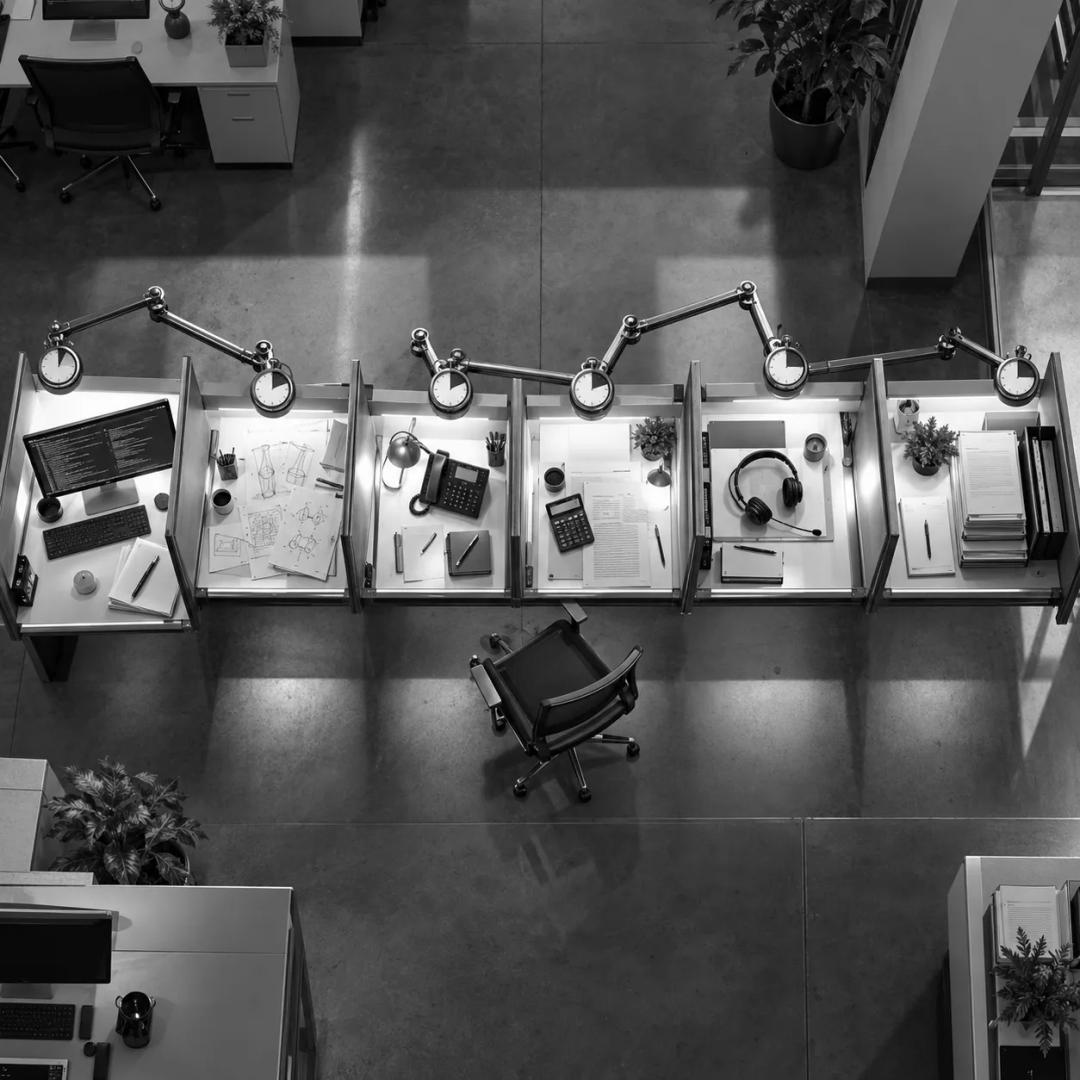
Gloria Mark's construct: time spent in an activity, plus frequency of interruption. It is a property of a working day rather than of a person's attention span, and that distinction is the whole reason the page exists. Fragmentation is measured by shadowing people and timing what they do; attention span, as a population quantity, is not measured at all. Because it is a property of a setting, it can be changed by changing the setting, and it says nothing about whether anyone's capacity to concentrate has altered.
What it is
The 2004 fieldwork by Víctor González and Mark observed information workers in three roles, analysts, software developers and managers, and found high discontinuity across all three: an average of about three minutes on a task, and somewhat more than two minutes with any one electronic tool or paper document, before switching. People worked across an average of ten working spheres, spending about twelve minutes in one before moving on. The 2005 study observed twenty-four information workers in detail, over seven hundred formal hours, and found fifty-seven per cent of working spheres interrupted, with collocated people working longer before switching and experiencing more interruptions.
In effect
Two figures have to be handled carefully. The recovery figure that circulates, twenty-three minutes, is not in these papers in that form; the published resumption figure, read at first hand, is twenty-five minutes and twenty-six seconds for same-day resumption, with a standard deviation of fifty-four minutes and forty-eight seconds, which is more than twice the mean and is not a stable central tendency. And the cost does not appear where people expect it. In Mark, Daniela Gudith and Ulrich Klocke's 2008 laboratory study of forty-eight people, interrupted tasks were completed in less time with no significant difference in errors or politeness, and the price showed up as higher stress, frustration, time pressure and effort. Part of the speed was that people wrote less: emails were significantly longer in the uninterrupted condition.
What it does not say
It does not say attention spans have shortened, and it cannot, because it measures a day rather than a person. It also does not establish that interruption degrades output: the one experimental result points the other way on completion time and quality, and registers the cost as strain instead. The scope is narrow. Every observational dataset here is information workers in a small number of US high-technology, financial or research organisations in the mid-2000s, with the laboratory work run on German university students, and the authors of the 2008 study volunteer that after twenty minutes of interrupted performance people reported significantly higher stress but that they cannot say whether people would cope over time.
Sources
- González, V. M., & Mark, G. (2004). "'Constant, constant, multi-tasking craziness': managing multiple working spheres." Proceedings of CHI '04, 113-120. doi:10.1145/985692.985707. Abstract read in full; González is first author. The abstract gives no sample; the companion papers give thirty-six individuals across three organisations, three workdays each.
- Mark, G., González, V. M., & Harris, J. (2005). "No task left behind? Examining the nature of fragmented work." Proceedings of CHI '05, 321-330. doi:10.1145/1054972.1055017. Full text read. Twenty-four workers, over seven hundred formal hours. Same-day resumption 25 minutes 26 seconds, standard deviation 54 minutes 48 seconds.
- Mark, G., Gudith, D., & Klocke, U. (2008). "The cost of interrupted work: more speed and stress." Proceedings of CHI '08, 107-110. doi:10.1145/1357054.1357072. Full text read; Mark first author. Forty-eight participants, mostly German university students, in a simulated office email task with interruptions set to two minutes.