Abhijit V. Banerjee
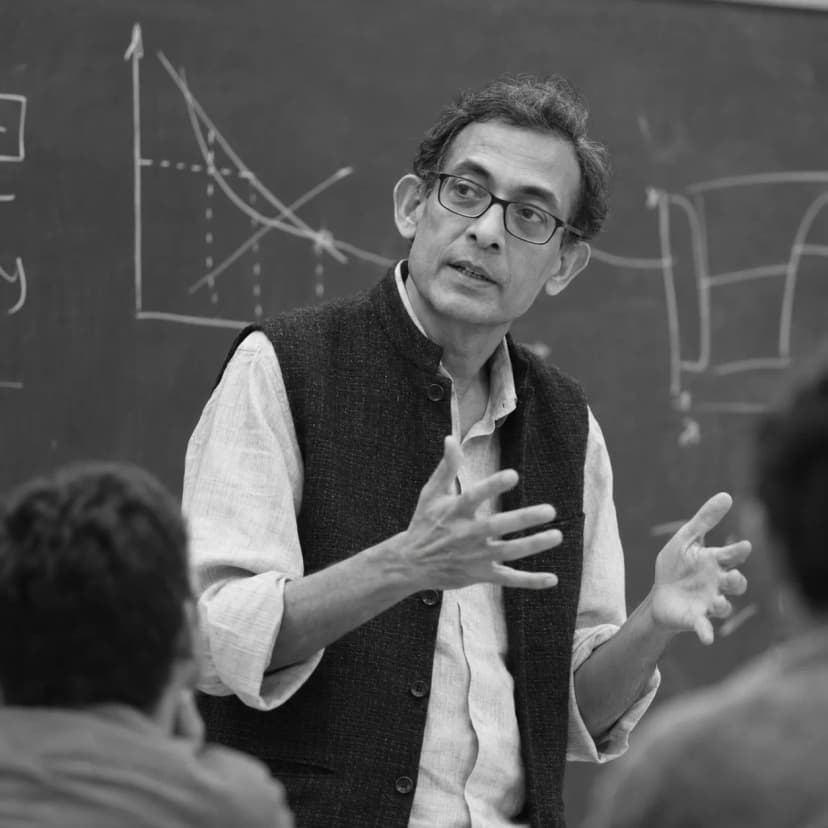
Abhijit V. Banerjee published a model of herd behaviour in the Quarterly Journal of Economics in 1992 that states the result most popular writing about crowds gets backwards. In it, a person who can see what others chose but not why is right to treat those choices as evidence, right to stop using his own information once enough people have gone ahead of him, and part of a crowd that ends up worse off than the information inside it should allow. Nobody in the model reasons badly.
Who they are
This site does not record an affiliation for him, because the research file behind the article that cites him gives none, and an affiliation is not something to guess at. What is established is the paper, its journal, its date and its sole authorship, all confirmed at the RePEc record and corroborated by the reference list of a later paper retrieved from Crossref.
That reticence is worth stating plainly rather than papering over. The convention on this site is that the article names a person and the page carries the apparatus, so where the apparatus is thin the page says so instead of filling the gap. In this case the thinness is narrow and does not affect the substance: the model is the contribution, and the model is on the record.
Key papers
He has no book credit on this site, and nothing here should be read as implying one. His relevance to this publication runs through a single 1992 journal article.
Banerjee, A. V. (1992), "A Simple Model of Herd Behavior," Quarterly Journal of Economics, 107(3), 797-817, doi:10.2307/2118364. A sequential decision model in which each decision-maker observes the decisions made by previous decision-makers before taking her own. Copying is rational for her, because those earlier decision-makers may hold information she lacks. Decision rules chosen by optimising individuals are therefore characterised by herd behaviour, with people doing what others are doing rather than using their information. And the resulting equilibrium is inefficient.
The read depth here is a limit on what this page can say and it is stated rather than left to inference. The abstract was read in full at the RePEc record. The full text is restricted and was not obtained, and no full text was obtained for any of the twelve journal articles behind the article that cites him. Nothing beyond the abstract is reported on this page.
Key ideas
The inversion, in three steps. Copying is rational for the individual. Copying is therefore what optimising individuals do. The outcome is inefficient anyway. Those are three separate claims and the argument lives in the gap between the second and the third.
Inefficiency is not error. The crowd in the model can arrive at the better option and still be carrying less information than it was handed, because each act of copying removes a private signal from circulation. The cost is a property of the aggregate rather than a mistake by anybody in it.
An account of herd behaviour that requires nobody to be insecure, weak-willed or socially anxious. This is what makes the 1992 result a theorem rather than a finding about personality, and it is why a popular framing of following the crowd as a failure of nerve does not describe this mechanism at all.
Independent discovery matters to how the result should be weighed. Sushil Bikhchandani, David Hirshleifer and Ivo Welch reached a closely related conclusion in the Journal of Political Economy in the same year, by a different route and under the name informational cascade.
Sources
- Banerjee, A. V. (1992), "A Simple Model of Herd Behavior," Quarterly Journal of Economics, 107(3), 797-817, doi:10.2307/2118364. Abstract read in full at the RePEc record; full text restricted and not read. Sole authorship confirmed at the same record and at the reference list of Muchnik, Aral and Taylor (2013) retrieved from Crossref.
- Bikhchandani, S., Hirshleifer, D., & Welch, I. (1992), "A Theory of Fads, Fashion, Custom, and Cultural Change as Informational Cascades," Journal of Political Economy, 100(5), 992-1026, doi:10.1086/261849. Recorded here only as the independent result reached in the same year. Crossref record read; no abstract is deposited for that paper and the article itself was not read.
- Baddeley, M. (2018), Copycats and Contrarians: Why We Follow Others ... and When We Don't, Yale University Press, pp. 17 to 30. A trade book, read in full by the vault in October 2026, which attributes the primary literature to him correctly. Cited for exposition only.