Adrian Owen
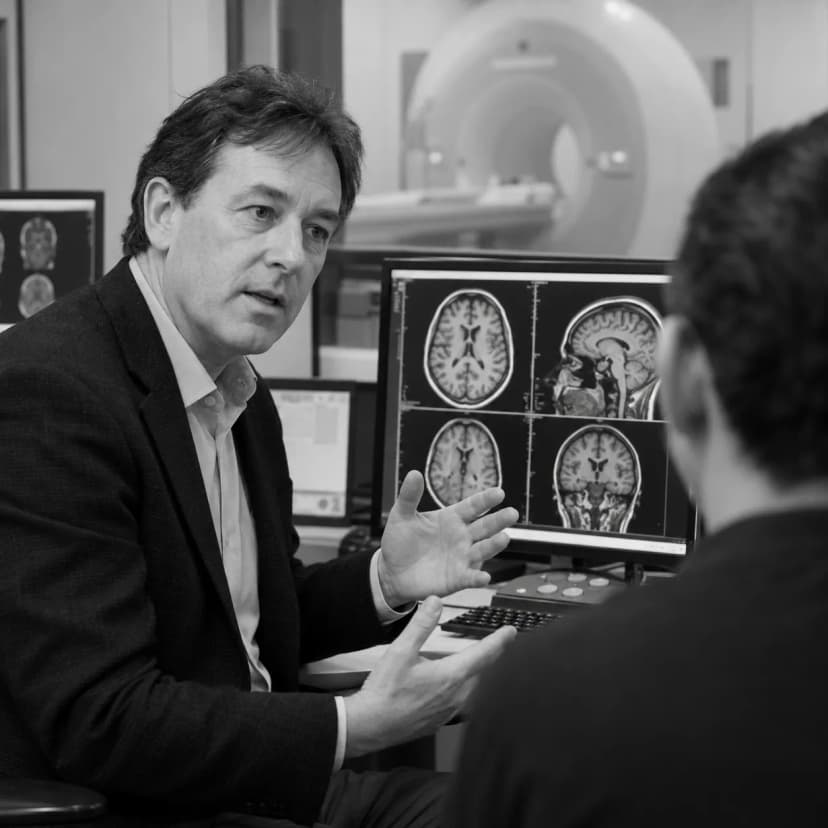
Adrian Owen is a British neuroscientist at Western University in Ontario and the first author of "Putting brain training to the test", a trial published in Nature in 2010. It remains one of the largest tests of whether practising computerised mental exercises makes people better at anything beyond the exercises themselves. Participants improved at the tasks they trained. The gains did not carry over to untrained tests, and a control group that only searched the web for obscure answers improved by about as much on those tests. This site cites the trial whenever it separates getting better at a game from getting better at thinking.
Who they are
Owen holds a Canada Excellence Research Chair in cognitive neuroscience and imaging at the Brain and Mind Institute, Western University. Before that he was a senior scientist at the Medical Research Council's Cognition and Brain Sciences Unit in Cambridge. He is best known outside psychology for showing that brain imaging can detect signs of awareness in some patients who appear to be entirely vegetative. That work is a different field from the one this site draws on, and nothing in the brain training trial depends on it.
The 2010 study was run with a BBC science programme, Bang Goes the Theory. The programme recruited volunteers online, which is how a laboratory study reached a scale that laboratories rarely manage. A total of 52,617 people aged 18 to 60 joined. The analysis used the 11,430 who completed at least two training sessions and both batteries of tests. The co-authors on the paper were Adam Hampshire, Jessica Grahn, Robert Stenton, Said Dajani, Alistair Burns, Robert Howard and Clive Ballard.
The scale is the point. Most training studies enrol a few dozen people, and small studies produce noisy estimates in both directions. A trial that analyses more than eleven thousand people can detect small effects, so its null result on transfer carries unusual weight.
Key papers
Owen, A. M., Hampshire, A., Grahn, J. A., Stenton, R., Dajani, S., Burns, A. S., Howard, R. J., & Ballard, C. G. (2010). "Putting brain training to the test." Nature, 465(7299), 775 to 778.
Participants were assigned to one of three groups for six weeks, with sessions of at least ten minutes, three times a week, and the average participant completed about 24 sessions. One group trained reasoning, planning and problem-solving. A second trained a broad mix of skills that included short-term memory, attention, visuospatial processing and mathematics. The control group spent the time searching the web for answers to obscure questions. Everyone was tested before and after on a battery that included tasks the training groups had not practised.
The result was specific. Performance improved on the trained tasks in the training groups. Improvements on the untrained tests were small, with the largest effect size at 0.35, and the control group improved by similar amounts. The authors concluded that there was no evidence for any generalised improvement in cognitive function following brain training in this large sample of healthy adults.
Key ideas
Near transfer is not far transfer. Practising a task makes you better at that task and at close relatives of it. The commercial claim was always the other kind: that practice on a game lifts memory, attention or reasoning in general. Owen's trial tested that claim directly and did not find it.
A comparison group improves too. People score higher on a cognitive test the second time they sit it, simply from familiarity. The control group's gain on the untrained tests is the number that shows how much of any apparent improvement is practice and expectation. A trial without that comparison cannot tell training from retesting.
What the trial does not say. It tested healthy adults aged 18 to 60, not older adults, so it does not answer the question the ACTIVE trial asked about people in their seventies. It tested two kinds of programme over six weeks, a modest dose compared with the heavy use some commercial products encourage, and adherence in an online mass trial is not controlled. The training camp's reply on those grounds has force. It does not make the central finding go away, because the question was whether general gains follow, and the answer in that sample was no.
How later work lines up. The 2016 review led by Daniel Simons reached a similar position from the studies that brain training companies themselves cite, and the 2019 second-order meta-analysis by Giovanni Sala and Fernand Gobet put the pooled far-transfer effect at zero once placebo effects and publication bias were controlled. Owen's paper is the single largest data point in that line.
Sources
- Owen, A. M., Hampshire, A., Grahn, J. A., Stenton, R., Dajani, S., Burns, A. S., Howard, R. J., & Ballard, C. G. (2010). "Putting brain training to the test." Nature, 465(7299), 775 to 778. doi:10.1038/nature09042. The participant numbers, design and results above were checked against the author manuscript of the paper and its abstract on 2026-10-23.
- Gazzaley, A., & Rosen, L. D. (2016). The Distracted Mind: Ancient Brains in a High-Tech World. The MIT Press. Chapter 10 cites Owen's trial at endnote 25, immediately before the placebo paper by Walter Boot and colleagues, at the point where the chapter makes its case for training.