Alexa M. Morcom
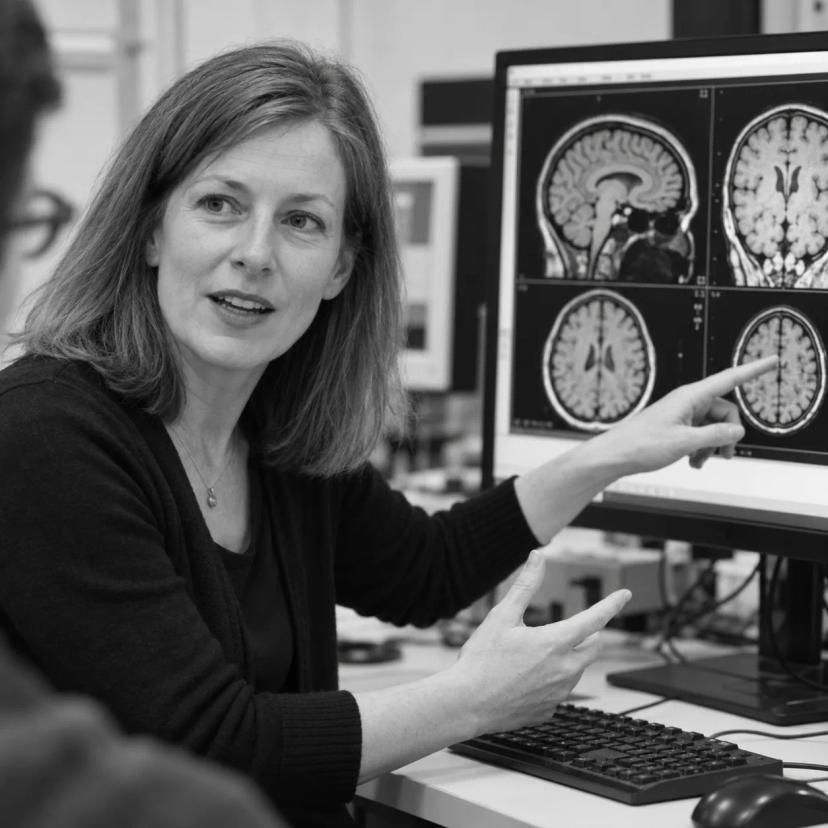
Alexa Morcom is first author of the 2007 NeuroImage paper that asked whether the brain has a baseline, and answered that studies of the resting state have limited standing as a measure of brain function. It is the clearest published statement of the resting baseline objection.
Who they are
The paper lists Alexa M. Morcom and Paul C. Fletcher as its authors. This page records nothing further about her career, because nothing further has been verified for it.
Key papers
Morcom, A. M., & Fletcher, P. C. (2007). "Does the brain have a baseline? Why we should be resisting a rest." NeuroImage, 37(4), 1073-1082. doi:10.1016/j.neuroimage.2006.09.013.
The paper examines the idea that the brain has a default mode, a network more active when people rest without a task. It notes that some researchers argued the resting activity is energetically expensive and represents an absolute baseline. The authors question whether resting-state studies are valuable and interpretable, argue that observations made at rest have no privileged status as a fundamental metric of brain functioning, and contend that resting-state research has limited utility in several areas.
Key ideas
Cost is not a reference. That resting activity is expensive does not make rest the point against which every other state should be measured.
A rest condition is one comparison among many. A pattern found by contrasting rest with tasks is a pattern about the contrast.
The replies to this position are set out on the page for the resting baseline objection.
Sources
- Morcom and Fletcher (2007), NeuroImage 37(4), 1073-1082. Abstract read.