Alfred Mele
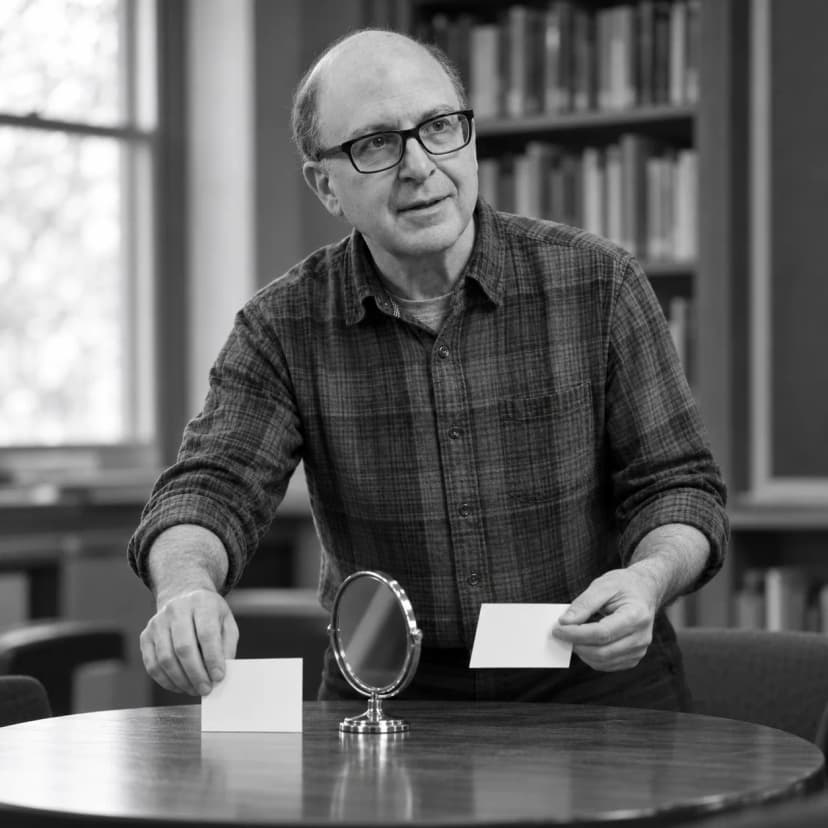
Alfred Mele is a philosopher at Florida State University and the author of Self-Deception Unmasked (Princeton University Press, 2001). He argues that treating self-deception as an intentional act of misleading the self is a mistake, and that motivationally biased assessment of evidence is enough to produce it.
Who they are
This page records the public professional record only. Nothing adverse is recorded and no motive is attributed.
The Florida State University philosophy department lists research areas including self-deception and weakness of will, the roles of beliefs, desires and intentions in action, motivation, free will and moral responsibility, and the science of conscious will and self-control. His listed books include Irrationality (1987), Springs of Action (1992), Autonomous Agents (1995), Self-Deception Unmasked (2001), Motivation and Agency (2003), Free Will and Luck (2006), Effective Intentions (2009), Backsliding (2012), Free: Why Science Hasn't Disproved Free Will (2014) and Aspects of Agency (2017).
A Florida State University College of Arts and Sciences faculty profile records that he took his doctorate in philosophy at the University of Michigan in 1979, with a dissertation on Aristotle, and taught at Davidson College in North Carolina until 2000, when he joined Florida State. The profile gives his chair as the William H. and Lucyle T. Werkmeister professorship and says his first book, Irrationality, appeared in 1987. It also records two multiyear John Templeton Foundation grants, awarded in 2010 and 2014: a free will project, and a later project on self-control. A university news item describes the second as a $4.5 million, three-year project called Philosophy and Science of Self-Control, which he directs. The profile adds that the Department of Philosophy held its Fall 2024 Werkmeister Conference in his honour. Nothing else about his career was checked for this page.
Key papers
Mele, A. R. (2001). Self-Deception Unmasked. Princeton University Press. The publisher's description says that Mele rejects attempts to model self-deception on dealings between two people, especially the assumption that it is intentional, and builds an account on empirical research about everyday reasoning and bias.
Mele, A. R. (1987). Irrationality. The department page says that he defends the account of self-deception from this book and that recent empirical work supports it.
Key ideas
On Mele's account, emotion and motivation can bias how people assess the evidence for their beliefs without their knowing it. The publisher's description distinguishes a "straight" form, in which we believe what we want to be true, from a "twisted" form, in which we believe what we wish were false. No inner deceiver is needed, and no divided mind.
That account is the main deflationary alternative to Robert Trivers's strategic view. The experiments of 2019 and 2020, in which an incentive to persuade raised confidence, fit both. They show that wanting to persuade moves belief. They do not separate a mind built to deceive itself from a mind in which wanting biases the weighing of evidence.
Sources
- Mele, A. R. (2001). Self-Deception Unmasked. Princeton University Press. Publisher description.
- Florida State University, Department of Philosophy. Faculty page for Alfred Mele, for research areas and the book list.
- Florida State University, College of Arts and Sciences. Faculty Spotlight: Alfred Mele, for education, posts, chair and Templeton grants. Florida State University News, 2014, on the Philosophy and Science of Self-Control grant.