Amanda Rotella
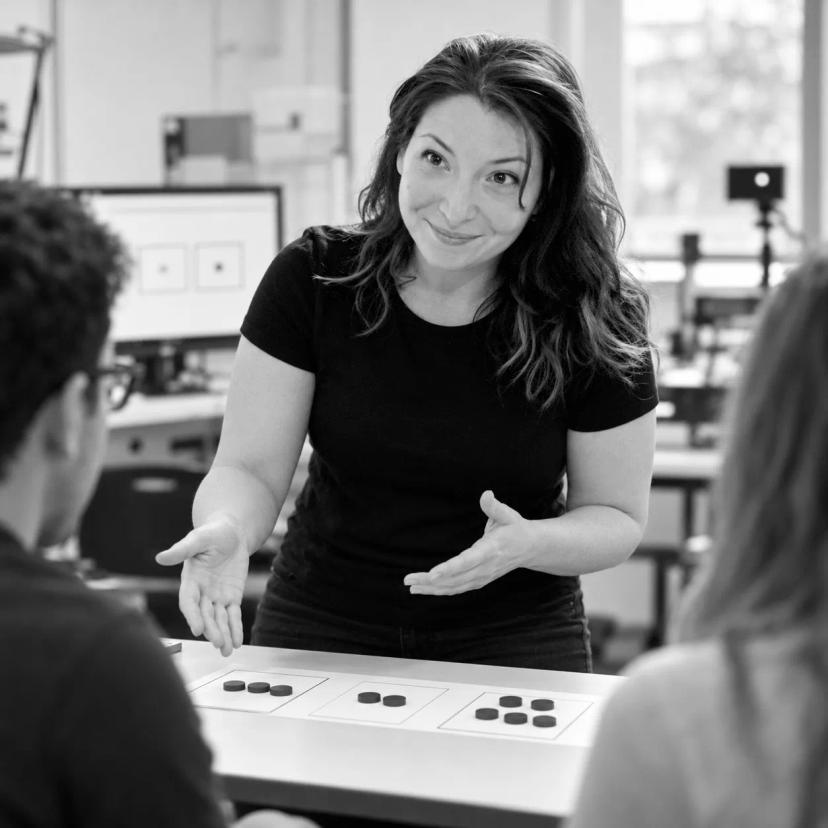
Amanda Rotella is first author, with Adam Maxwell Sparks, Sandeep Mishra and Pat Barclay, of a 2021 preregistered study in PLoS ONE that failed to replicate the watching eyes effect and the general effect of being observed in a dictator game.
Who they are
Rotella's affiliation was not checked for this page. What this library has verified is one paper.
The study, titled "No effect of 'watching eyes': An attempted replication and extension investigating individual differences", appeared in PLoS ONE in 2021 (volume 16, issue 10, article e0255531). It was preregistered, which means the hypotheses and analysis plan were fixed before data were collected. The task was a dictator game. Participants decided how to divide money, and their decisions were either made public or kept private, with some decisions made in the presence of eye images. The authors also measured how observed participants felt, and whether individual differences in prosociality moderated the effects.
The results were negative. Participants did not give more money when decisions were public or when eye images were present, even though they reported feeling more observed in the public condition. An exploratory interaction model, which the authors describe as underpowered, suggested that less prosocial participants gave less than prosocial participants in private settings but not in public ones. The authors suggested that future work should examine whether individual differences in prosociality shape how people respond to being observed.
The paper adds a feeling-versus-behaviour distinction to the literature. People can report feeling watched without changing what they do, which is a point about the mechanism that the pooled generosity results leave open.
Key papers
Rotella, A., Sparks, A. M., Mishra, S., & Barclay, P. (2021). No effect of "watching eyes": An attempted replication and extension investigating individual differences. PLoS ONE, 16(10), e0255531. doi:10.1371/journal.pone.0255531
Key ideas
The paper is evidence against the generosity side of The Watching Eyes Effect, and it arrived after the two 2017 meta-analyses by Northover and colleagues had reached the same conclusion from pooled data. It is also an example of Preregistration used on a contested effect, where fixing the plan in advance removes the room to explore the data until something appears.
It does not address eye cues and antisocial behaviour, where Dear and colleagues reported a 35 per cent reduction in risk in 2019.
Sources
- Rotella and colleagues (2021), abstract read on the Northumbria University research portal. The number of participants was not stated in the material read and is not given here.