Amos Tversky
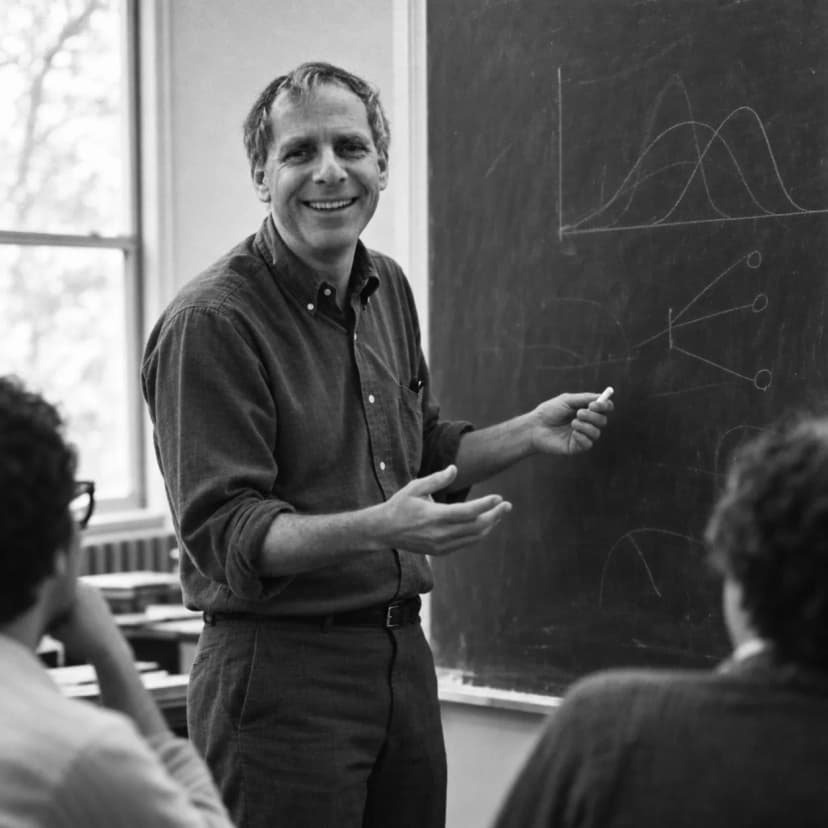
Cognitive psychologist, and first author of the 1974 paper that put anchoring on the record. He worked with Daniel Kahneman on prospect theory and on the whole heuristics-and-biases programme. He died in 1996, six years before the Nobel Memorial Prize the joint work won, which is why the public attaches the ideas to one name.
Who they are
Tversky and Kahneman began working together at the Hebrew University in 1969 and produced, over the following two decades, the research programme that made judgment under uncertainty a field. The division of labour between them is not recoverable from the papers and both described the collaboration as genuinely joint.
This site credits him first wherever he is first author, which on the founding anchoring paper he is. That is a standing rule here rather than a courtesy: the most reliable error in popular behavioural economics is the one that drops the collaborator and keeps the famous name.
Key papers
Tversky, A., & Kahneman, D. (1974). 'Judgment under uncertainty: Heuristics and biases.' Science, 185(4157), 1124-1131.* The paper that introduced anchoring and adjustment alongside availability and representativeness. It contains the wheel of fortune demonstration, in which a rigged wheel stopping at ten or sixty-five moved students' estimates of what percentage of UN countries were African from twenty-five per cent to forty-five.
Kahneman, D., & Tversky, A. (1979). 'Prospect theory: An analysis of decision under risk.' Econometrica, 47(2), 263-291.* The paper behind [[Reference Point]] and loss aversion, in which value is felt as a change from a starting point rather than as an absolute state.
Key ideas
Anchoring, as he framed it, worked by adjustment: a person starts from the number in front of them, moves away, and stops too early. Kahneman's later account, selective accessibility, explains the same effect by what the anchor makes easy to remember. The two have never been fully separated, and a test the literature treats as a signature of the second account failed repeatedly in experiments by Adam Harris and colleagues.
The wider programme he built with Kahneman is the reason anyone writes about cognitive bias at all, and it is also the source of the overclaiming this publication spends a good deal of time correcting.
Concepts on this site
Sources
- Tversky, A., & Kahneman, D. (1974). doi:10.1126/science.185.4157.1124
- Kahneman, D., & Tversky, A. (1979). Prospect theory. Econometrica, 47(2), 263-291.
- Vault note: [[Amos Tversky]], which records the standing rule that he is credited first where he is first author.