Anne Treisman
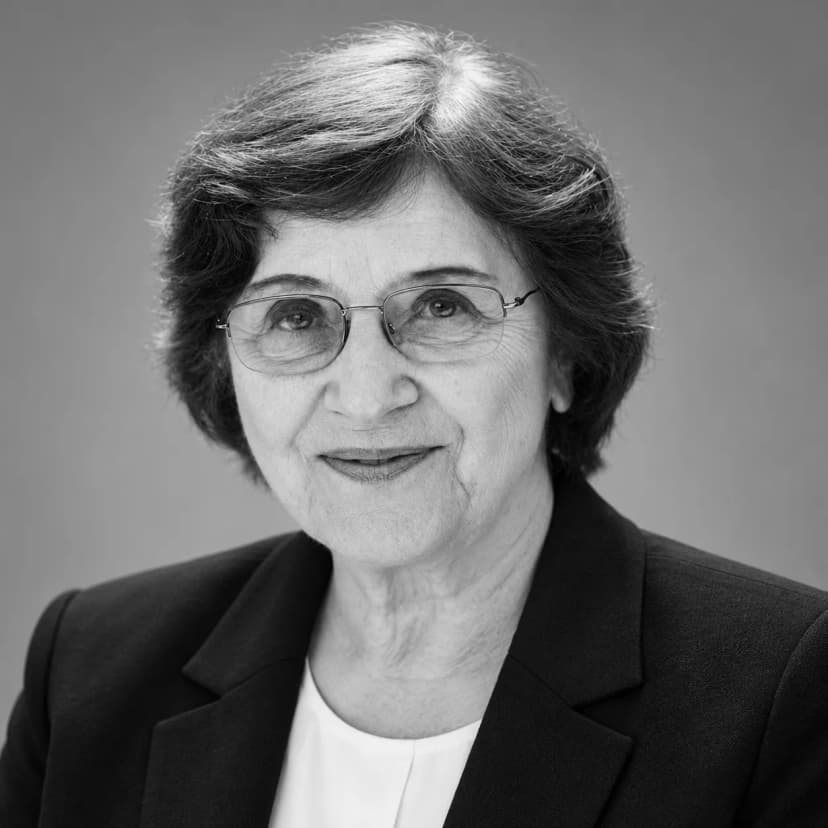
English psychologist (1935 to 2018) whose experiments on selective listening led to attenuation theory: the message being ignored is turned down, not shut out, so words that matter to the listener can still get through.
Who they are
Anne Marie Treisman was born in Wakefield, West Riding of Yorkshire, on 27 February 1935 and died at her home in Manhattan on 9 February 2018. She took a first degree in French literature at Newnham College, Cambridge, in 1954, followed by a second in psychology, and a doctorate at Oxford in 1961 with a thesis titled "Attention and speech". She worked at the Medical Research Council's Psycholinguistics Research Unit in Oxford, at the University of British Columbia, at the University of California, Berkeley from 1986, and at Princeton University from 1993 until she retired in 2010.
Her honours included election as a Fellow of the Royal Society in 1989, membership of the US National Academy of Sciences in 1994, the Grawemeyer Award in Psychology in 2009 and the National Medal of Science in Behavioral and Social Science.
Key papers
Treisman, A. M. (1960). "Contextual cues in selective listening." Quarterly Journal of Experimental Psychology, 12(4), 242-248. doi:10.1080/17470216008416732.
Treisman and Garry Gelade published "A feature integration theory of attention" in Cognitive Psychology in 1980.
Key ideas
Attenuation theory modified Donald Broadbent's filter model. Where Broadbent's filter shut out the unattended message before its meaning was analysed, Treisman proposed that the message is weakened and that highly meaningful or pertinent information can still get through. Her 1960 experiments switched two passages between the ears partway through. According to the abstract, listeners occasionally repeated a word or two from the wrong ear at the switch but never followed it for longer, and did so more often when the passage was predictable. She suggested the filter raises thresholds for the rejected source instead of working as an all-or-none barrier.
On this account a person's own name has a permanently low threshold, which is how it can reach awareness in the conversation they are ignoring, the finding Neville Moray reported in 1959. Textbooks date the model to 1960 and to 1964.
Her later feature integration theory concerns visual attention and is a separate body of work. See Attenuation Theory and Selective Attention.
Sources
- Treisman (1960), Quarterly Journal of Experimental Psychology, 12(4), 242-248.
- Biographical details are from her encyclopaedia entry, which gives two different years for the National Medal of Science. The description of the 1960 experiments is from the abstract of the paper (Crossref record), read 22 October 2026.