Anya Hurlbert
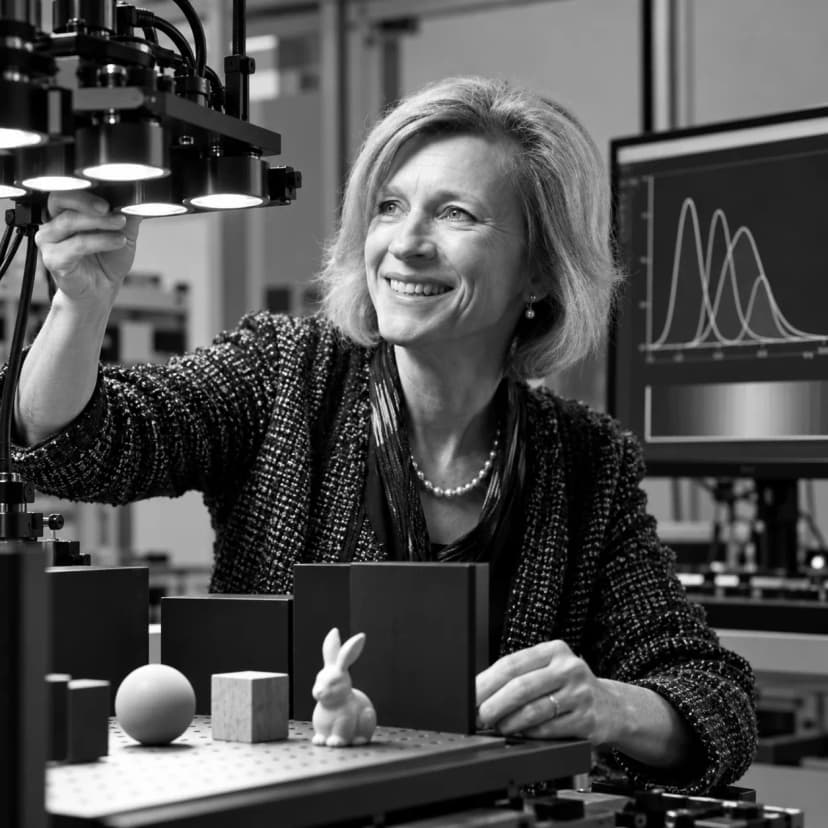
Anya Hurlbert is Professor of Visual Neuroscience in the School of Psychology at Newcastle University. She is the first author of the 2007 Current Biology letter, written with Yazhu Ling, that reported a consistent sex difference in colour preference: both sexes leaned towards blue, and women leaned further towards the red end of the red-green dimension of colour vision. The letter is the laboratory study this site uses for the idea that women lean towards red, and a 2015 rerun with Saudi and English participants did not repeat its pattern. Her wider work is on how the human visual system produces the experience of colour.
Who they are
Hurlbert trained across physics, physiology, neuroscience and medicine. According to her Newcastle University staff profile she holds a BA in Physics from Princeton University, studied for a Part III Diploma in Theoretical Physics and an MA in Physiology at Cambridge University on a Marshall Scholarship, took a PhD in Brain and Cognitive Sciences at MIT, where she worked with Tomaso Poggio and Peter Schiller, and earned an MD at Harvard Medical School. A Vision Research Fellowship in Andrew Parker's laboratory at Oxford University followed, and she then became a lecturer in Physiological Sciences at Newcastle.
Her career at Newcastle has included institution building. She was acting head of the Division of Psychology, Brain and Behaviour in 2003 and interim head in 2007, a period in which the School of Psychology was created. In 2004 she co-founded the university's Institute of Neuroscience with the late Professor Colin Ingram and co-directed it until 2014. In 2012 she established the Centre for Translational Systems Neuroscience with a Wellcome Trust Capital Award, and since 2021 she has sat on the steering group of the Centre for Research Excellence in Transformative Neuroscience. In 2016 she became the university's first Dean of Advancement.
Outside the university she is a trustee of the Science Museum Group and chairs the advisory board of the National Science and Media Museum in Bradford. Her profile also lists a place on the Rank Prize Optoelectronics Committee, a directorship of the Vision Sciences Society, and membership of the Scientific Consultative Group at the National Gallery in London, where she was previously a Scientist Trustee from 2010 to 2018. She is a consulting editor of the journal Perception and an associate editor of the Journal of Vision.
Key papers
The paper that belongs on this site is Hurlbert and Ling (2007), 'Biological components of sex differences in color preference', Current Biology 17(16), R623-R625, doi:10.1016/j.cub.2007.06.022. It is a letter, a short format. Press reports describe a sample of 208 volunteers aged 20 to 26, among them 171 British and 37 Chinese, who chose as fast as they could between pairs of coloured rectangles. The authors summarised each person's choices as weights on the two basic dimensions of human colour vision, the blue-yellow dimension and the red-green dimension, and reported that the sex difference showed up consistently in those weights. The letter's abstract, read at Newcastle University's repository, confirms the method and the cross-cultural sex difference in those weights but gives no sample counts. The sample figures are from press accounts, which do not report effect sizes, and the full text was not read for this page.
Her profile also lists a book, Color in Nature, published by Princeton University Press in 2024 and co-authored, and a book chapter on colour in the work of David Hockney in Hockney's Eye (2022). Neither was read for this page.
Key ideas
The 2007 letter frames colour preference as a position on two axes, not as a list of liked and disliked hues. Because the axes correspond to the way the early visual system codes colour, the framing lets a sex difference be stated in terms of a physiological dimension. Both sexes leaned towards blue, and women leaned further than men towards red. The Chinese volunteers differed in the same direction, and both Chinese men and women preferred red more than the British group did.
Press accounts quote Hurlbert offering an evolutionary reading: that women who were good at spotting ripe red fruit may have been favoured during early humans' gathering, and that culture could then amplify the tendency. She described her explanation of why blue is liked, which involved clear skies and water, as speculation, and the team said it would test infants next to separate nature from nurture. Those are hypotheses, not findings of the letter.
The method has been reused. In 2015 a psychologist at King Saud University in Riyadh applied the same style of analysis to Saudi and English participants and found that male curves looked alike across the two countries while female curves differed, and concluded that a universal sex difference in red-green weighting was not supported. A fair reading of the two papers together is that the sex difference in colour preference depends on the culture sampled.
Her wider research, as her profile describes it, asks how and why we see what we see. It covers colour constancy and colour perception, the effects of light spectra on mood and performance, machine learning for biomedical image analysis, colour vision testing, hyperspectral imaging of foodstuffs and artwork, and colour in paintings. Her projects have included HI-LED, a European programme on human-centric LED lighting, and a tuneable LED lighting demonstration at the National Gallery's summer 2014 exhibition Making Colour. The site's page on colour constancy covers a topic central to that work.
Sources
- Newcastle University staff profile, Anya Hurlbert, School of Psychology, ncl.ac.uk. Source of the education, career, roles, research areas and projects above.
- Hurlbert, A. C., & Ling, Y. (2007). 'Biological components of sex differences in color preference.' Current Biology, 17(16), R623-R625. doi:10.1016/j.cub.2007.06.022. Bibliographic record confirmed; sample and findings from ScienceDaily (20 August 2007) and Scientific American. Full text not read.
- Al-Rasheed, A. S. (2015). 'An experimental study of gender and cultural differences in hue preference.' Frontiers in Psychology, 6, 30. doi:10.3389/fpsyg.2015.00030.