Aristotle
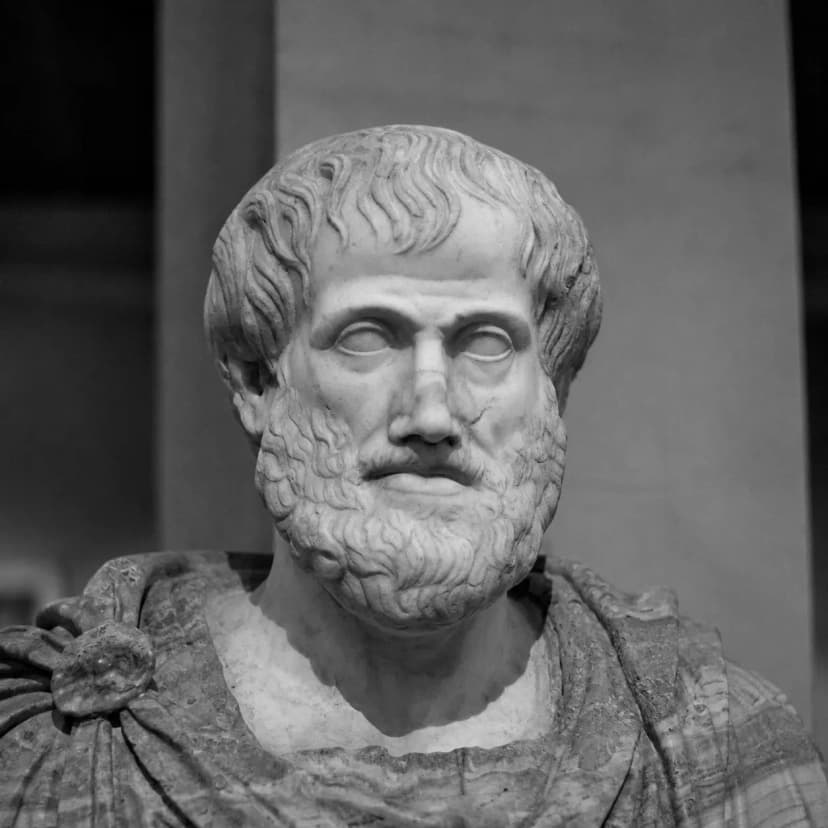
Aristotle, 384 to 322 BCE, was a Greek philosopher whose Nicomachean Ethics set out the account of virtue as a mean between extremes that still frames most Western thinking about character. Courage is the first of the moral virtues he treats, in Book III, and the correction this site makes is that treating it first is not the same as ranking it first. He never claims that courage makes the other virtues possible. That formulation is modern, and it gets attached to him because it sounds like him.
Who they are
Aristotle was born in Stagira in northern Greece, studied for twenty years at Plato's Academy in Athens, tutored Alexander of Macedon, and later founded his own school, the Lyceum. His surviving works run across logic, physics, biology, metaphysics, politics, rhetoric and poetics, and the ethical writings are only one part of a system.
The Nicomachean Ethics asks what a human life goes well at, and answers in terms of activity rather than feeling: the good life is the exercise of the characteristic human capacities well, over a whole life. Virtues are the settled dispositions that make that exercise reliable, and they are learned the way crafts are learned, by repetition until the right response becomes the natural one. The doctrine of the mean is the analytical tool: each virtue sits between a vice of excess and a vice of deficiency, and where the mean falls depends on the person and the circumstances rather than on a rule.
Courage comes first among the moral virtues in Book III, and the ordering is regularly reported as a ranking. It is not one. What he does say about it is narrower and considerably more useful than the version that circulates. Courage concerns fear and confidence specifically, not risk in general. Its excess is rashness and its deficiency is cowardice. Its fullest expression is facing death in battle, because that is where the fear is greatest and the stakes are unambiguous. The virtue only shows itself when something real is at risk: a man who is unafraid because nothing is at stake is not demonstrating anything.
He is also careful about the near-misses. In Book III he separates courage proper from five states that resemble it and are not it, including the courage of the citizen-soldier who acts to avoid disgrace, the confidence of the experienced professional who knows the danger is smaller than it looks, the rush of spirited anger, the buoyancy of the habitually optimistic, and the steadiness of the person who simply does not know what they are facing. That list is the part modern writing about courage most often skips, and it is the part that makes the concept hard to measure. Two people can behave identically at the moment of danger and only one of them be brave.
Key papers
Nicomachean Ethics, Book II. Virtue as a mean between excess and deficiency, and as a disposition formed by habituation rather than instruction.
Nicomachean Ethics, Book III, chapters 6 to 9. The account of courage: its object, its two opposed vices, its fullest case in facing death in battle, and the five states that resemble courage without being it.
Eudemian Ethics, Book III. A second treatment of courage covering much of the same ground, generally taken to be the earlier of the two ethical works.
Key ideas
Virtue as a mean: courage lies between cowardice and rashness, and the mean is relative to the person and the situation rather than fixed by a rule.
Courage is about fear and confidence specifically. It is not a general willingness to take risks.
The virtue requires real stakes. Where nothing is at risk, nothing has been demonstrated.
Several things look like courage and are not, including experience, anger, optimism and ignorance of the danger. Identical behaviour does not imply identical virtue.
The correction this site makes: treating courage first is not the same as ranking it first, and he never claims it makes the other virtues possible. That line is modern and attaches to his name because it sounds like him.
Sources
- Aristotle, Nicomachean Ethics, Book II. Virtue as a mean between excess and deficiency, formed by habituation.
- Aristotle, Nicomachean Ethics, Book III, chapters 6 to 9. The account of courage, its two opposed vices, and the five states that resemble it without being it.
- Aristotle, Eudemian Ethics, Book III. The second treatment of courage, generally taken to be the earlier of the two ethical works.
- Stanford Encyclopedia of Philosophy, entry on Aristotle. The reference used for his dates.
- Vault note: [[Aristotle]], which records the ranking correction.